Bower Julie K, Bollinger Claire E, Foraker Randi E, Hood Darryl B, Shoben Abigail B, Lai Albert M
Division of Epidemiology, The Ohio State University College of Public Health.
Division of Environmental Health Sciences, The Ohio University College of Public Health.
EGEMS (Wash DC). 2017 Feb 23;5(1):1263. doi: 10.13063/2327-9214.1263. eCollection 2017.
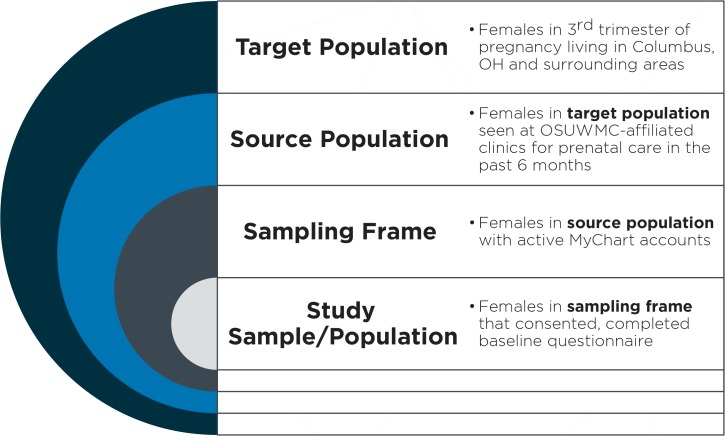
With the growing use of electronic medical records, electronic health records (EHRs), and personal health records (PHRs) for health care delivery, new opportunities have arisen for population health researchers. Our objective was to characterize PHR users and examine sample representativeness and nonresponse bias in a study of pregnant women recruited via the PHR.
Demographic characteristics were examined for PHR users and nonusers. Enrolled study participants (responders, n=187) were then compared with nonresponders and a representative sample of the target population.
PHR patient portal users (34 percent of eligible persons) were older and more likely to be White, have private health insurance, and develop gestational diabetes than nonusers. Of eligible persons (all PHR users), 11 percent (187/1,713) completed a self-administered PHR based questionnaire. Participants in the research study were more likely to be non-Hispanic White (90 percent versus 79 percent) and married (85 percent versus 77 percent), and were less likely to be Non-Hispanic Black (3 percent versus 12 percent) or Hispanic (3 percent versus 6 percent). Responders and nonresponders were similar regarding age distribution, employment status, and health insurance status. Demographic characteristics were similar between responders and nonresponders.
Demographic characteristics of the study population differed from the general population, consistent with patterns seen in traditional population-based studies. The PHR may be an efficient method for recruiting and conducting observational research with additional benefits of efficiency and cost-cost-effectiveness.
随着电子病历、电子健康记录(EHR)和个人健康记录(PHR)在医疗保健服务中的使用日益增加,人群健康研究人员迎来了新的机遇。我们的目标是描述PHR用户的特征,并在一项通过PHR招募的孕妇研究中检验样本代表性和无应答偏差。
对PHR用户和非用户的人口统计学特征进行了检查。然后将纳入研究的参与者(应答者,n = 187)与无应答者以及目标人群的代表性样本进行比较。
PHR患者门户用户(占符合条件者的34%)比非用户年龄更大,更有可能是白人,拥有私人医疗保险,并且患妊娠期糖尿病的可能性更高。在符合条件的人群(所有PHR用户)中,11%(187/1713)完成了基于PHR的自填问卷。该研究中的参与者更有可能是非西班牙裔白人(90%对79%)且已婚(85%对77%),而非西班牙裔黑人(3%对12%)或西班牙裔(3%对6%)的可能性较小。应答者和无应答者在年龄分布、就业状况和医疗保险状况方面相似。应答者和无应答者的人口统计学特征相似。
研究人群的人口统计学特征与一般人群不同,这与传统的基于人群的研究中观察到的模式一致。PHR可能是一种招募和开展观察性研究的有效方法,还具有效率和成本效益等额外优势。