Jiang Ying, Ma Wencong
Department of Dermatology, 1st Hospital of Jilin University, Changchun, Jilin, China (mainland).
Department of Surgery, 1st Hospital of Jilin University, Changchun, Jilin, China (mainland).
Med Sci Monit. 2017 Mar 17;23:1340-1346. doi: 10.12659/msm.900212.
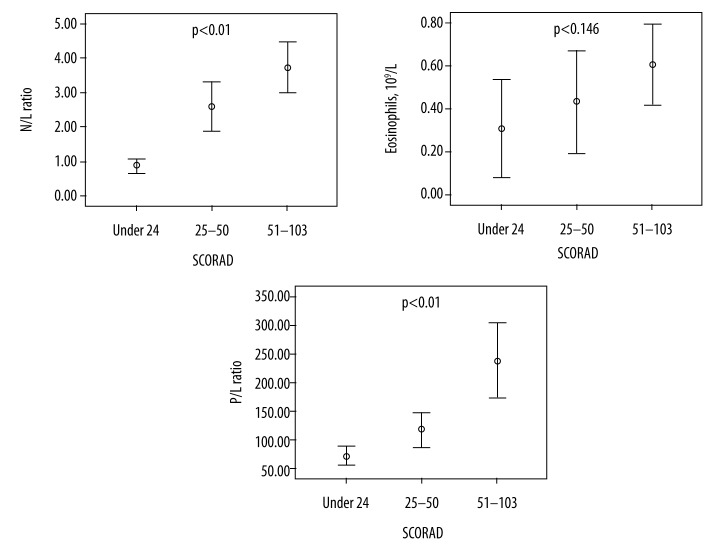
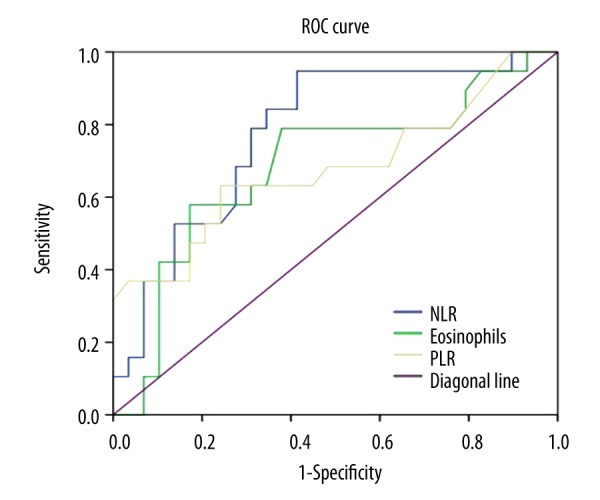
BACKGROUND To develop new strategies for identifying atopic dermatitis patients, a better understanding of the signs for chronic inflammatory status is needed. This study was designed to investigate whether neutrophil-to-lymphocyte ratio (NLR) and platelet-to-lymphocyte ratio (PLR) are related to the severity of atopic dermatitis (AD) assessed by the Scoring Atopic Dermatitis (SCORAD) index. MATERIAL AND METHODS A retrospective study involving 80 AD patients and 45 healthy control subjects was performed. NLR, PLR, and the number of peripheral blood eosinophils were compared between AD patients and healthy controls, and correlations between these indexes and clinical characteristics were analyzed. RESULTS NLR, PLR, and eosinophils in AD patients were all significantly higher than in healthy individuals. Among AD patients, NLR (p<0.001) and PLR (p<0.001), as contrasted with eosinophils (p=0.146), were correlated positively with SCORAD index. Additionally, an NLR level of 1.75 was determined as the predictive cut-off value of severe AD (SCORAD ≥51) (sensitivity 94.7%, specificity 58.6%, the area under the receiver-operating characteristic curve (AUROC) 0.778, p=0.001). For eosinophils, the sensitivity and specificity were 78.9% and 62.1%, respectively, and the AUROC was only 0.685 (p=0.032) in predicting high SCORAD. CONCLUSIONS NLR and PLR reflect inflammatory response and disease severity in AD patients.
背景 为了制定识别特应性皮炎患者的新策略,需要更好地了解慢性炎症状态的体征。本研究旨在调查中性粒细胞与淋巴细胞比值(NLR)和血小板与淋巴细胞比值(PLR)是否与通过特应性皮炎评分(SCORAD)指数评估的特应性皮炎(AD)严重程度相关。 材料与方法 进行了一项回顾性研究,纳入80例AD患者和45例健康对照者。比较AD患者和健康对照者的NLR、PLR及外周血嗜酸性粒细胞数量,并分析这些指标与临床特征之间的相关性。 结果 AD患者的NLR、PLR和嗜酸性粒细胞均显著高于健康个体。在AD患者中,与嗜酸性粒细胞(p = 0.146)相比,NLR(p < 0.001)和PLR(p < 0.001)与SCORAD指数呈正相关。此外,确定NLR水平为1.75作为重度AD(SCORAD≥51)的预测临界值(敏感性94.7%,特异性58.6%,受试者工作特征曲线下面积(AUROC)0.778,p = 0.001)。对于嗜酸性粒细胞,在预测高SCORAD时,敏感性和特异性分别为78.9%和62.1%,AUROC仅为0.685(p = 0.032)。 结论 NLR和PLR反映了AD患者的炎症反应和疾病严重程度。