Department of Medicine, Stanford University, United States.
Department of Otolaryngology-Head and Neck Surgery, Stanford University, United States.
EBioMedicine. 2017 Mar;17:223-236. doi: 10.1016/j.ebiom.2017.02.025. Epub 2017 Mar 1.
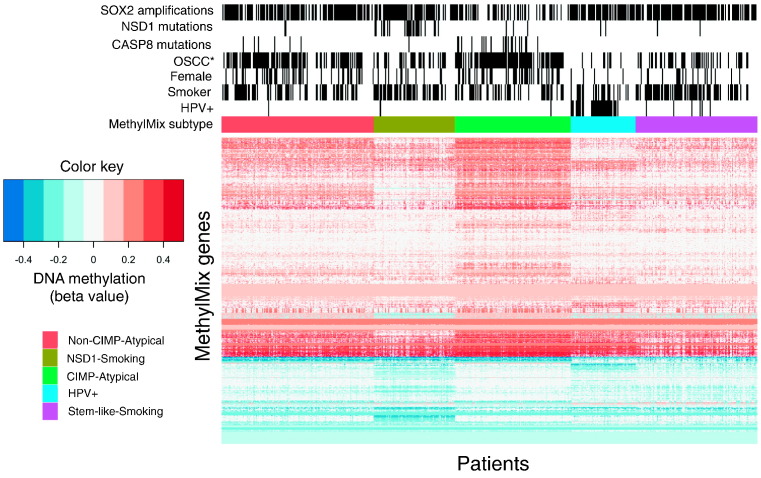
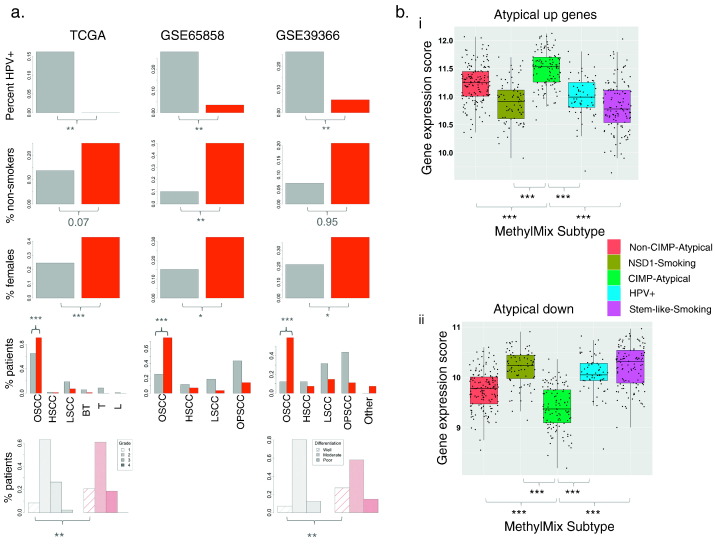
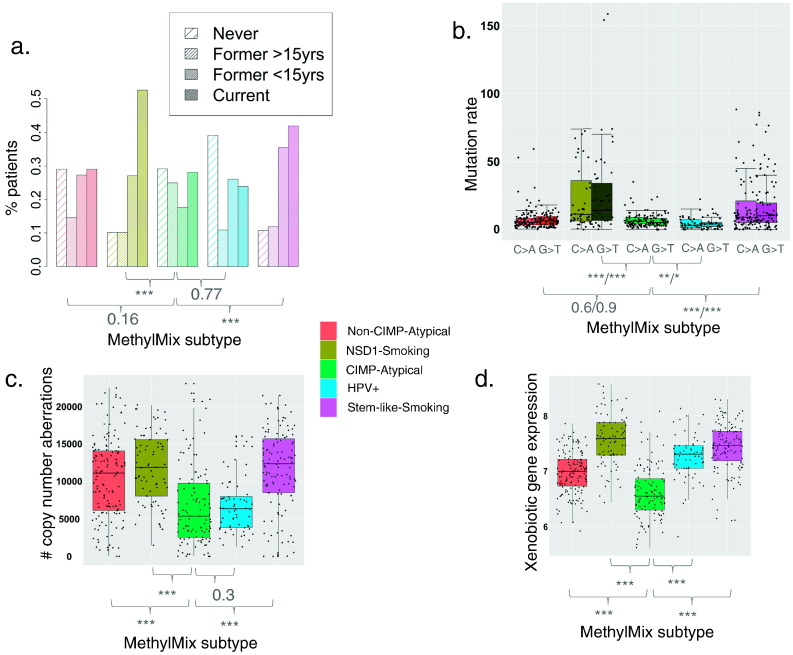
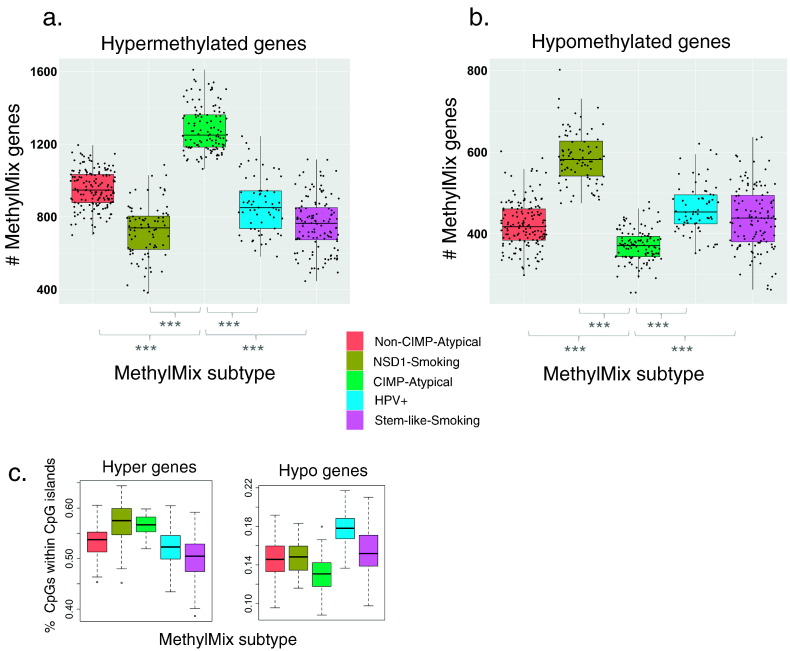
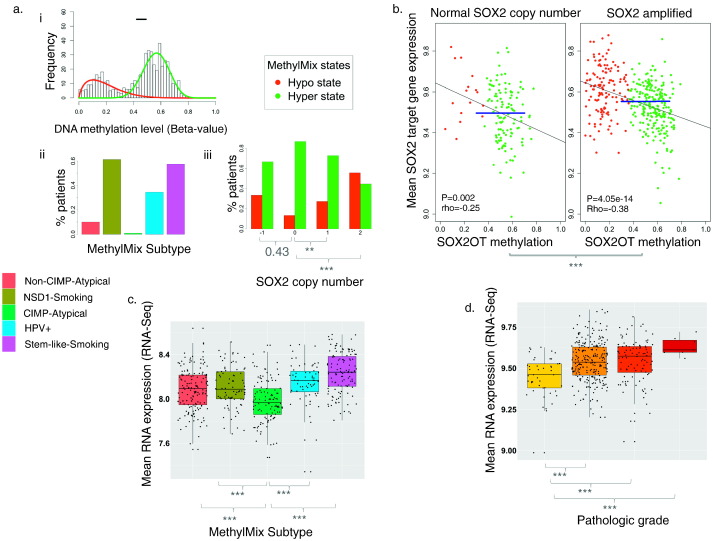
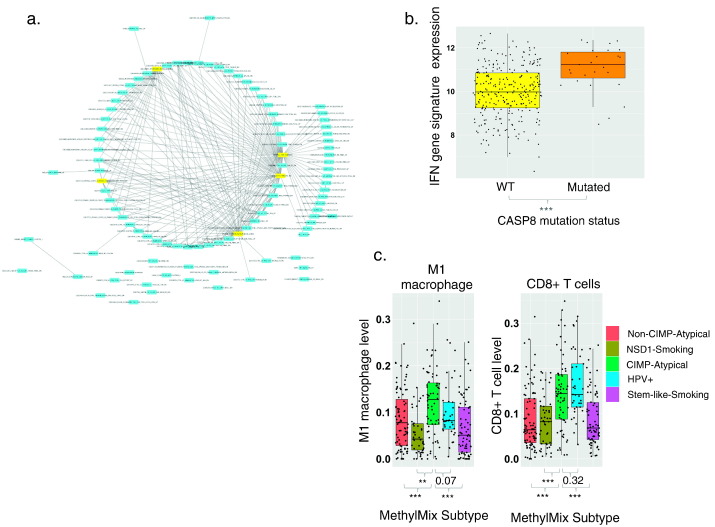
Head and neck squamous cell carcinoma (HNSCC) is broadly classified into HNSCC associated with human papilloma virus (HPV) infection, and HPV negative HNSCC, which is typically smoking-related. A subset of HPV negative HNSCCs occur in patients without smoking history, however, and these etiologically 'atypical' HNSCCs disproportionately occur in the oral cavity, and in female patients, suggesting a distinct etiology. To investigate the determinants of clinical and molecular heterogeneity, we performed unsupervised clustering to classify 528 HNSCC patients from The Cancer Genome Atlas (TCGA) into putative intrinsic subtypes based on their profiles of epigenetically (DNA methylation) deregulated genes. HNSCCs clustered into five subtypes, including one HPV positive subtype, two smoking-related subtypes, and two atypical subtypes. One atypical subtype was particularly genomically stable, but featured widespread gene silencing associated with the 'CpG island methylator phenotype' (CIMP). Further distinguishing features of this 'CIMP-Atypical' subtype include an antiviral gene expression profile associated with pro-inflammatory M1 macrophages and CD8+ T cell infiltration, CASP8 mutations, and a well-differentiated state corresponding to normal SOX2 copy number and SOX2OT hypermethylation. We developed a gene expression classifier for the CIMP-Atypical subtype that could classify atypical disease features in two independent patient cohorts, demonstrating the reproducibility of this subtype. Taken together, these findings provide unprecedented evidence that atypical HNSCC is molecularly distinct, and postulates the CIMP-Atypical subtype as a distinct clinical entity that may be caused by chronic inflammation.
头颈部鳞状细胞癌(HNSCC)广泛分为与人类乳头瘤病毒(HPV)感染相关的 HNSCC 和 HPV 阴性 HNSCC,后者通常与吸烟有关。然而,HPV 阴性 HNSCC 的一部分发生在没有吸烟史的患者中,这些在病因学上“非典型”的 HNSCC 不成比例地发生在口腔中,并且发生在女性患者中,提示存在不同的病因。为了研究临床和分子异质性的决定因素,我们对来自癌症基因组图谱(TCGA)的 528 例 HNSCC 患者进行了无监督聚类,根据其表观遗传(DNA 甲基化)失调基因的谱将其分类为假定的内在亚型。HNSCC 分为五个亚型,包括一个 HPV 阳性亚型、两个与吸烟相关的亚型和两个非典型亚型。一个非典型亚型特别具有基因组稳定性,但具有广泛的基因沉默,与“CpG 岛甲基化表型”(CIMP)相关。这种“CIMP-非典型”亚型的进一步区别特征包括与促炎 M1 巨噬细胞和 CD8+T 细胞浸润相关的抗病毒基因表达谱、CASP8 突变以及与正常 SOX2 拷贝数和 SOX2OT 高甲基化相对应的良好分化状态。我们开发了一种用于 CIMP-非典型亚型的基因表达分类器,可以在两个独立的患者队列中分类非典型疾病特征,证明了这种亚型的可重复性。总之,这些发现提供了前所未有的证据表明非典型 HNSCC 在分子上是不同的,并假设 CIMP-非典型亚型是一种独特的临床实体,可能是由慢性炎症引起的。