Kennedy Eleanor, Heron Jon, Munafò Marcus
MRC Integrative Epidemiology Unit at the University of Bristol and School of Experimental Psychology, University of Bristol, Bristol, United Kingdom.
School of Experimental Psychology, 12a Priory Road, Bristol, BS8 1TU, United Kingdom.
Eur Child Adolesc Psychiatry. 2017 Oct;26(10):1197-1206. doi: 10.1007/s00787-017-0975-1. Epub 2017 Mar 17.
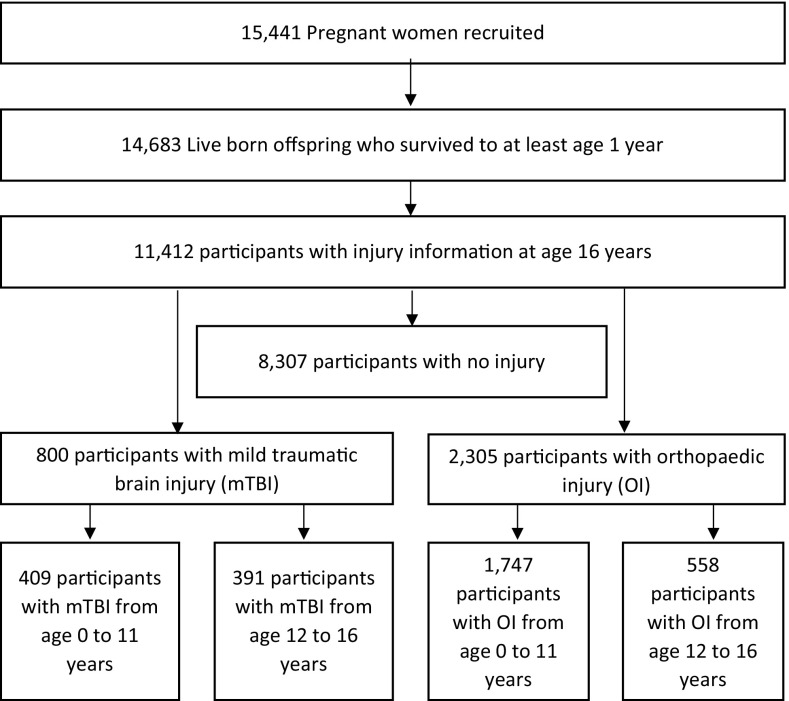
Recent research suggests a link between traumatic brain injury (TBI) in youth and later risk behaviour. We explored the association between mild TBI and psychiatric symptoms, substance use and criminal behaviour using data from a longitudinal birth cohort. Participants with mild TBI (n = 800), orthopaedic injuries (n = 2305) and no injuries (n = 8307) were identified from self and parent reports up to age 16 years. Self-report measures of substance use (alcohol, tobacco and cannabis) and criminal behaviours, and parent-reported psychiatric symptoms were collected at age 17 years. Analyses were adjusted for pre-birth and early childhood confounders. Participants with a TBI showed increased odds of hazardous alcohol use compared to those with no injury and those with an orthopaedic injury. Relative to those with no injury, participants with a TBI showed increased odds of problematic use of tobacco and cannabis, being in trouble with the police and having more parent-reported conduct problems. Sustaining either a TBI or an orthopaedic injury increased the odds of offending behaviour compared to having no injuries. There was no clear evidence of association between orthopaedic injury and the other risk outcomes. The increased odds of risk behaviour associated with TBI relative to no injury replicated previous research. However, the inclusion of a non-brain-related injury group adds evidence for a possible causal pathway between mild TBI in youth and later hazardous alcohol use only. This highlights the importance of including an additional negative control injury group in mild TBI research.
近期研究表明,青少年创伤性脑损伤(TBI)与后期的风险行为之间存在联系。我们利用一个纵向出生队列的数据,探讨了轻度TBI与精神症状、物质使用及犯罪行为之间的关联。通过自我报告和家长报告,确定了16岁以下患有轻度TBI(n = 800)、骨科损伤(n = 2305)和未受伤(n = 8307)的参与者。在17岁时收集了关于物质使用(酒精、烟草和大麻)和犯罪行为的自我报告测量数据,以及家长报告的精神症状。分析对出生前和幼儿期的混杂因素进行了调整。与未受伤者和骨科损伤者相比,患有TBI的参与者出现有害酒精使用的几率增加。与未受伤者相比,患有TBI的参与者出现烟草和大麻使用问题、与警方发生麻烦以及有更多家长报告的行为问题的几率增加。与未受伤相比,遭受TBI或骨科损伤都会增加犯罪行为的几率。没有明确证据表明骨科损伤与其他风险结果之间存在关联。与未受伤相比,TBI相关的风险行为几率增加重复了先前的研究。然而,纳入一个与大脑无关的损伤组为青少年轻度TBI与后期仅有害酒精使用之间可能的因果途径提供了证据。这凸显了在轻度TBI研究中纳入额外阴性对照损伤组的重要性。