Deco Gustavo, Cabral Joana, Woolrich Mark W, Stevner Angus B A, van Hartevelt Tim J, Kringelbach Morten L
Computational and Theoretical Neuroscience Group, Center for Brain and Cognition, Universitat Pompeu Fabra, Barcelona, Spain; Institució Catalana de la Recerca i Estudis Avançats, Barcelona, Spain.
Department of Psychiatry, University of Oxford, Oxford, UK; Center of Functionally Integrative Neuroscience, Aarhus University, DK.
Neuroimage. 2017 May 15;152:538-550. doi: 10.1016/j.neuroimage.2017.03.023. Epub 2017 Mar 15.
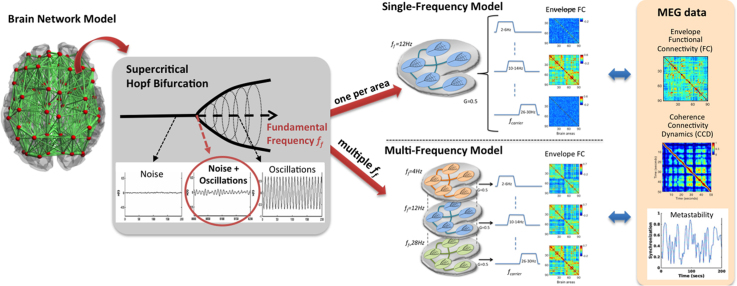
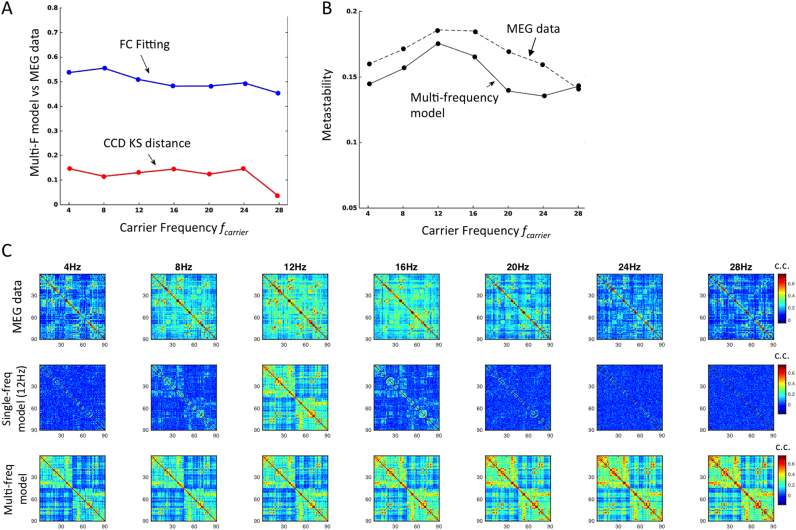
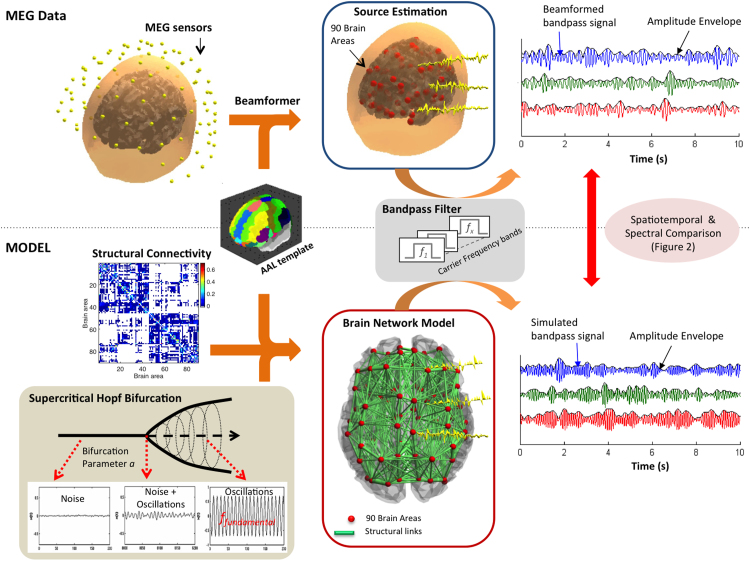
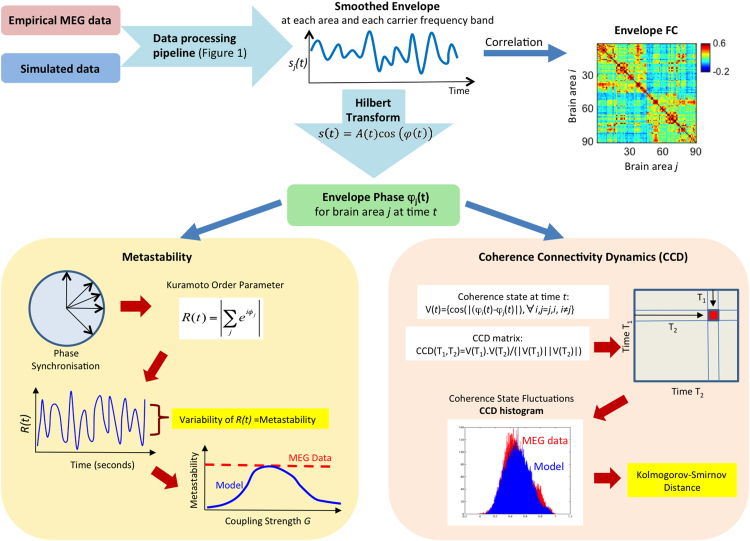
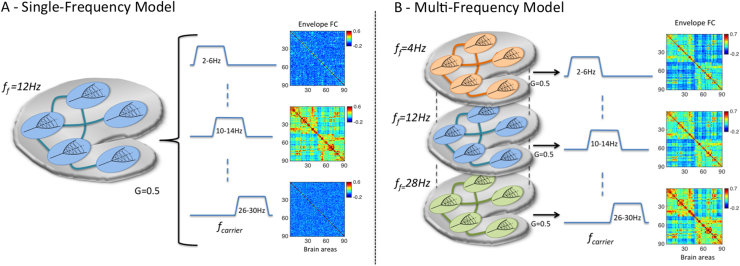
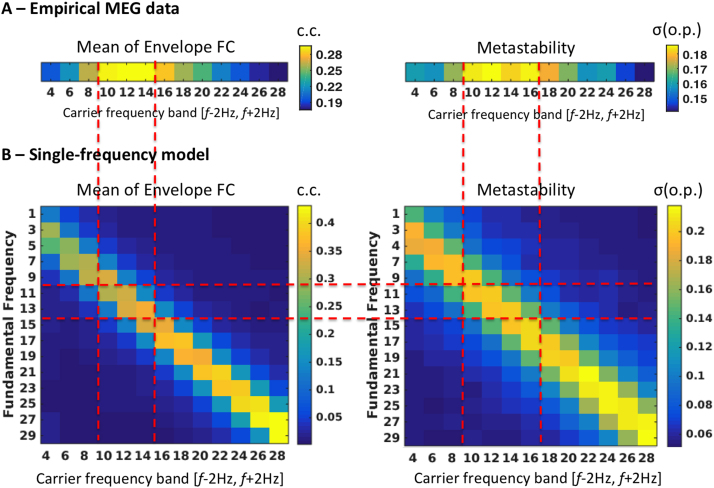
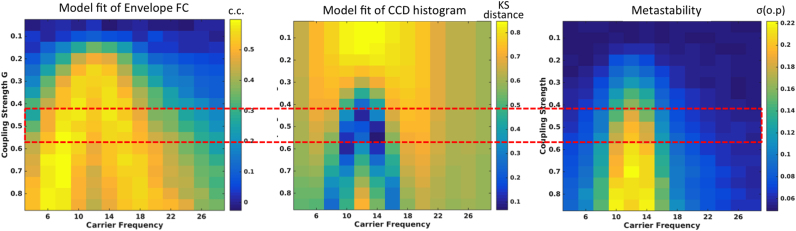
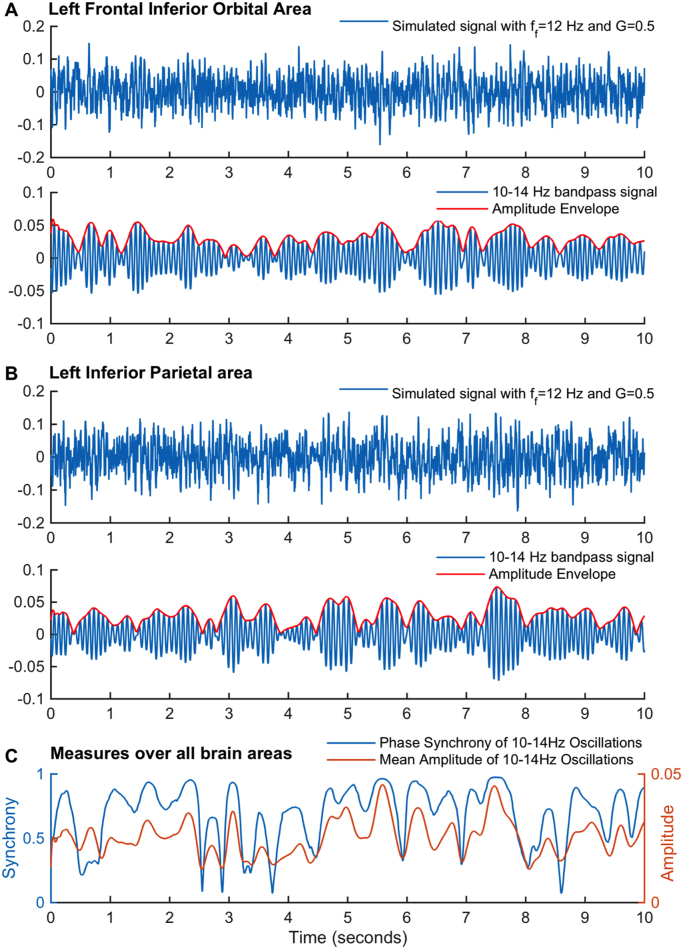
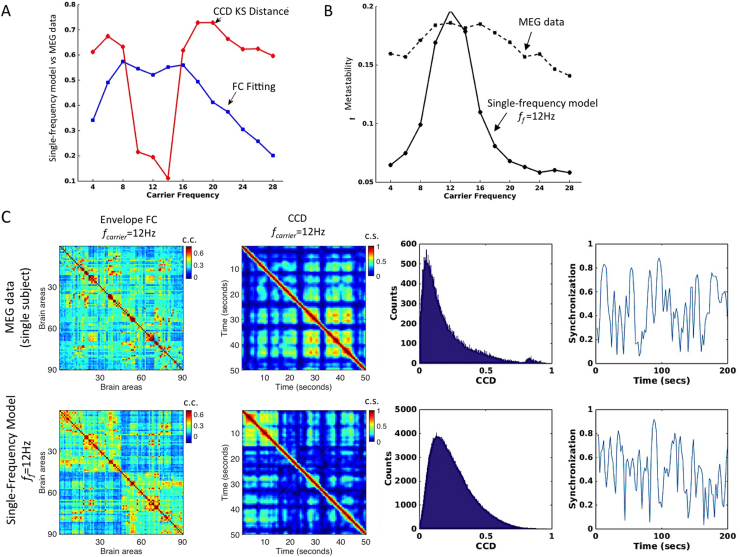
During rest, envelopes of band-limited on-going MEG signals co-vary across the brain in consistent patterns, which have been related to resting-state networks measured with fMRI. To investigate the genesis of such envelope correlations, we consider a whole-brain network model assuming two distinct fundamental scenarios: one where each brain area generates oscillations in a single frequency, and a novel one where each brain area can generate oscillations in multiple frequency bands. The models share, as a common generator of damped oscillations, the normal form of a supercritical Hopf bifurcation operating at the critical border between the steady state and the oscillatory regime. The envelopes of the simulated signals are compared with empirical MEG data using new methods to analyse the envelope dynamics in terms of their phase coherence and stability across the spectrum of carrier frequencies. Considering the whole-brain model with a single frequency generator in each brain area, we obtain the best fit with the empirical MEG data when the fundamental frequency is tuned at 12Hz. However, when multiple frequency generators are placed at each local brain area, we obtain an improved fit of the spatio-temporal structure of on-going MEG data across all frequency bands. Our results indicate that the brain is likely to operate on multiple frequency channels during rest, introducing a novel dimension for future models of large-scale brain activity.
在静息状态下,带限的持续脑磁图(MEG)信号的包络在全脑以一致的模式共同变化,这与通过功能磁共振成像(fMRI)测量的静息态网络有关。为了研究这种包络相关性的起源,我们考虑一个全脑网络模型,假设两种不同的基本情况:一种是每个脑区在单一频率下产生振荡,另一种是新颖的情况,即每个脑区可以在多个频段产生振荡。作为阻尼振荡的共同发生器,这些模型共享一个超临界霍普夫分岔的标准形式,该分岔在稳态和振荡状态之间的临界边界处起作用。使用新方法将模拟信号的包络与经验性MEG数据进行比较,以根据其在载波频率频谱上的相位相干性和稳定性来分析包络动态。考虑每个脑区具有单个频率发生器的全脑模型,当基频调谐到12Hz时,我们获得了与经验性MEG数据的最佳拟合。然而,当在每个局部脑区放置多个频率发生器时,我们对所有频段的持续MEG数据的时空结构获得了更好的拟合。我们的结果表明,大脑在静息状态下可能在多个频率通道上运行,为未来大规模脑活动模型引入了一个新的维度。