Nani Bruno Dias, Lima Patricia Oliveira de, Marcondes Fernanda Klein, Groppo Francisco Carlos, Rolim Gustavo Sattolo, Moraes Antonio Bento Alves de, Cogo-Müller Karina, Franz-Montan Michelle
Department of Physiological Sciences, Piracicaba Dental School, University of Campinas-UNICAMP, Piracicaba, SP, Brazil.
Department of Basic Health/Applied Psychology, Federal University of Juiz de Fora (UFJF), Governador Valadares, MG, Brazil.
PLoS One. 2017 Mar 20;12(3):e0173686. doi: 10.1371/journal.pone.0173686. eCollection 2017.
To investigate the associations among salivary bacteria, oral emanations of volatile sulfur compounds, and academic-related chronic stress in healthy male subjects.
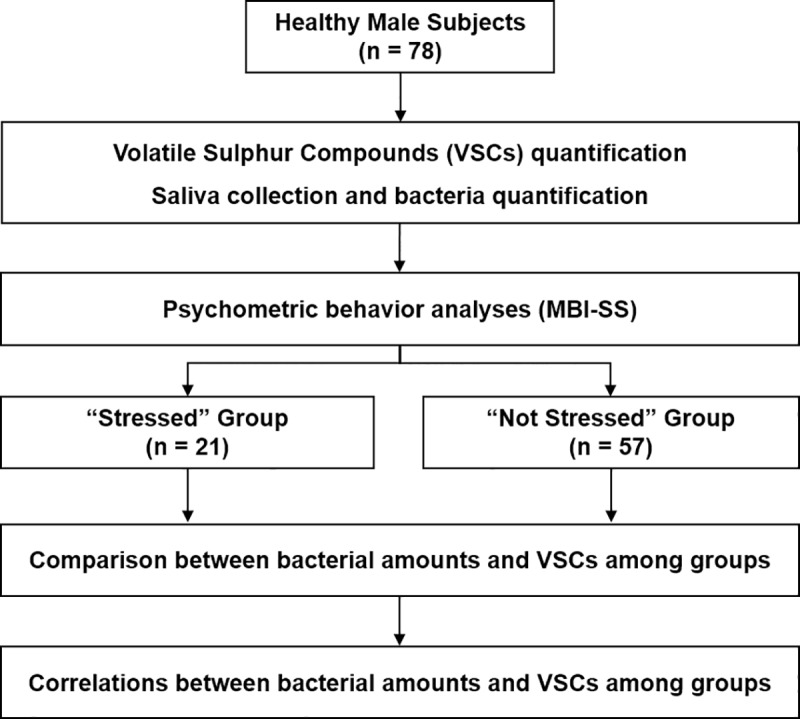
Seventy-eight healthy male undergraduate dental students were classified as stressed or not by evaluation of burnout, a syndrome attributed to academic-related chronic stress. This evaluation was carried out using the Maslach Burnout Inventory-Student Survey questionnaire. Oral emanations of hydrogen sulfide, methyl mercaptan, and dimethyl sulfide were measured using an Oral Chroma™ portable gas chromatograph. The amounts in saliva of total bacteria and seven bacteria associated with halitosis were quantified by qPCR. The in vitro production of H2S by S. moorei and/or F. nucleatum was also measured with the Oral Chroma™ instrument.
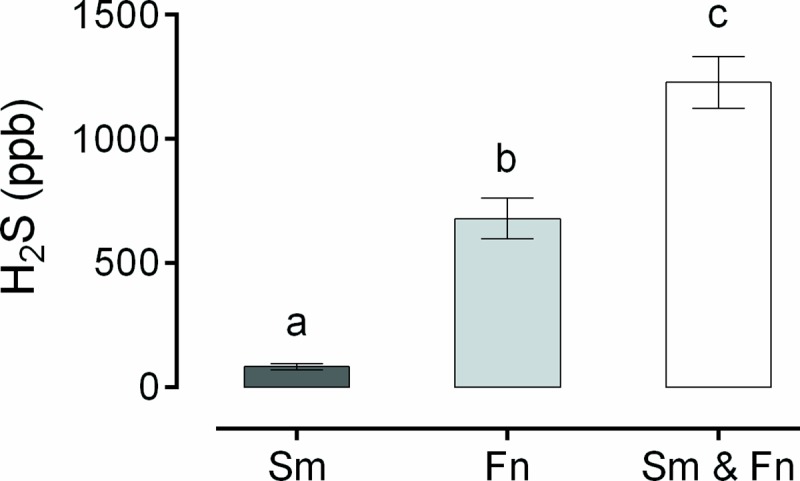
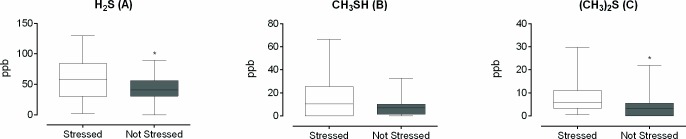
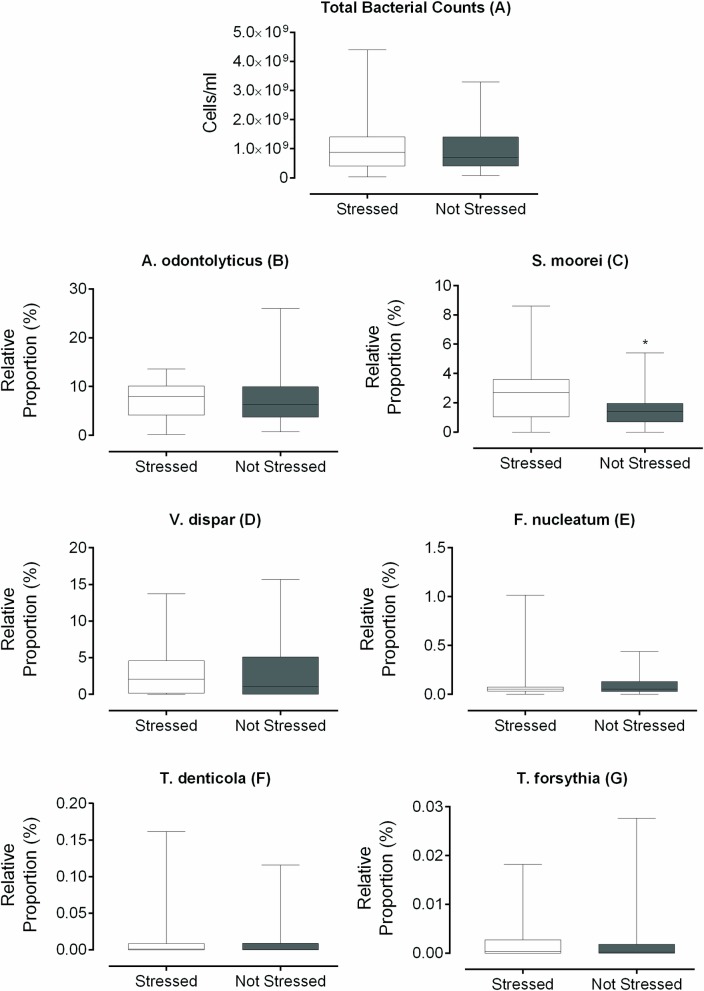
The stressed students group showed increased oral emanations of hydrogen sulfide and dimethyl sulfide, together with higher salivary Solobacterium moorei levels (p < 0.05, Mann Whitney test). There were moderate positive correlations between the following pairs of variables: Fusobacterium nucleatum and S. moorei; F. nucleatum and hydrogen sulfide; Tannerella forsythia and F. nucleatum; T. forsythia and S. moorei. These correlations only occurred for the stressed group (p < 0.05, Spearman correlation). The in vitro experiment demonstrated that S. moorei increased H2S production by F. nucleatum (p < 0.05, ANOVA and Tukey's test).
The increased amount of S. moorei in saliva, and its coexistence with F. nucleatum and T. forsythia, seemed to be responsible for increased oral hydrogen sulfide in the healthy male stressed subjects.
研究健康男性受试者唾液细菌、挥发性硫化合物的口腔散发物与学业相关慢性应激之间的关联。
78名健康男性本科牙科学生通过倦怠评估被分为有压力组或无压力组,倦怠是一种与学业相关慢性应激有关的综合征。使用马氏倦怠量表-学生调查问卷进行此项评估。使用Oral Chroma™便携式气相色谱仪测量口腔中硫化氢、甲硫醇和二甲基硫的散发量。通过qPCR对唾液中总细菌以及与口臭相关的7种细菌的数量进行定量。还使用Oral Chroma™仪器测量了穆尔氏菌和/或具核梭杆菌在体外产生硫化氢的情况。
有压力的学生组口腔中硫化氢和二甲基硫的散发量增加,同时唾液中穆尔氏菌水平更高(p<0.05,曼-惠特尼检验)。以下变量对之间存在中度正相关:具核梭杆菌与穆尔氏菌;具核梭杆菌与硫化氢;福赛斯坦纳菌与具核梭杆菌;福赛斯坦纳菌与穆尔氏菌。这些相关性仅在有压力的组中出现(p<0.05,斯皮尔曼相关性)。体外实验表明,穆尔氏菌增加了具核梭杆菌产生硫化氢的量(p<0.05,方差分析和图基检验)。
唾液中穆尔氏菌数量的增加及其与具核梭杆菌和福赛斯坦纳菌的共存,似乎是导致健康男性有压力受试者口腔硫化氢增加的原因。