Huygens Martine W J, Swinkels Ilse C S, de Jong Judith D, Heijmans Monique J W M, Friele Roland D, van Schayck Onno C P, de Witte Luc P
Department of Health Services Research, School for Public Health and Primary Care (CAPHRI), Maastricht University, P.O. Box 616, 6200 MD, Maastricht, The Netherlands.
Centre for Care Technology Research, Maastricht, The Netherlands.
BMC Fam Pract. 2017 Mar 20;18(1):40. doi: 10.1186/s12875-017-0615-3.
There is a growing emphasis on self-monitoring applications that allow patients to measure their own physical health parameters. A prerequisite for achieving positive effects is patients' willingness to self-monitor. The controllability of disease types, patients' perceived self-efficacy and health problems could play an essential role in this. The purpose of this study is to investigate the relationship between patients' willingness to self-monitor and a range of disease and patient specific variables including controllability of disease type, patients' perceived self-efficacy and health problems.
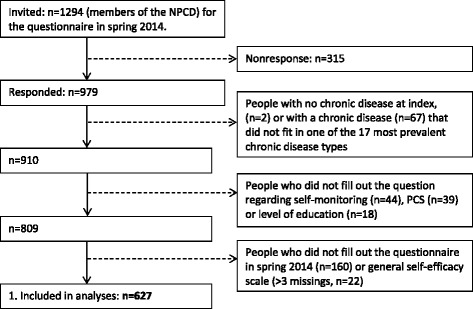
Data regarding 627 participants with 17 chronic somatic disease types from a Dutch panel of people with chronic diseases have been used for this cross-sectional study. Perceived self-efficacy was assessed using the general self-efficacy scale, perceived health problems using the Physical Health Composite Score (PCS). Participants indicated their willingness to self-monitor. An expert panel assessed for 17 chronic disease types the extent to which patients can independently keep their disease in control. Logistic regression analyses were conducted.
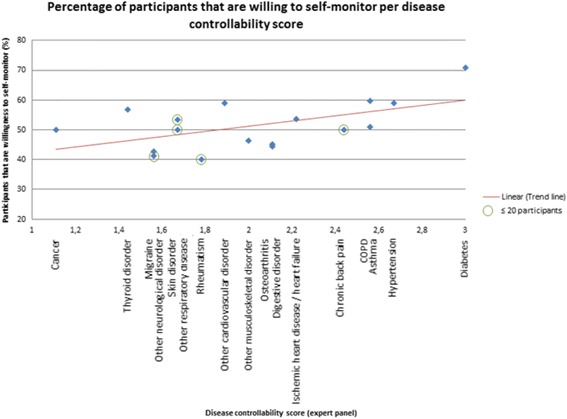
Patients' willingness to self-monitor differs greatly among disease types: patients with diabetes (71.0%), asthma (59.6%) and hypertension (59.1%) were most willing to self-monitor. In contrast, patients with rheumatism (40.0%), migraine (41.2%) and other neurological disorders (42.9%) were less willing to self-monitor. It seems that there might be a relationship between disease controllability scores and patients' willingness to self-monitor. No evidence is found of a relationship between general self-efficacy and PCS scores, and patients' willingness to self-monitor.
This study provides the first evidence that patients' willingness to self-monitor might be associated with disease controllability. Further research should investigate this association more deeply and should focus on how disease controllability influences willingness to self-monitor. In addition, since willingness to self-monitor differed greatly among patient groups, it should be taken into account that not all patient groups are willing to self-monitor.
人们越来越重视自我监测应用程序,这些程序可让患者自行测量身体健康参数。取得积极效果的一个先决条件是患者自我监测的意愿。疾病类型的可控性、患者感知的自我效能感和健康问题可能在其中发挥重要作用。本研究的目的是调查患者自我监测意愿与一系列疾病及患者特定变量之间的关系,这些变量包括疾病类型的可控性、患者感知的自我效能感和健康问题。
本横断面研究使用了来自荷兰慢性病患者小组的627名患有17种慢性躯体疾病类型的参与者的数据。使用一般自我效能量表评估感知自我效能感,使用身体健康综合评分(PCS)评估感知健康问题。参与者表明了他们自我监测的意愿。一个专家小组评估了17种慢性病类型患者能够独立控制疾病的程度。进行了逻辑回归分析。
患者自我监测的意愿在疾病类型之间差异很大:糖尿病患者(71.0%)、哮喘患者(59.6%)和高血压患者(59.1%)最愿意自我监测。相比之下,风湿病患者(40.0%)、偏头痛患者(41.2%)和其他神经系统疾病患者(42.9%)不太愿意自我监测。疾病可控性评分与患者自我监测意愿之间似乎可能存在关联。未发现一般自我效能感和PCS评分与患者自我监测意愿之间存在关联的证据。
本研究首次提供证据表明,患者自我监测的意愿可能与疾病可控性有关。进一步的研究应更深入地调查这种关联,并应关注疾病可控性如何影响自我监测意愿。此外,由于不同患者群体自我监测的意愿差异很大,应考虑到并非所有患者群体都愿意自我监测。