Huettmann Falk, Magnuson Emily Elizabeth, Hueffer Karsten
EWHALE Lab, Institute of Arctic Biology, Department of Wildlife Biology, University of Alaska Fairbanks, 902 N. Koyukuk Dr., P.O. Box 757000, Fairbanks, AK, 99775, USA.
Department of Biology and Wildlife, University of Alaska Fairbanks, 982 N. Koyukuk Dr., PO Box 756100, Fairbanks, AK, 99775, USA.
Acta Vet Scand. 2017 Mar 20;59(1):18. doi: 10.1186/s13028-017-0285-0.
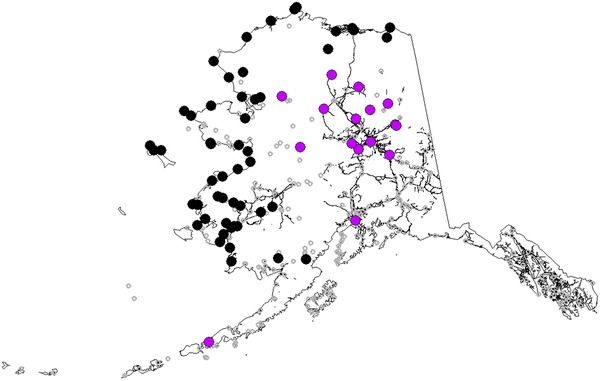
Rabies is a disease of global significance including in the circumpolar Arctic. In Alaska enzootic rabies persist in northern and western coastal areas. Only sporadic cases have occurred in areas outside of the regions considered enzootic for the virus, such as the interior of the state and urbanized regions.
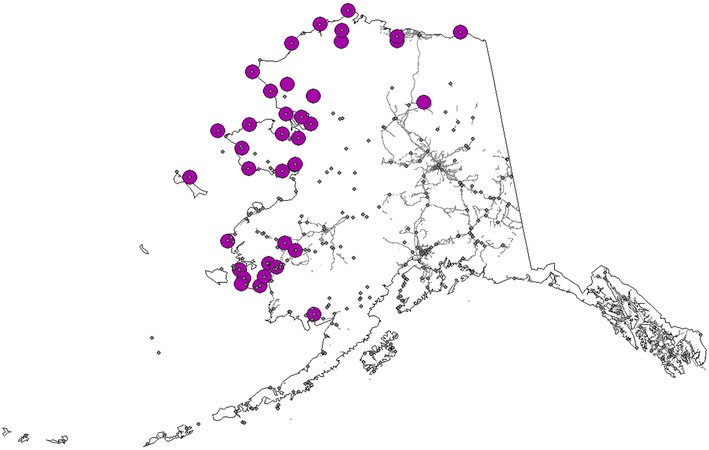
Here we examine the distribution of diagnosed rabies cases in Alaska, explicit in space and time. We use a geographic information system (GIS), 20 environmental data layers and provide a quantitative non-parsimonious estimate of the predicted ecological niche, based on data mining, machine learning and open access data. We identify ecological correlates and possible drivers that determine the ecological niche of rabies virus in Alaska. More specifically, our models show that rabies cases are closely associated with human infrastructure, and reveal an ecological niche in remote northern wilderness areas. Furthermore a model utilizing climate modeling suggests a reduction of the current ecological niche for detection of rabies virus in Alaska, a state that is disproportionately affected by a changing climate.
Our results may help to better inform public health decisions in the future and guide further studies on individual drivers of rabies distribution in the Arctic.
狂犬病是一种具有全球重要性的疾病,包括在北极圈地区。在阿拉斯加,动物狂犬病在北部和西部沿海地区持续存在。在该病毒被认为是动物狂犬病流行区域之外的地区,如该州内陆和城市化地区,仅出现过零星病例。
在此,我们研究了阿拉斯加确诊狂犬病病例在空间和时间上的分布情况。我们使用地理信息系统(GIS)、20个环境数据层,并基于数据挖掘、机器学习和开放获取数据,对预测的生态位进行了定量的非简约估计。我们确定了决定阿拉斯加狂犬病病毒生态位的生态相关因素和可能的驱动因素。更具体地说,我们的模型表明狂犬病病例与人类基础设施密切相关,并揭示了偏远北部荒野地区的一个生态位。此外,一个利用气候模型的模型表明,阿拉斯加检测狂犬病病毒的当前生态位将减少,阿拉斯加州受到气候变化的影响尤为严重。
我们的结果可能有助于未来更好地为公共卫生决策提供信息,并指导对北极地区狂犬病分布的个体驱动因素的进一步研究。