Ecological Wildlife Habitat Analysis of the Land- and Seascape (EWHALE) Lab, Biology and Wildlife Department, University of Alaska Fairbanks, Fairbanks, AK 99775, USA.
Vet Res. 2013 Jun 13;44(1):42. doi: 10.1186/1297-9716-44-42.
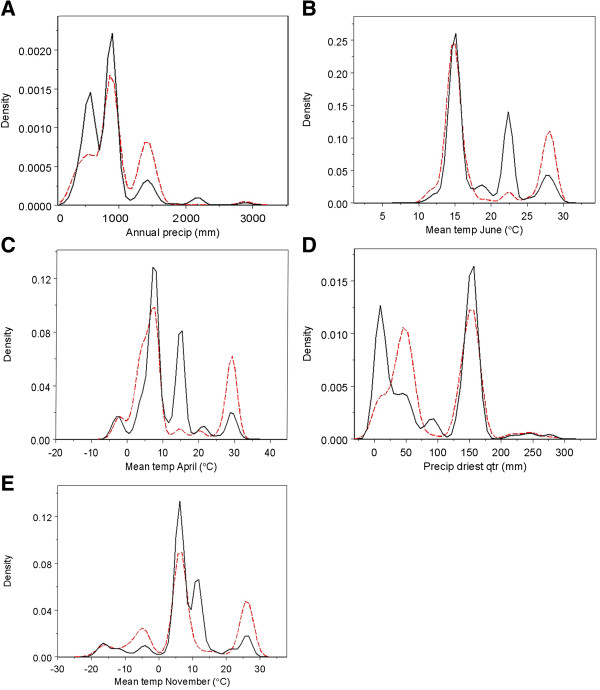
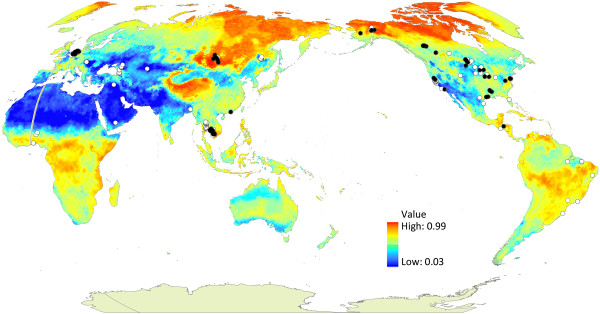
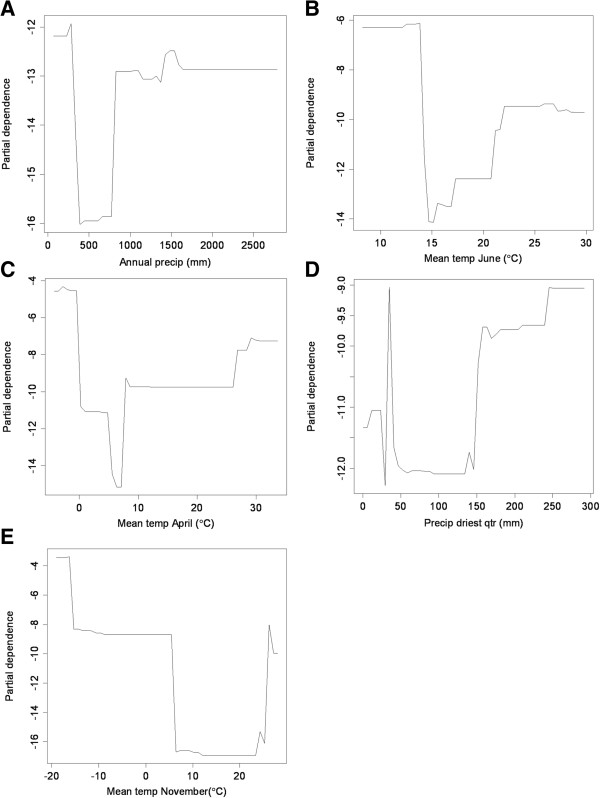
Avian influenza virus (AIV) is enzootic to wild birds, which are its natural reservoir. The virus exhibits a large degree of genetic diversity and most of the isolated strains are of low pathogenicity to poultry. Although AIV is nearly ubiquitous in wild bird populations, highly pathogenic H5N1 subtypes in poultry have been the focus of most modeling efforts. To better understand viral ecology of AIV, a predictive model should 1) include wild birds, 2) include all isolated subtypes, and 3) cover the host's natural range, unbounded by artificial country borders. As of this writing, there are few large-scale predictive models of AIV in wild birds. We used the Random Forests algorithm, an ensemble data-mining machine-learning method, to develop a global-scale predictive map of AIV, identify important predictors, and describe the environmental niche of AIV in wild bird populations. The model has an accuracy of 0.79 and identified northern areas as having the highest relative predicted risk of outbreak. The primary niche was described as regions of low annual rainfall and low temperatures. This study is the first global-scale model of low-pathogenicity avian influenza in wild birds and underscores the importance of largely unstudied northern regions in the persistence of AIV.
禽流感病毒(AIV)在野生鸟类中流行,野生鸟类是其天然宿主。该病毒表现出很大程度的遗传多样性,大多数分离株对家禽的致病性较低。尽管 AIV 在野生鸟类种群中几乎无处不在,但家禽中的高致病性 H5N1 亚型一直是大多数建模工作的重点。为了更好地了解 AIV 的病毒生态学,预测模型应 1)包含野生鸟类,2)包含所有分离的亚型,3)涵盖宿主的自然范围,不受人为国界的限制。截至目前,很少有关于野生鸟类中 AIV 的大规模预测模型。我们使用随机森林算法(一种集成数据挖掘机器学习方法)来开发 AIV 的全球规模预测图,识别重要的预测因子,并描述野生鸟类中 AIV 的环境生态位。该模型的准确率为 0.79,确定北方地区爆发的相对风险最高。主要生态位被描述为年降雨量低和温度低的地区。这项研究是第一个关于野生鸟类中低致病性禽流感的全球规模模型,突出了在 AIV 持续存在中,很大程度上未被研究的北方地区的重要性。