Freyd Thibaud, Warszycki Dawid, Mordalski Stefan, Bojarski Andrzej J, Sylte Ingebrigt, Gabrielsen Mari
Department of Medical Biology, Faculty of Health Sciences, UiT - the Arctic University of Norway, Tromsø, Norway.
Department of Medicinal Chemistry, Institute of Pharmacology, Polish Academy of Sciences, Kraków, Poland.
PLoS One. 2017 Mar 21;12(3):e0173889. doi: 10.1371/journal.pone.0173889. eCollection 2017.
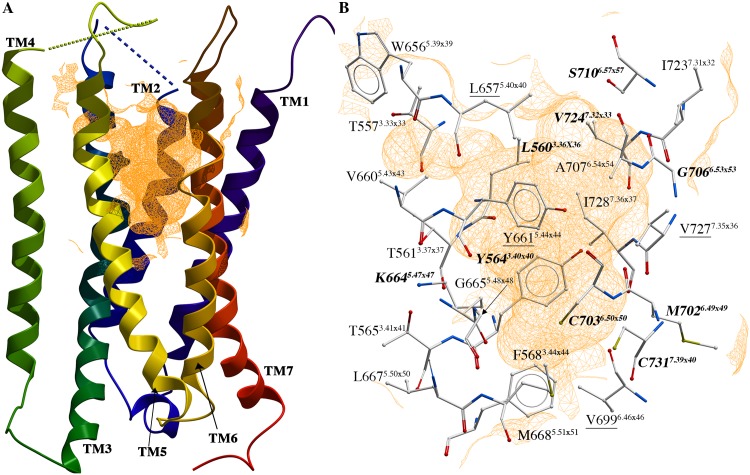
γ-aminobutyric acid (GABA) is the main inhibitory neurotransmitter in the central nervous system, and disturbances in the GABAergic system have been implicated in numerous neurological and neuropsychiatric diseases. The GABAB receptor is a heterodimeric class C G protein-coupled receptor (GPCR) consisting of GABAB1a/b and GABAB2 subunits. Two GABAB receptor ligand binding sites have been described, namely the orthosteric GABA binding site located in the extracellular GABAB1 Venus fly trap domain and the allosteric binding site found in the GABAB2 transmembrane domain. To date, the only experimentally solved three-dimensional structures of the GABAB receptor are of the Venus fly trap domain. GABAB receptor allosteric modulators, however, show great therapeutic potential, and elucidating the structure of the GABAB2 transmembrane domain may lead to development of novel drugs and increased understanding of the allosteric mechanism of action. Despite the lack of x-ray crystal structures of the GABAB2 transmembrane domain, multiple crystal structures belonging to other classes of GPCRs than class A have been released within the last years. More closely related template structures are now available for homology modelling of the GABAB receptor. Here, multiple homology models of the GABAB2 subunit of the GABAB receptor have been constructed using templates from class A, B and C GPCRs, and docking of five clusters of positive allosteric modulators and decoys has been undertaken to select models that enrich the active compounds. Using this ligand-guided approach, eight GABAB2 homology models have been chosen as possible structural representatives of the transmembrane domain of the GABAB2 subunit. To the best of our knowledge, the present study is the first to describe homology modelling of the transmembrane domain of the GABAB2 subunit and the docking of positive allosteric modulators in the receptor.
γ-氨基丁酸(GABA)是中枢神经系统中的主要抑制性神经递质,GABA能系统紊乱与多种神经和神经精神疾病有关。GABAB受体是一种异二聚体C类G蛋白偶联受体(GPCR),由GABAB1a/b和GABAB2亚基组成。已描述了两个GABAB受体配体结合位点,即位于细胞外GABAB1捕蝇草结构域的正构GABA结合位点和在GABAB2跨膜结构域中发现的变构结合位点。迄今为止,GABAB受体唯一通过实验解析的三维结构是捕蝇草结构域的结构。然而,GABAB受体变构调节剂具有巨大的治疗潜力,阐明GABAB2跨膜结构域的结构可能会导致新型药物的开发,并增进对变构作用机制的理解。尽管缺乏GABAB2跨膜结构域的X射线晶体结构,但在过去几年中已发布了属于A类以外其他GPCR类别的多个晶体结构。现在有更密切相关的模板结构可用于GABAB受体的同源建模。在此,使用来自A、B和C类GPCR的模板构建了GABAB受体GABAB2亚基的多个同源模型,并对五组正构变构调节剂和诱饵进行了对接,以选择富集活性化合物的模型。使用这种配体导向方法,已选择了八个GABAB2同源模型作为GABAB2亚基跨膜结构域的可能结构代表。据我们所知,本研究是首次描述GABAB2亚基跨膜结构域的同源建模以及受体中正构变构调节剂的对接。