Singh Pallavi, Dwivedi Padmanabh
Laboratory of Plant Tissue Culture and Stress Physiology, Department of Plant Physiology, Institute of Agricultural Sciences, Banaras Hindu University, Varanasi, India.
3 Biotech. 2014 Aug;4(4):431-437. doi: 10.1007/s13205-013-0172-y. Epub 2013 Sep 26.
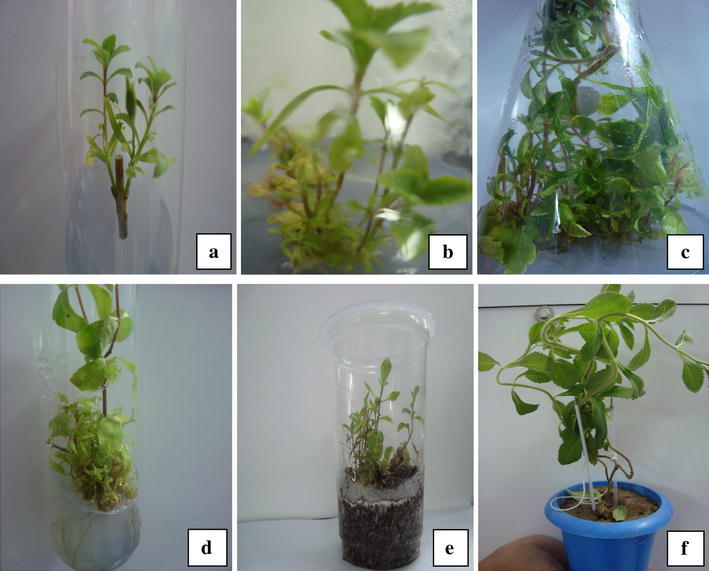
Stevia rebaudiana Bertoni, member of Asteraceae family, has bio-active compounds stevioside and rebaudioside which taste about 300 times sweeter than sucrose. It regulates blood sugar, prevents hypertension and tooth decay as well as used in treatment of skin disorders having high medicinal values, and hence there is a need for generating the plant on large scale. We have developed an efficient micropropagation protocol on half strength Murashige and Skoog (MS) media, using two-stage culture procedures. Varying concentrations of cytokinins, i.e., benzylaminopurine, kinetin and thidiazuron (TDZ) were supplemented in the nutrient media to observe their effects on shoot development. All the cytokinins promoted shoot formation, however, best response was observed in the TDZ (0.5 mg/l). The shoots from selected induction medium were sub-cultured on the multiplication media. The media containing 0.01 mg/l TDZ produced maximum number of shoot (11.00 ± 0.40) with longer shoots (7.17 ± 0.16) and highest number of leaves (61.00 ± 1.29). Rooting response was best observed in one-fourth strength on MS media supplemented with indole-3-butyric acid (1.0 mg/l) and activated charcoal (50 mg/l) with (11.00 ± 0.40) number of roots. The plantlets thus obtained were hardened and transferred to the pots with soil and sand mixture, where the survival rate was 80 % after 2 months. Quantitative analysis of stevioside content in leaves of in vivo mother plant and in vitro plantlets was carried out by high performance liquid chromatography. A remarkable increase in stevioside content was noticed in the in vitro-raised plants as compared to in vivo grown plants. The protocol reported here might be useful in genetic improvement and high stevioside production.
甜叶菊是菊科植物,含有生物活性化合物甜菊糖苷和莱鲍迪苷,其甜度约为蔗糖的300倍。它能调节血糖、预防高血压和龋齿,还用于治疗具有高药用价值的皮肤疾病,因此需要大规模种植这种植物。我们利用两阶段培养程序,在半强度的Murashige和Skoog(MS)培养基上开发了一种高效的微繁殖方案。在营养培养基中添加不同浓度的细胞分裂素,即苄氨基嘌呤、激动素和噻二唑素(TDZ),以观察它们对芽发育的影响。所有细胞分裂素都促进了芽的形成,然而,在TDZ(0.5毫克/升)中观察到最佳反应。将从选定诱导培养基上获得的芽转接至增殖培养基上。含有0.01毫克/升TDZ的培养基产生的芽数量最多(11.00±0.40),芽较长(7.17±0.16),叶片数量最多(61.00±1.29)。在添加了吲哚-3-丁酸(1.0毫克/升)和活性炭(50毫克/升)的四分之一强度MS培养基上,生根反应最佳,生根数量为(11.00±0.40)。由此获得的植株经过炼苗后转移到装有土壤和沙子混合物的花盆中,2个月后的成活率为80%。通过高效液相色谱法对体内母株和离体植株叶片中的甜菊糖苷含量进行了定量分析。与体内生长的植株相比,离体培养的植株中甜菊糖苷含量显著增加。本文报道的方案可能有助于遗传改良和高甜菊糖苷产量的提高。