Al-Ammar Yousif, Al-Mansour Bader, Al-Rashood Omar, Tunio Mutahir A, Islam Tahera, Al-Asiri Mushabbab, Al-Qahtani Khalid Hussain
King Saud University, College of Medicine, Department of Otolaryngology-Head & Neck Surgery, Riyadh, Saudi Arabia.
King Fahad Medical City, Radiation Oncology, Riyadh, Saudi Arabia.
Braz J Otorhinolaryngol. 2018 Mar-Apr;84(2):220-226. doi: 10.1016/j.bjorl.2017.02.002. Epub 2017 Feb 28.
Increased body mass index is known to be associated with the high prevalence of differentiated thyroid cancers; however data on its impact on survival outcome after thyroidectomy and adjuvant therapy is scanty.
We aimed to evaluate the impact of body mass index on overall survival and disease free survival rates in patients with differentiated thyroid cancers.
Between 2000 and 2011, 209 patients with differentiated thyroid cancers (papillary, follicular, hurthle cell) were treated with thyroidectomy followed by adjuvant radioactive iodine-131 therapy and thyroid-stimulating hormone suppression. Based on body mass index, patients were divided into five groups; (a) <18.5kg/m (underweight); (b) 18.5-25kg/m (normal weight); (c) 26-30kg/m (overweight); (d) 31-40kg/m (obese) and (e) >40kg/m (morbid obese). Various demographic, clinical and treatment characteristics and related toxicity and outcomes (overall survival, and disease free survival) were analyzed and compared.
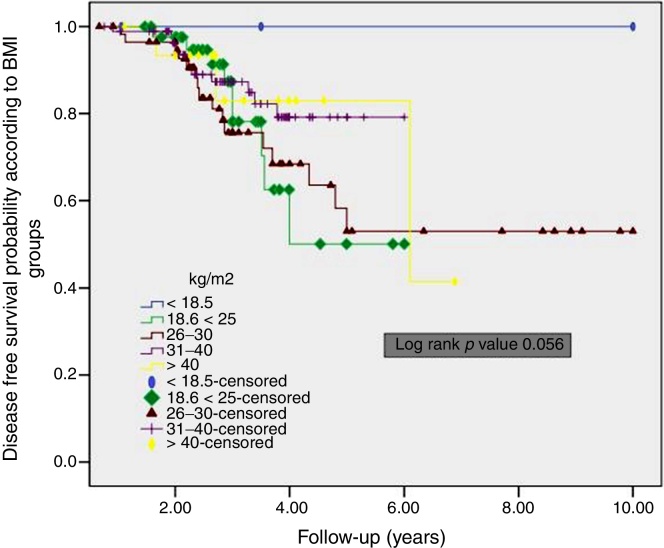
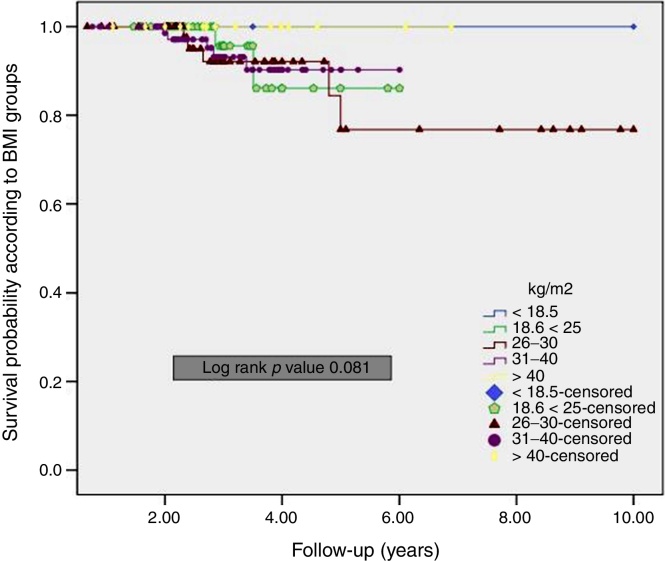
Median follow up period was 5.2years (0.6-10). Mean body mass index was 31.3kg/m (17-72); body mass index 31-40kg/m was predominant (89 patients, 42.6%) followed by 26-30kg/m seen in 58 patients (27.8%). A total of 18 locoregional recurrences (8.6%) and 12 distant metastasis (5.7%) were seen. The 10 year disease free survival and overall survival rates were 83.1% and 58.0% respectively. No significant impact of body mass index on overall survival or disease free survival rates was found (p=0.081). Similarly, multivariate analysis showed that body mass index was not an independent prognostic factor for overall survival and disease free survival.
Although body mass index can increase the risk of thyroid cancer, it has no impact on treatment outcome; however, further trials are warranted.
已知体重指数增加与分化型甲状腺癌的高患病率相关;然而,关于其对甲状腺切除术后及辅助治疗生存结局影响的数据却很匮乏。
我们旨在评估体重指数对分化型甲状腺癌患者总生存率和无病生存率的影响。
2000年至2011年间,209例分化型甲状腺癌(乳头状、滤泡状、嗜酸性细胞型)患者接受了甲状腺切除术,随后接受辅助放射性碘-131治疗及促甲状腺激素抑制治疗。根据体重指数,患者被分为五组:(a)<18.5kg/m²(体重过轻);(b)18.5 - 25kg/m²(正常体重);(c)26 - 30kg/m²(超重);(d)31 - 40kg/m²(肥胖);(e)>40kg/m²(病态肥胖)。分析并比较了各种人口统计学、临床和治疗特征以及相关毒性和结局(总生存率和无病生存率)。
中位随访期为5.2年(0.6 - 10年)。平均体重指数为31.3kg/m²(17 - 72);体重指数在31 - 40kg/m²的患者居多(89例,42.6%),其次是体重指数在26 - 30kg/m²的患者,共58例(27.8%)。共观察到18例局部区域复发(8.6%)和12例远处转移(5.7%)。10年无病生存率和总生存率分别为83.1%和58.0%。未发现体重指数对总生存率或无病生存率有显著影响(p = 0.081)。同样,多因素分析表明体重指数不是总生存率和无病生存率的独立预后因素。
尽管体重指数会增加甲状腺癌风险,但对治疗结局无影响;然而仍需进一步试验。