Peacock Thomas P, Benton Donald J, Sadeyen Jean-Remy, Chang Pengxiang, Sealy Joshua E, Bryant Juliet E, Martin Stephen R, Shelton Holly, McCauley John W, Barclay Wendy S, Iqbal Munir
Avian Viral Diseases Programme, The Pirbright Institute, Pirbright Woking, GU24 0NF, UK.
Imperial College London, London W2 1NY, UK.
Emerg Microbes Infect. 2017 Mar 22;6(3):e11. doi: 10.1038/emi.2016.139.
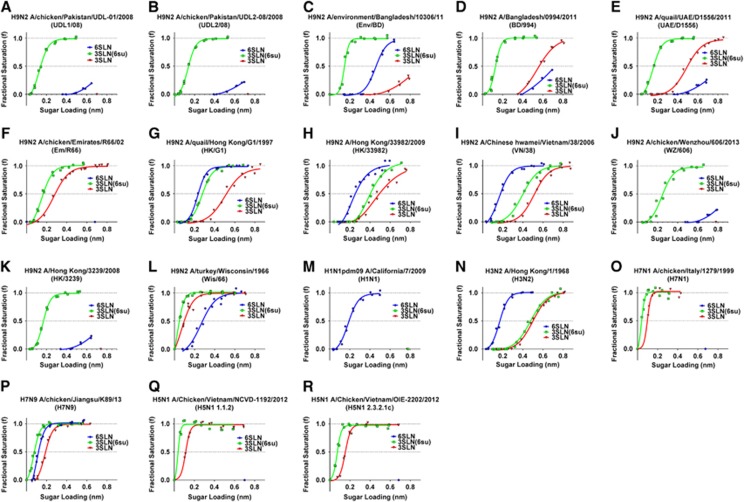
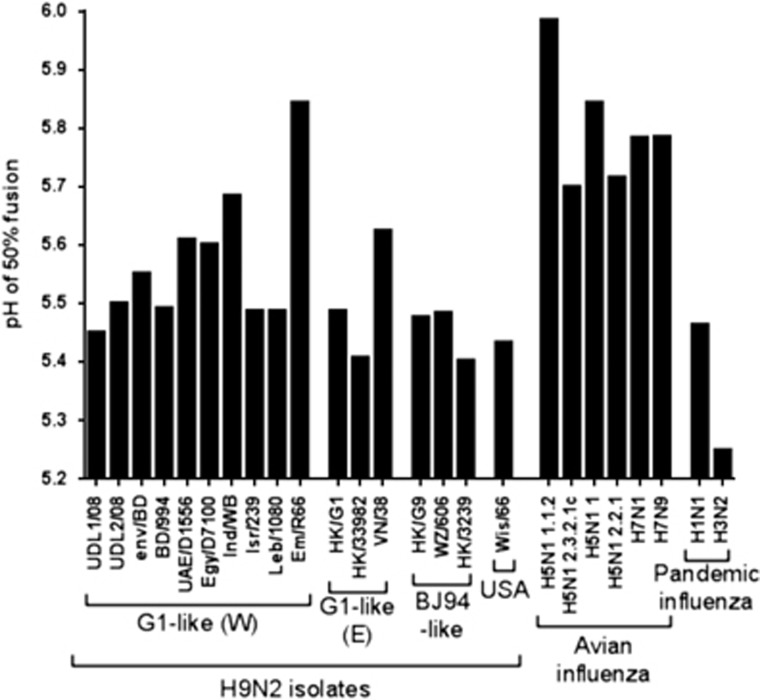
H9N2 avian influenza viruses are primarily a disease of poultry; however, they occasionally infect humans and are considered a potential pandemic threat. Little work has been performed to assess the intrinsic biochemical properties related to zoonotic potential of H9N2 viruses. The objective of this study, therefore, was to investigate H9N2 haemagglutinins (HAs) using two well-known correlates for human adaption: receptor-binding avidity and pH of fusion. Receptor binding was characterized using bio-layer interferometry to measure virus binding to human and avian-like receptor analogues and the pH of fusion was assayed by syncytium formation in virus-infected cells at different pHs. We characterized contemporary H9N2 viruses of the zoonotic G1 lineage, as well as representative viruses of the zoonotic BJ94 lineage. We found that most contemporary H9N2 viruses show a preference for sulphated avian-like receptor analogues. However, the 'Eastern' G1 H9N2 viruses displayed a consistent preference in binding to a human-like receptor analogue. We demonstrate that the presence of leucine at position 226 of the HA receptor-binding site correlated poorly with the ability to bind a human-like sialic acid receptor. H9N2 HAs also display variability in their pH of fusion, ranging between pH 5.4 and 5.85 which is similar to that of the first wave of human H1N1pdm09 viruses but lower than the pH of fusion seen in zoonotic H5N1 and H7N9 viruses. Our results suggest possible molecular mechanisms that may underlie the relatively high prevalence of human zoonotic infection by particular H9N2 virus lineages.
H9N2禽流感病毒主要感染家禽;不过,它们偶尔也会感染人类,被视为一种潜在的大流行威胁。目前针对H9N2病毒人畜共患病潜力相关的内在生化特性开展的研究较少。因此,本研究的目的是利用两个为人熟知的人类适应性相关指标,即受体结合亲和力和融合pH值,来研究H9N2血凝素(HA)。通过生物层干涉术测量病毒与人源和禽源样受体类似物的结合情况来表征受体结合特性,并通过在不同pH值下对病毒感染细胞中的合胞体形成进行检测来测定融合pH值。我们对人畜共患病G1谱系的当代H9N2病毒以及人畜共患病BJ94谱系的代表性病毒进行了表征。我们发现,大多数当代H9N2病毒更倾向于结合硫酸化的禽源样受体类似物。然而,“东部”G1 H9N2病毒在与人源样受体类似物的结合上表现出一致的偏好。我们证明,HA受体结合位点第226位的亮氨酸的存在与人源样唾液酸受体的结合能力相关性较差。H9N2 HA的融合pH值也存在差异,范围在5.4至5.85之间,这与人类甲型H1N1pdm09病毒第一波疫情时的情况相似,但低于人畜共患病H5N1和H7N9病毒的融合pH值。我们的研究结果提示了可能的分子机制,这些机制可能是特定H9N2病毒谱系导致人类人畜共患病感染相对高发的基础。