Souza Ana C O, Amaral Andre C
Laboratory of Pathogenic Dimorphic Fungi, Institute of Biomedical Sciences, University of São Paulo São Paulo, Brazil.
Laboratory of Nano and Biotechnology, Institute of Tropical Pathology and Public Health, Federal University of Goiás Goiânia, Brazil.
Front Microbiol. 2017 Mar 7;8:336. doi: 10.3389/fmicb.2017.00336. eCollection 2017.
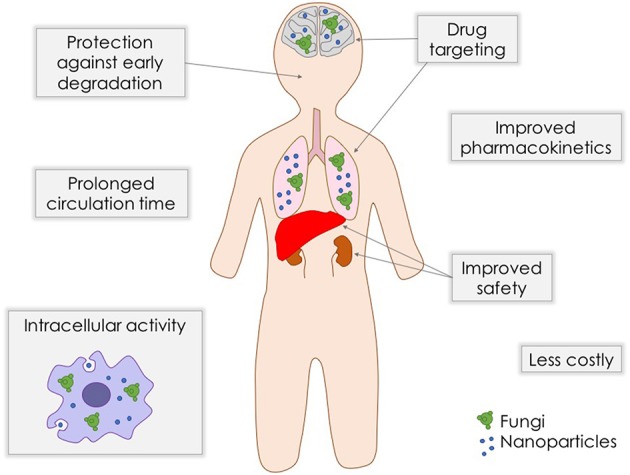
Fungal diseases have been emerging as an important public health problem worldwide with the increase in host predisposition factors due to immunological dysregulations, immunosuppressive and/or anticancer therapy. Antifungal therapy for systemic mycosis is limited, most of times expensive and causes important toxic effects. Nanotechnology has become an interesting strategy to improve efficacy of traditional antifungal drugs, which allows lower toxicity, better biodistribution, and drug targeting, with promising results and . In this review, we provide a discussion about conventional antifungal and nanoantifungal therapies for systemic mycosis.
随着免疫失调、免疫抑制和/或抗癌治疗导致宿主易患因素增加,真菌病已成为全球重要的公共卫生问题。用于系统性真菌病的抗真菌治疗方法有限,多数情况下费用高昂且会产生严重的毒副作用。纳米技术已成为提高传统抗真菌药物疗效的一种有趣策略,它具有更低的毒性、更好的生物分布和药物靶向性,取得了令人鼓舞的成果。在本综述中,我们将讨论用于系统性真菌病的传统抗真菌疗法和纳米抗真菌疗法。