Edwards Meghan K, Loprinzi Paul D
Department of Health, Exercise Science and Recreation Management, Physical Activity Epidemiology Laboratory, Exercise Psychology Laboratory, The University of Mississippi, University, MS, USA.
Health Promot Perspect. 2017 Mar 5;7(2):88-94. doi: 10.15171/hpp.2017.16. eCollection 2017.
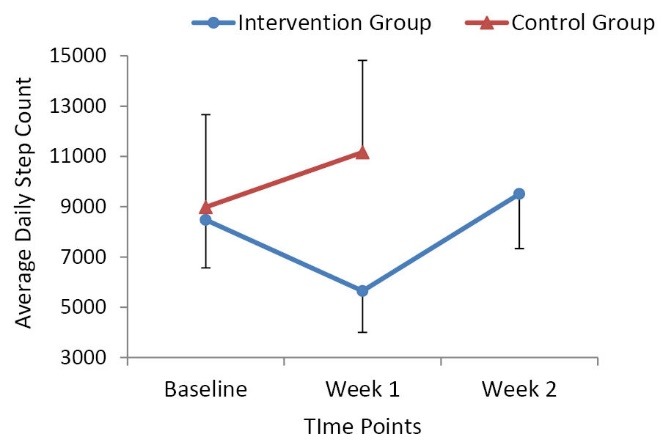
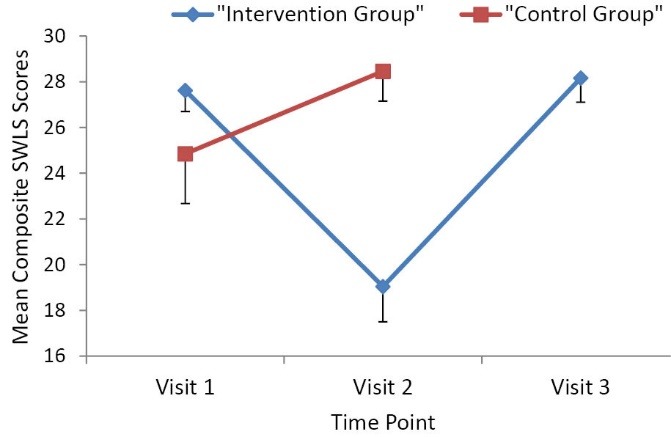
No study has experimentally manipulated sedentary behavior and evaluated its effect on life satisfaction. Thus, the purpose of this study was to evaluate the effects of a free-living, sedentary behavior-inducing randomized controlled intervention on life satisfaction. Active, young adults between the ages of 18-35 were recruited and randomly assigned into a sedentary behavior intervention group (n = 26) or a control group (n = 13). The intervention group participants were instructed to eliminate all exercise and restrict daily steps (as measured via pedometry) to 5000 or less per day for one week. The control group was instructed to maintain regular levels of exercise and other physical activity for one week. Both groups completed the Satisfaction with Life Scale (SWLS) pre-intervention and immediately post-intervention. There was a significant group x time interaction (F = 32.75, P < 0.001), with post-hoc contrast tests indicating decreased SWLS score (indicating lower levels of life satisfaction) in the intervention group during Visit 2 (post-intervention) compared with Visit 1 (pre-intervention); this corresponded with a mean absolute (Visit 2 minus Visit 1) change of -8.58 (95% CI: -5.91, -11.24) for SWLS scores in the intervention group (31.1% reduction). A one-week sedentary behavior-inducing intervention may negatively impact life satisfaction in an active, young adult population. Regular physical activity may be imperative in avoiding negative life satisfaction-related consequences.
尚无研究通过实验手段操控久坐行为并评估其对生活满意度的影响。因此,本研究旨在评估一项自由生活、诱导久坐行为的随机对照干预措施对生活满意度的影响。招募了年龄在18 - 35岁之间的活跃青年成年人,并将他们随机分为久坐行为干预组(n = 26)或对照组(n = 13)。干预组参与者被要求在一周内取消所有运动,并将每日步数(通过计步器测量)限制在5000步及以下。对照组被要求在一周内保持常规的运动和其他身体活动水平。两组在干预前和干预后立即完成了生活满意度量表(SWLS)。存在显著的组×时间交互作用(F = 32.75,P < 0.001),事后对比测试表明,与第1次访视(干预前)相比,干预组在第2次访视(干预后)时SWLS得分降低(表明生活满意度水平较低);这对应于干预组SWLS得分的平均绝对变化(第2次访视减去第1次访视)为-8.58(95% CI:-5.91,-11.24)(降低31.1%)。为期一周的诱导久坐行为干预可能会对活跃的青年成年人群体的生活满意度产生负面影响。规律的体育活动对于避免与生活满意度相关的负面后果可能至关重要。