Hwang Seung Hwan, Kwon Shin Hwa, Kim Set Byeol, Lim Soon Sung
Department of Food Science and Nutrition, Hallym University, 1 Hallymdeahak-gil, Chuncheon 24252, Republic of Korea.
Institute of Natural Medicine, Hallym University, 1 Hallymdeahak-gil, Chuncheon 24252, Republic of Korea.
Biomed Res Int. 2017;2017:4273257. doi: 10.1155/2017/4273257. Epub 2017 Feb 23.
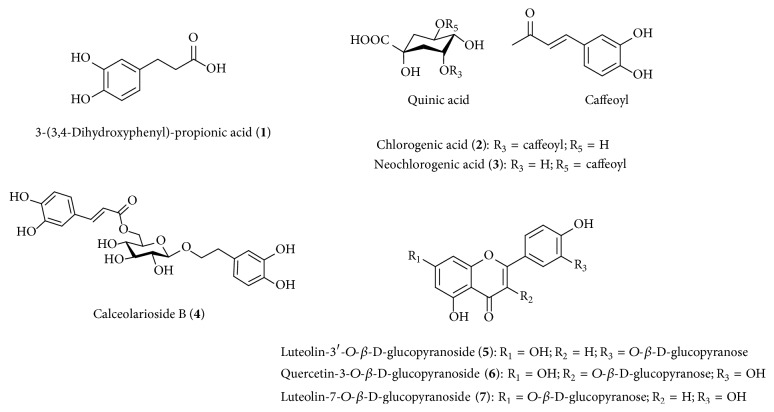
(Thunb.) Decne. (Lardizabalaceae) leaves (SHL) have been used traditionally as analgesics, sedatives, diuretics, and so on, in China. To date, no data have been reported on the inhibitory effect of SHL and its constituents on rat lens aldose reductase (RLAR) and advanced glycation end products (AGEs). Therefore, the inhibitory effect of compounds isolated from SHL extract on RLAR and AGEs was investigated to evaluate potential treatments of diabetic complications. The ethyl acetate (EtOAC) fraction of SHL extract showed strong inhibitory activity on RLAR and AGEs; therefore, EtOAc fraction (3.0 g) was subjected to Sephadex LH-20 column chromatography, for further fractionation, with 100% MeOH solvent system to investigate its effect on RLAR and AGEs. Phytochemical investigation of SHL led to the isolation of seven compounds. Among the isolated compounds, chlorogenic acid, calceolarioside B, luteolin-3'---D-glucopyranoside, quercetin-3---D-glucopyranoside, and luteolin-7---D-glucopyranoside exhibited significant inhibitory activity against RLAR with IC in the range of 7.34-23.99 M. In addition, 3-(3,4-dihydroxyphenyl) propionic acid, neochlorogenic acid, and luteolin-3'---D-glucopyranoside exhibited the most potent inhibitory activity against formation of AGEs, with an IC value of 115.07-184.06 M, compared to the positive control aminoguanidine (820.44 M). Based on these findings, SHL dietary supplements could be considered for the prevention and/or treatment of diabetes complication.
(木通科)野木瓜属植物的叶子在中国传统上被用作镇痛药、镇静剂、利尿剂等。迄今为止,尚未有关于野木瓜属植物叶子及其成分对大鼠晶状体醛糖还原酶(RLAR)和晚期糖基化终产物(AGEs)抑制作用的报道。因此,研究了从野木瓜属植物叶子提取物中分离出的化合物对RLAR和AGEs的抑制作用,以评估糖尿病并发症的潜在治疗方法。野木瓜属植物叶子提取物的乙酸乙酯(EtOAC)部分对RLAR和AGEs表现出强烈的抑制活性;因此,将乙酸乙酯部分(3.0 g)用100%甲醇溶剂系统进行葡聚糖凝胶LH - 20柱色谱进一步分离,以研究其对RLAR和AGEs的影响。对野木瓜属植物叶子的植物化学研究导致分离出七种化合物。在分离出的化合物中,绿原酸、荷包牡丹苷B、木犀草素 - 3'-O-D-葡萄糖苷、槲皮素 - 3-O-D-葡萄糖苷和木犀草素 - 7-O-D-葡萄糖苷对RLAR表现出显著的抑制活性,IC50值在7.34 - 23.99 μM范围内。此外,3-(3,4-二羟基苯基)丙酸、新绿原酸和木犀草素 - 3'-O-D-葡萄糖苷对AGEs的形成表现出最有效的抑制活性,IC50值为115.07 - 184.06 μM,与阳性对照氨基胍(820.44 μM)相比。基于这些发现,野木瓜属植物叶子的膳食补充剂可考虑用于预防和/或治疗糖尿病并发症。