Duff Whitney R D, Kontulainen Saija A, Candow Darren G, Gordon Julianne J, Mason Riley S, Taylor-Gjevre Regina, Nair Bindu, Szafron Michael, Baxter-Jones Adam D G, Zello Gordon A, Chilibeck Philip D
College of Kinesiology, Physical Activity Complex, 87 Campus Drive, University of Saskatchewan, Saskatoon, SK S7N 5B2, Canada.
Faculty of Kinesiology and Health Studies, Centre for Kinesiology, Health, and Sport, 3737 Wascana Parkway, University of Regina, Regina, SK, S4S 0A2, Canada.
Bone Rep. 2016 Apr 28;5:96-103. doi: 10.1016/j.bonr.2016.04.004. eCollection 2016 Dec.
To compare the effects of nine months of exercise training and ibuprofen supplementation (given immeditately after exercise sessions) on bone and muscle in postmenopausal women.
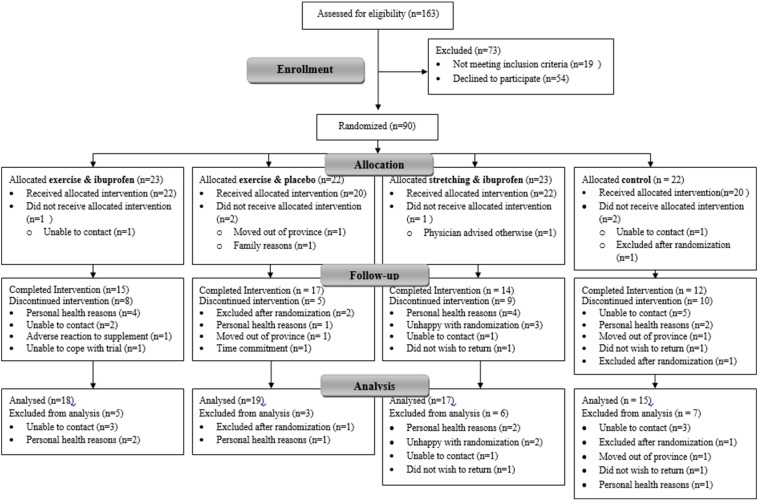
In a double-blind randomized trial, participants (females: n = 90, mean age 64.8, SD 4.3 years) were assigned (computer generated, double blind) to receive supervised resistance training or stretching 3 days/week, and ibuprofen (400 mg, post-exercise) or placebo (i.e. 4 groups) for 9 months. In this proof-of-concept study the sample size was halved from required 200 identified via 90% power calculation. Baseline and post-intervention testing included: Dual energy x-ray absorptiometry (DXA) for lumbar spine, femoral neck, and total body areal bone mineral density (aBMD); geometry of proximal femur; total body lean tissue and fat mass; predicted 1-repetition maximum muscle strength testing (1RM; biceps curl, hack squat).
Exercise training or ibuprofen supplementation had no effects on aBMD of the lumbar spine, femoral neck, and total body. There was a significant exercise × supplement × time interaction for aBMD of Ward's region of the femoral neck (p = 0.015) with post hoc comparison showing a 6% decrease for stretching with placebo vs. a 3% increase for stretching with ibuprofen (p = 0.017). Resistance training increased biceps curl and hack squat strength vs. stretching (22% vs. 4% and 114% vs. 12%, respectively) (p < 0.01) and decreased percent body fat compared to stretching (2% vs. 0%) (p < 0.05).
Ibuprofen supplementation provided some benefits to bone when taken independent of exercise training in postmenopausal women. This study provides evidence towards a novel, easily accessible stimulus for enhancing bone health [i.e. ibuprofen].
比较九个月的运动训练和布洛芬补充剂(运动后立即服用)对绝经后女性骨骼和肌肉的影响。
在一项双盲随机试验中,参与者(女性:n = 90,平均年龄64.8岁,标准差4.3岁)被分配(计算机生成,双盲)接受每周3天的监督抗阻训练或拉伸训练,并服用布洛芬(400毫克,运动后)或安慰剂(即4组),为期9个月。在这项概念验证研究中,样本量从通过90%功效计算确定的所需200例减半。基线和干预后测试包括:腰椎、股骨颈和全身面积骨密度(aBMD)的双能X线吸收法(DXA);股骨近端几何形状;全身瘦组织和脂肪量;预测的1次重复最大肌肉力量测试(1RM;二头肌弯举、哈克深蹲)。
运动训练或布洛芬补充剂对腰椎、股骨颈和全身的aBMD没有影响。股骨颈沃德区的aBMD存在显著的运动×补充剂×时间交互作用(p = 0.015),事后比较显示,服用安慰剂进行拉伸时aBMD下降6%,而服用布洛芬进行拉伸时aBMD增加3%(p = 0.017)。与拉伸相比,抗阻训练增加了二头肌弯举和哈克深蹲的力量(分别为22%对4%和114%对12%)(p < 0.01),与拉伸相比,体脂百分比降低(2%对0%)(p < 0.05)。
在绝经后女性中,独立于运动训练服用布洛芬补充剂对骨骼有一些益处。本研究为增强骨骼健康提供了一种新的、易于获得的刺激因素[即布洛芬]的证据。