Finlay C A, Hinds P W, Tan T H, Eliyahu D, Oren M, Levine A J
Department of Molecular Biology, Princeton University, New Jersey 08544.
Mol Cell Biol. 1988 Feb;8(2):531-9. doi: 10.1128/mcb.8.2.531-539.1988.
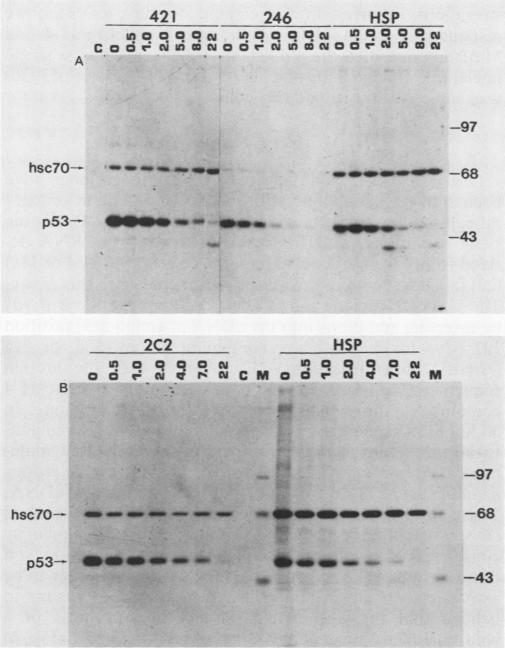
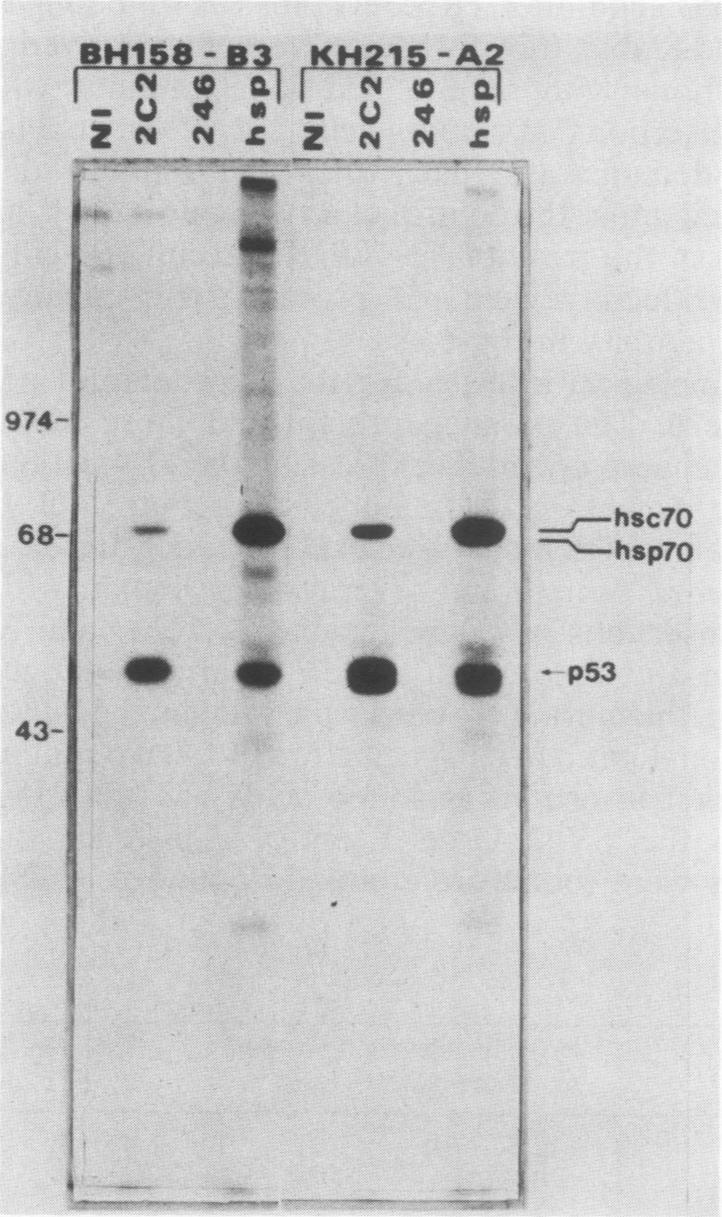
The 11-4 p53 cDNA clone failed to transform primary rat fibroblasts when cotransfected with the ras oncogene. Two linker insertion mutations at amino acid 158 or 215 (of 390 amino acids) activated this p53 cDNA for transformation with ras. These mutant cDNAs produced a p53 protein that lacked an epitope, recognized by monoclonal antibody PAb246 (localized at amino acids 88 to 110 in the protein) and preferentially bound to a heat shock protein, hsc70. In rat cells transformed by a genomic p53 clone plus ras, two populations of p53 proteins were detected, PAb246+ and PAb246-, which did or did not bind to this monoclonal antibody, respectively. The PAb246- p53 preferentially associated with hsc70, and this protein had a half-life 4- to 20-fold longer than free p53 (PAb246+). These data suggest a possible functional role for hsc70 in the transformation process. cDNAs for p53 derived from methylcholanthrene-transformed cells transform rat cells in cooperation with the ras oncogene and produce a protein that bound with the heat shock proteins. Recombinant clones produced between a Meth A cDNA and 11-4 were tested for the ability to transform rat cells. A single amino acid substitution at residue 132 was sufficient to activate the 11-4 p53 cDNA for transformation. These studies have identified a region between amino acids 132 and 215 in the p53 protein which, when mutated, can activate the p53 cDNA. These results also call into question what the correct p53 wild-type sequence is and whether a wild-type p53 gene can transform cells in culture.
11 - 4 p53 cDNA克隆与ras癌基因共转染时无法转化原代大鼠成纤维细胞。在390个氨基酸中的第158或215位氨基酸处的两个接头插入突变激活了该p53 cDNA以与ras共同进行转化。这些突变cDNA产生了一种p53蛋白,该蛋白缺乏单克隆抗体PAb246所识别的表位(该表位位于蛋白质的第88至110位氨基酸处),并且优先与热休克蛋白hsc70结合。在由基因组p53克隆加ras转化的大鼠细胞中,检测到两种p53蛋白群体,分别为PAb246 +和PAb246 -,它们分别与或不与该单克隆抗体结合。PAb246 - p53优先与hsc70相关联,并且该蛋白的半衰期比游离p53(PAb246 +)长4至20倍。这些数据表明hsc70在转化过程中可能具有功能作用。源自甲基胆蒽转化细胞的p53 cDNA与ras癌基因协同作用可转化大鼠细胞,并产生与热休克蛋白结合的蛋白质。测试了在Meth A cDNA和11 - 4之间产生的重组克隆转化大鼠细胞的能力。第132位残基处的单个氨基酸取代足以激活11 - 4 p53 cDNA进行转化。这些研究确定了p53蛋白中第132至215位氨基酸之间的一个区域,该区域发生突变时可激活p53 cDNA。这些结果还对正确的p53野生型序列是什么以及野生型p53基因是否能在培养中转化细胞提出了疑问。