Traut W, Fanning E
Institute for Biochemistry, Munich, Federal Republic of Germany.
Mol Cell Biol. 1988 Feb;8(2):903-11. doi: 10.1128/mcb.8.2.903-911.1988.
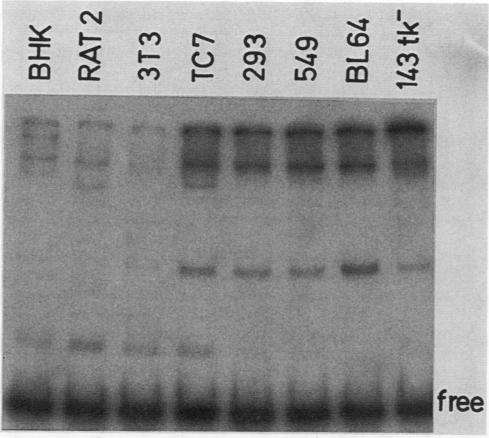
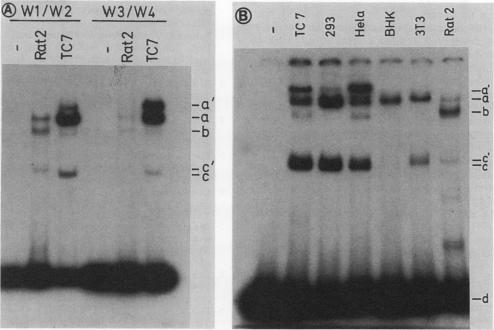
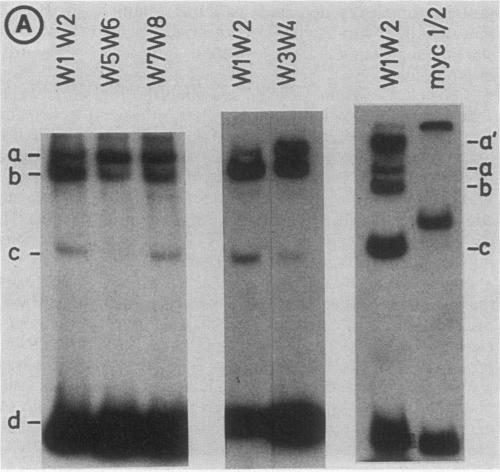
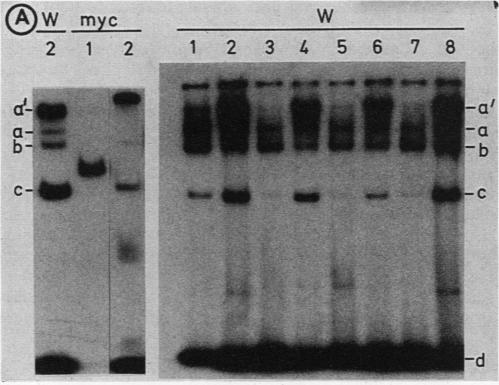
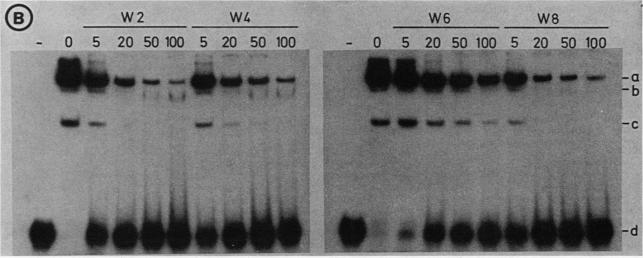
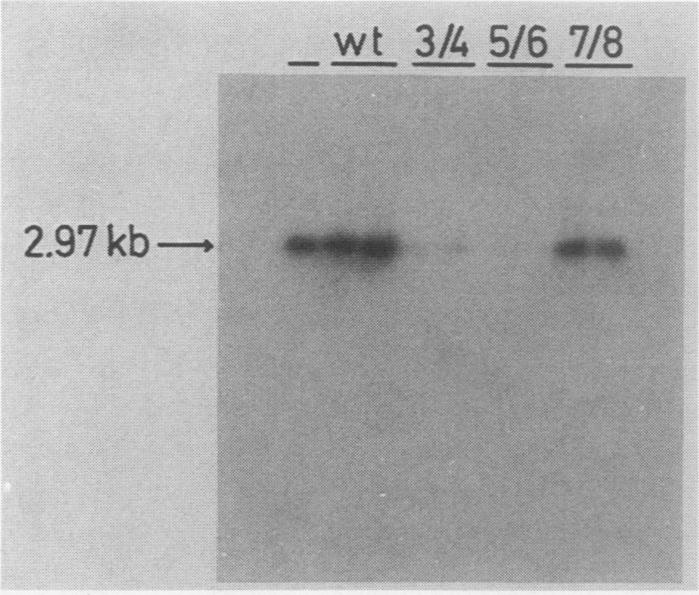
The core origin of simian virus 40 (SV40) DNA replication is composed of a 64-base-pair sequence encompassing T-antigen-binding site II and adjacent sequences on either side. A 7-base-pair sequence to the early side of T-antigen-binding site II which is conserved among the papovavirus genomes SV40, BK, JC, and SA12 was recently shown to be part of a 10-base-pair sequence required for origin activity (S. Deb, A.L. DeLucia, C.-P. Baur, A. Koff, and P. Tegtmeyer, Mol. Cell. Biol. 6:1663-1670, 1986), but its functional role was not defined. In the present report, we have used gel retention assays to identify a monkey cell factor that interacts specifically with double-stranded DNA carrying this sequence and also binds to single-stranded DNA. DNA-protein complexes formed with extracts from primate cells are more abundant and display electrophoretic mobilities distinct from those formed with rodent cell extracts. The binding activity of the factor on mutant templates is correlated with the replication activity of the origin. The results suggest that the monkey cell factor may be involved in SV40 DNA replication.
猿猴病毒40(SV40)DNA复制的核心起始区域由一段64个碱基对的序列组成,该序列包含T抗原结合位点II以及其两侧的相邻序列。T抗原结合位点II早期的一段7个碱基对的序列,在乳头瘤病毒基因组SV40、BK、JC和SA12中保守,最近被证明是起始活性所需的10个碱基对序列的一部分(S. Deb、A.L. DeLucia、C.-P. Baur、A. Koff和P. Tegtmeyer,《分子细胞生物学》6:1663 - 1670,1986),但其功能作用尚未明确。在本报告中,我们使用凝胶滞留分析来鉴定一种猴细胞因子,它能与携带该序列的双链DNA特异性相互作用,并且也能与单链DNA结合。与灵长类细胞提取物形成的DNA - 蛋白质复合物更为丰富,且显示出与啮齿动物细胞提取物形成的复合物不同的电泳迁移率。该因子在突变模板上的结合活性与起始区域的复制活性相关。结果表明,猴细胞因子可能参与SV40 DNA复制。