Departments of *Medicine (Cardiology); and †Cell Biology, Duke University Medical Center, Durham, NC.
J Cardiovasc Pharmacol. 2017 Sep;70(3):142-158. doi: 10.1097/FJC.0000000000000482.
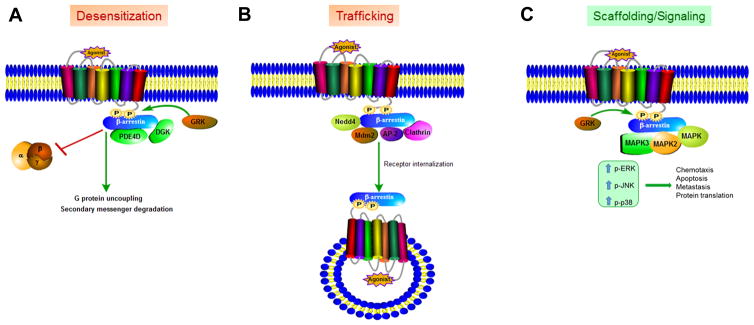
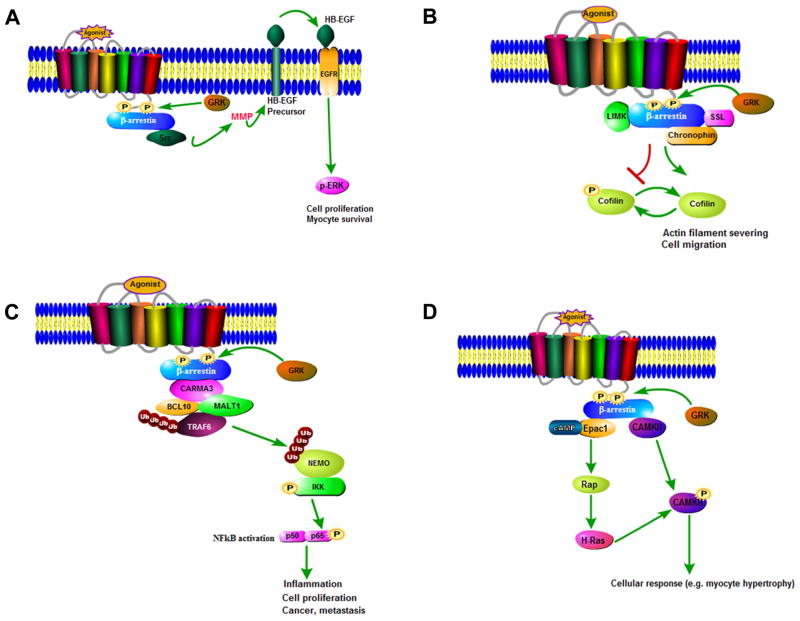
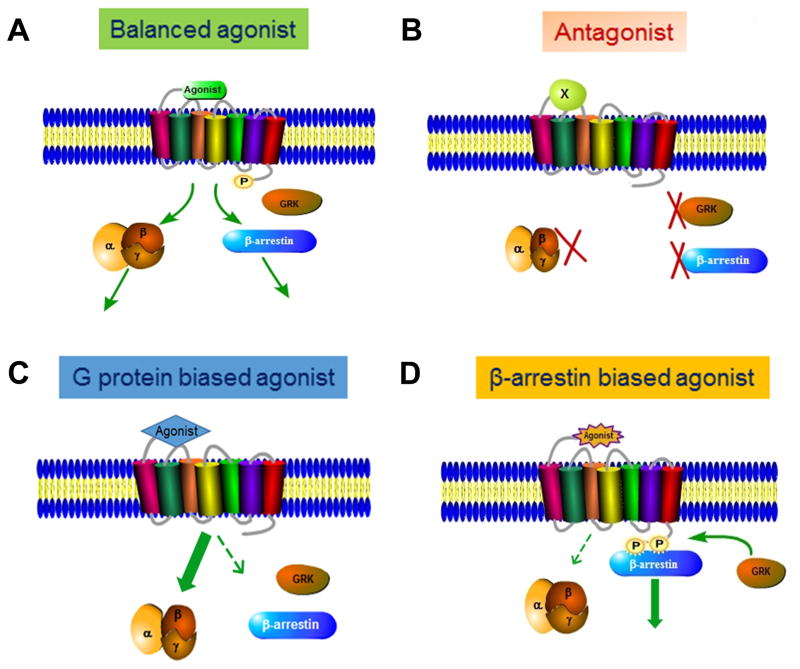
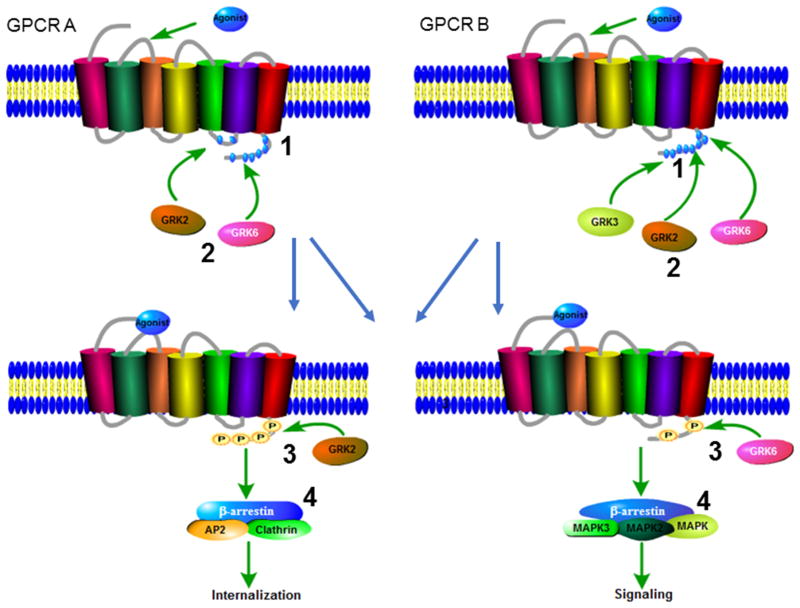
β-arrestin1 (or arrestin2) and β-arrestin2 (or arrestin3) are ubiquitously expressed cytosolic adaptor proteins that were originally discovered for their inhibitory role in G protein-coupled receptor (GPCR) signaling through heterotrimeric G proteins. However, further biochemical characterization revealed that β-arrestins do not just "block" the activated GPCRs, but trigger endocytosis and kinase activation leading to specific signaling pathways that can be localized on endosomes. The signaling pathways initiated by β-arrestins were also found to be independent of G protein activation by GPCRs. The discovery of ligands that blocked G protein activation but promoted β-arrestin binding, or vice-versa, suggested the exciting possibility of selectively activating intracellular signaling pathways. In addition, it is becoming increasingly evident that β-arrestin-dependent signaling is extremely diverse and provokes distinct cellular responses through different GPCRs even when the same effector kinase is involved. In this review, we summarize various signaling pathways mediated by β-arrestins and highlight the physiologic effects of β-arrestin-dependent signaling.
β-arrestin1(或 arrestin2)和β-arrestin2(或 arrestin3)是广泛表达的细胞质衔接蛋白,最初因其在 G 蛋白偶联受体(GPCR)信号通过异三聚体 G 蛋白中的抑制作用而被发现。然而,进一步的生化特征分析显示,β-arrestins 不仅仅“阻断”激活的 GPCR,还能触发内吞作用和激酶激活,从而导致可以定位于内体的特定信号通路。由β-arrestins 引发的信号通路也被发现与 GPCR 对 G 蛋白的激活无关。发现了既能阻断 G 蛋白激活又能促进β-arrestin 结合的配体,或者反之亦然,这表明选择性激活细胞内信号通路的可能性令人兴奋。此外,越来越明显的是,β-arrestin 依赖性信号通路极其多样化,即使涉及相同的效应激酶,也能通过不同的 GPCR 引发不同的细胞反应。在这篇综述中,我们总结了β-arrestin 介导的各种信号通路,并强调了β-arrestin 依赖性信号通路的生理效应。