Ran Lingyun, Jiang Xiaodong, Li Baogang, Kong Hongqian, Du Mengqi, Wang Xiaolan, Yu Hua, Liu Qin
Nursing School of Kunming Medical University, Kunming, Yunnan Province, China.
Chongqing Three Gorges Medical College, Chongqing, China.
BMC Geriatr. 2017 Mar 22;17(1):74. doi: 10.1186/s12877-017-0455-y.
The health-related quality of life (HRQoL) of the elderly population of Yi ethnic minority, which is the seventh largest nationality in China, has been rarely reported. This study was designed to explore the HRQoL of the elderly Yi ethnicity and association between their HRQOL and functional abilities.
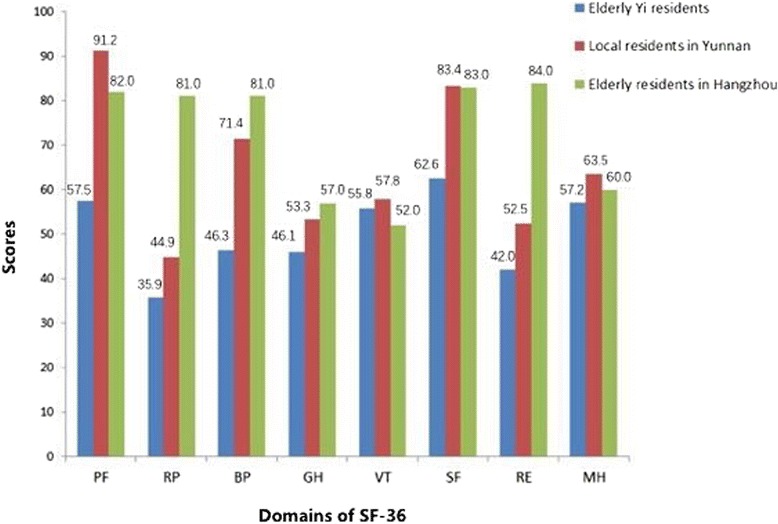
A total of 291 Yi ethnic residents were randomly recruited from 12 rural counties in Yunnan province and divided into different age groups. Local residents in Yunnan province and the elderly from Hangzhou were enrolled as controls. The MOS 36-Item Short Form Health Survey (SF-36), activities of daily living (ADL), instrumental activities of daily living (IADL) scales were utilized to evaluate the HRQoL and functional ability. One-way ANOVA was used to statistically compare the ADL and IADL among different age groups. The influential variables on HRQOL were analyzed by multiple linear regression analysis. Pearson correlation analysis was used to analyze the association among HRQoL, ADL and IADL.
The HRQoL of the elderly Yi minority was significantly lower than those of local residents in Yunnan province and the elderly counterparts in Hangzhou. The IADL ability of the elderly Yi minority was low, whereas they could perform most items of ADL. ADL, IADL, and education level were positively associated with HRQoL, whereas age, chronic diseases, and the frequency of medication use were negatively correlated with HRQoL.
The HRQoL and functional capacity of the elderly Yi ethnic minority were lower compared with their counterparts in Yunnan province and Hangzhou. The low level of IADL indicated that the elderly Yi participants had a high risk of cognitive impairment. Much attention should be diverted to influential factors of the HRQoL.
彝族是中国第七大民族,关于彝族老年人群健康相关生活质量(HRQoL)的报道较少。本研究旨在探讨彝族老年人的HRQoL及其HRQoL与功能能力之间的关联。
从云南省12个农村县随机招募了291名彝族居民,并将其分为不同年龄组。云南省当地居民和杭州的老年人作为对照。采用MOS 36项简短健康调查(SF - 36)、日常生活活动(ADL)量表和工具性日常生活活动(IADL)量表来评估HRQoL和功能能力。采用单因素方差分析对不同年龄组的ADL和IADL进行统计学比较。通过多元线性回归分析HRQoL的影响因素。采用Pearson相关分析来分析HRQoL、ADL和IADL之间的关联。
彝族老年人的HRQoL显著低于云南省当地居民和杭州的老年人群。彝族老年人的IADL能力较低,而他们能够完成大部分ADL项目。ADL、IADL和教育水平与HRQoL呈正相关,而年龄、慢性病和用药频率与HRQoL呈负相关。
与云南省和杭州的老年人群相比,彝族老年人的HRQoL和功能能力较低。IADL水平较低表明彝族老年参与者存在认知障碍的高风险。应更多关注HRQoL的影响因素。