Department of Veterinary Pathobiology, Texas A&M University College of Veterinary Medicine and Biomedical Sciences, 4647 TAMU, College Station, TX, 77843, USA.
Parasit Vectors. 2017 Mar 22;10(1):152. doi: 10.1186/s13071-017-2080-1.
Protease inhibitors (PIs) are important regulators of physiology and represent anti-parasitic druggable and vaccine targets. We conducted bioinformatic analyses of genome and transcriptome data to determine the protease inhibitor (PI) repertoire in Amblyomma americanum and in 25 other ixodid tick species. For A. americanum, we compared the PI repertoires in fed and unfed, male and female A. americanum ticks. We also analyzed PI repertoires of female 48, 96 and 120 h-fed midgut (MG) and salivary gland (SG) tissues.
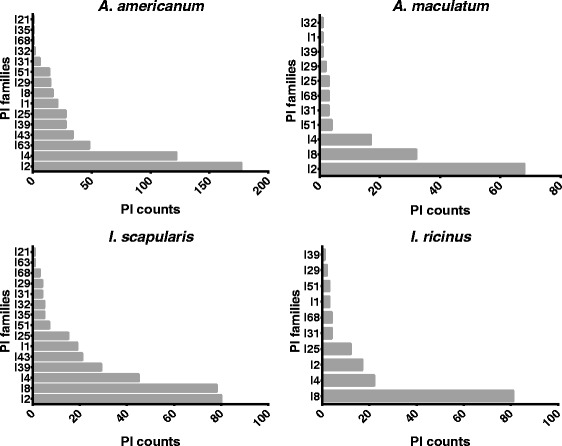
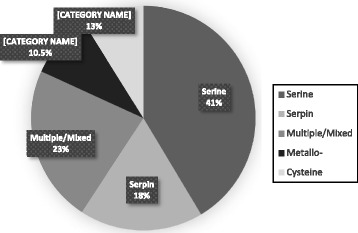
We found 1,595 putative non-redundant PI sequences across 26 ixodid tick species. Ticks express PIs from at least 18 different families: I1, I2, I4, I8, I21, I25, I29, I31, I32, I35, I39, I43, I51, I53, I63, I68, I72 and I74 (MEROPS). The largest PI families were I2, I4 and I8 and lowest in I21, I31, I32, I35 and I68. The majority (75%) of tick PIs putatively inhibit serine proteases, with ~11 and 9% putatively regulating cysteine or metalloprotease-mediated pathways, respectively, and ~4% putatively regulating multiple/mixed protease types. In A. americanum, we found 370 PIs in female and 354 in male ticks. In A. americanum we found 231 and 442 in unfed and fed ticks, respectively. In females, we found 206 and 164 PIs in SG and MG, respectively. The majority of highly cross-tick species conserved PIs were in families I1, I2, I8, I21, I25, I29, I39 and I43.
Ticks appear to express large and diverse repertoires of PIs that primarily target serine protease-mediated pathways. We speculate that PI families with the highest repertoires may contain functionally redundant members while those with the lowest repertoires are functionally non-redundant PIs. We found some highly conserved PIs in the latter category, which we propose as potential candidates for broad-spectrum anti-tick vaccine candidates or druggable targets in tick control.
蛋白酶抑制剂(PIs)是生理活动的重要调节剂,也是抗寄生虫药物靶点和疫苗的潜在目标。我们对基因组和转录组数据进行了生物信息学分析,以确定美洲钝缘蜱和 25 种其他硬蜱物种中的蛋白酶抑制剂(PI)谱。对于美洲钝缘蜱,我们比较了饱食和饥饿、雄性和雌性美洲钝缘蜱的 PI 谱。我们还分析了 48、96 和 120 小时饱食的雌性中肠(MG)和唾液腺(SG)组织中的 PI 谱。
我们在 26 种硬蜱物种中发现了 1595 个非冗余的假定 PI 序列。蜱虫表达的 PI 来自至少 18 个不同的家族:I1、I2、I4、I8、I21、I25、I29、I31、I32、I35、I39、I43、I51、I53、I63、I68、I72 和 I74(MEROPs)。最大的 PI 家族是 I2、I4 和 I8,而 I21、I31、I32、I35 和 I68 则最低。大多数(75%)蜱 PI 假定抑制丝氨酸蛋白酶,约 11%和 9%假定分别调节半胱氨酸或金属蛋白酶介导的途径,约 4%假定调节多种/混合蛋白酶类型。在美洲钝缘蜱中,我们在雌性中发现了 370 个 PI,在雄性中发现了 354 个 PI。在美洲钝缘蜱中,我们在未进食和进食的蜱中分别发现了 231 和 442 个 PI。在雌性中,我们在 SG 和 MG 中分别发现了 206 和 164 个 PI。高度跨种保守 PI 主要存在于 I1、I2、I8、I21、I25、I29、I39 和 I43 家族中。
蜱似乎表达了大量多样化的 PI 谱,主要针对丝氨酸蛋白酶介导的途径。我们推测,PI 家族中具有最高谱的成员可能包含功能冗余的成员,而谱最低的 PI 则是功能非冗余的 PI。我们在后者中发现了一些高度保守的 PI,我们将其提议为广谱抗蜱候选疫苗或蜱控制中的潜在药物靶点。