Garcia Gustavo Rocha, Gardinassi Luiz Gustavo, Ribeiro José Marcos, Anatriello Elen, Ferreira Beatriz Rossetti, Moreira Higo Nasser Santanna, Mafra Cláudio, Martins Maria Marlene, Szabó Matias Pablo Juan, de Miranda-Santos Isabel Kinney Ferreira, Maruyama Sandra Regina
Department of Biochemistry and Immunology, Ribeirão Preto School of Medicine, University of São Paulo, Ribeirão Preto, SP, Brazil.
Parasit Vectors. 2014 Sep 8;7:430. doi: 10.1186/1756-3305-7-430.
Tick salivary constituents antagonize inflammatory, immune and hemostatic host responses, favoring tick blood feeding and the establishment of tick-borne pathogens in hosts during hematophagy. Amblyomma triste, A. cajennense and A. parvum ticks are very important in veterinary and human health because they are vectors of the etiological agents for several diseases. Insights into the tick salivary components involved in blood feeding are essential to understanding vector-pathogen-host interactions, and transcriptional profiling of salivary glands is a powerful tool to do so. Here, we functionally annotated the sialotranscriptomes of these three Amblyomma species, which allowed comparisons between these and other hematophagous arthropod species.
mRNA from the salivary glands of A. triste, A. cajennense and A. parvum ticks fed on different host species were pyrosequenced on a 454-Roche platform to generate four A. triste (nymphs fed on guinea pigs and females fed on dogs) libraries, one A. cajennense (females fed on rabbits) library and one was A. parvum (females fed on dogs) library. Bioinformatic analyses used in-house programs with a customized pipeline employing standard assembly and alignment algorithms, protein databases and protein servers.
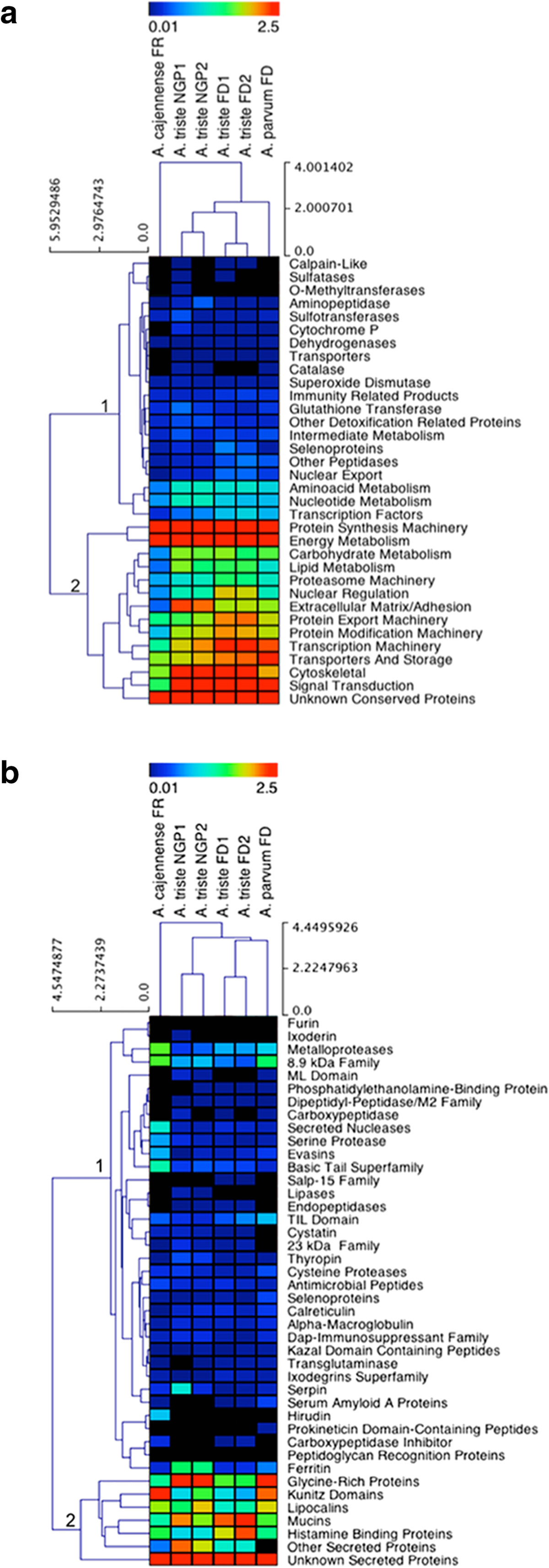
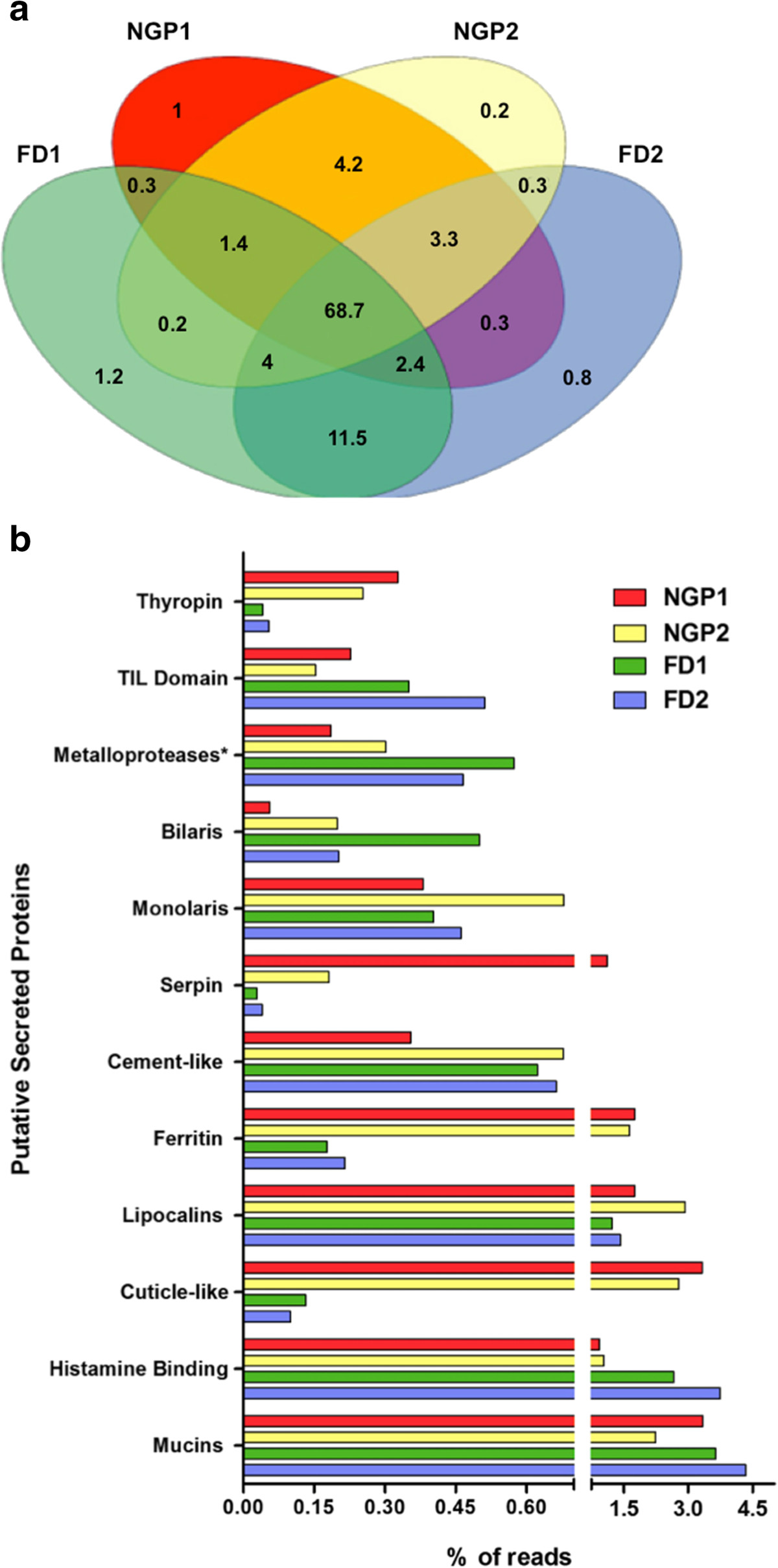
Each library yielded an average of 100,000 reads, which were assembled to obtain contigs of coding sequences (CDSs). The sialotranscriptome analyses of A. triste, A. cajennense and A. parvum ticks produced 11,240, 4,604 and 3,796 CDSs, respectively. These CDSs were classified into over 100 distinct protein families with a wide range of putative functions involved in physiological and blood feeding processes and were catalogued in annotated, hyperlinked spreadsheets. We highlighted the putative transcripts encoding saliva components with critical roles during parasitism, such as anticoagulants, immunosuppressants and anti-inflammatory molecules. The salivary content underwent changes in the abundance and repertoire of many transcripts, which depended on the tick and host species.
The annotated sialotranscriptomes described herein richly expand the biological knowledge of these three Amblyomma species. These comprehensive databases will be useful for the characterization of salivary proteins and can be applied to control ticks and tick-borne diseases.
蜱唾液成分可拮抗宿主的炎症、免疫和止血反应,有利于蜱吸血以及在吸血过程中在宿主体内建立蜱传病原体。黑角花蜱、卡延花蜱和微小花蜱对兽医和人类健康非常重要,因为它们是多种疾病病原体的传播媒介。深入了解参与吸血的蜱唾液成分对于理解媒介-病原体-宿主相互作用至关重要,而唾液腺的转录谱分析是实现这一目标的有力工具。在此,我们对这三种花蜱的唾液转录组进行了功能注释,以便与其他吸血节肢动物物种进行比较。
以罗氏454平台对取食不同宿主物种的黑角花蜱、卡延花蜱和微小花蜱唾液腺中的mRNA进行焦磷酸测序,生成4个黑角花蜱文库(取食豚鼠的若虫和取食犬的雌蜱)、1个卡延花蜱文库(取食兔的雌蜱)和1个微小花蜱文库(取食犬的雌蜱)。生物信息学分析使用内部程序,采用定制流程,运用标准组装和比对算法、蛋白质数据库及蛋白质服务器。
每个文库平均产生100,000条 reads,经组装获得编码序列(CDS)的重叠群。黑角花蜱、卡延花蜱和微小花蜱的唾液转录组分析分别产生了11,240、4,604和3,796个CDS。这些CDS被分类到100多个不同的蛋白质家族中,具有广泛的推定功能,涉及生理和吸血过程,并编目在带注释的超链接电子表格中。我们重点关注了编码在寄生过程中起关键作用的唾液成分的推定转录本,如抗凝剂、免疫抑制剂和抗炎分子。唾液成分在许多转录本的丰度和种类上发生了变化,这取决于蜱和宿主物种。
本文所述的注释唾液转录组极大地扩展了这三种花蜱的生物学知识。这些全面的数据库将有助于唾液蛋白的表征,并可应用于蜱及蜱传疾病的防控。