Zhang Duo, Li Yan, Liu Shengnan, Wang Yu-Cheng, Guo Feifan, Zhai Qiwei, Jiang Jingjing, Ying Hao
Key Laboratory of Food Safety Research, Institute for Nutritional Sciences, Shanghai Institutes for Biological Sciences, Chinese Academy of Sciences, University of Chinese Academy of Sciences, 320 Yueyang Road, Shanghai, 200031 China.
Shanghai Clinical Center, Chinese Academy of Sciences, Shanghai Xuhui Central Hospital, 966 Middle Huaihai Road, Shanghai, 200031 China.
Cell Biosci. 2017 Mar 21;7:14. doi: 10.1186/s13578-017-0141-y. eCollection 2017.
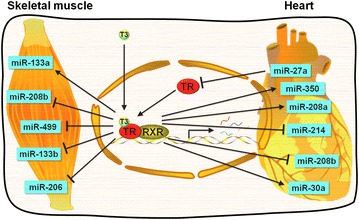
Thyroid hormone (TH) signaling plays critical roles in the differentiation, growth, metabolism, and physiological function of all organs or tissues, including heart and skeletal muscle. Due to the significant progress in our understanding of the molecular mechanisms that underlie TH action, it's widely accepted that TH signaling is regulated at multiple levels. A growing number of discoveries suggest that microRNAs (miRNAs) act as fine-tune regulators of gene expression and adds sophisticated regulatory tiers to signaling pathways. Recently, some pioneering studies in cardiac and skeletal muscle demonstrating the interplay between miRNAs and TH signaling suggest that miRNAs might mediate and/or modulate TH signaling. This review presents recent advances involving the crosstalk between miRNAs and TH signaling and current evidence showing the importance of miRNA in TH signaling with particular emphasis on the study of muscle-specific miRNAs (myomiRs) in cardiac and skeletal muscle. Although the research of the reciprocal regulation of miRNAs and TH signaling is only at the beginning stage, it has already contributed to our current understanding of both TH action and miRNA biology. We also encourage further investigations to address the relative contributions of miRNAs in TH signaling under physiological and pathological conditions and how a group of miRNAs are coordinated to integrate into the complex hierarchical regulatory network of TH.
甲状腺激素(TH)信号传导在包括心脏和骨骼肌在内的所有器官或组织的分化、生长、代谢及生理功能中发挥着关键作用。由于我们对TH作用的分子机制的理解取得了重大进展,TH信号传导在多个水平受到调控这一观点已被广泛接受。越来越多的发现表明,微小RNA(miRNA)作为基因表达的微调调节因子,为信号通路增添了复杂的调控层级。最近,在心脏和骨骼肌中进行的一些开创性研究表明了miRNA与TH信号传导之间的相互作用,提示miRNA可能介导和/或调节TH信号传导。本综述介绍了miRNA与TH信号传导之间相互作用的最新进展,以及目前表明miRNA在TH信号传导中重要性的证据,特别强调了心脏和骨骼肌中肌肉特异性miRNA(肌miR)的研究。尽管miRNA与TH信号传导的相互调节研究尚处于起步阶段,但它已经有助于我们目前对TH作用和miRNA生物学的理解。我们还鼓励进一步研究,以阐明miRNA在生理和病理条件下对TH信号传导的相对贡献,以及一组miRNA如何协同作用以融入TH复杂的层级调控网络。