Larman Bridget C, Dethoff Elizabeth A, Weeks Kevin M
Department of Chemistry, University of North Carolina , Chapel Hill, North Carolina 27599-3290, United States.
Biochemistry. 2017 Apr 25;56(16):2175-2183. doi: 10.1021/acs.biochem.6b01166. Epub 2017 Apr 16.
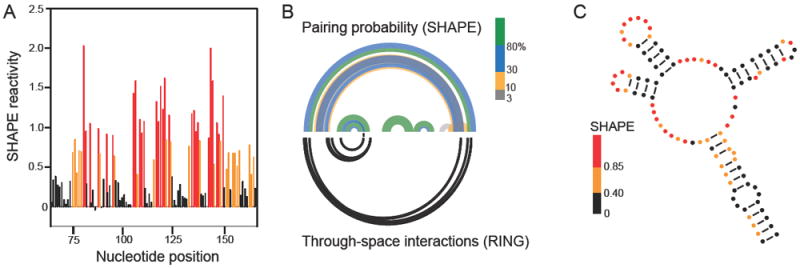
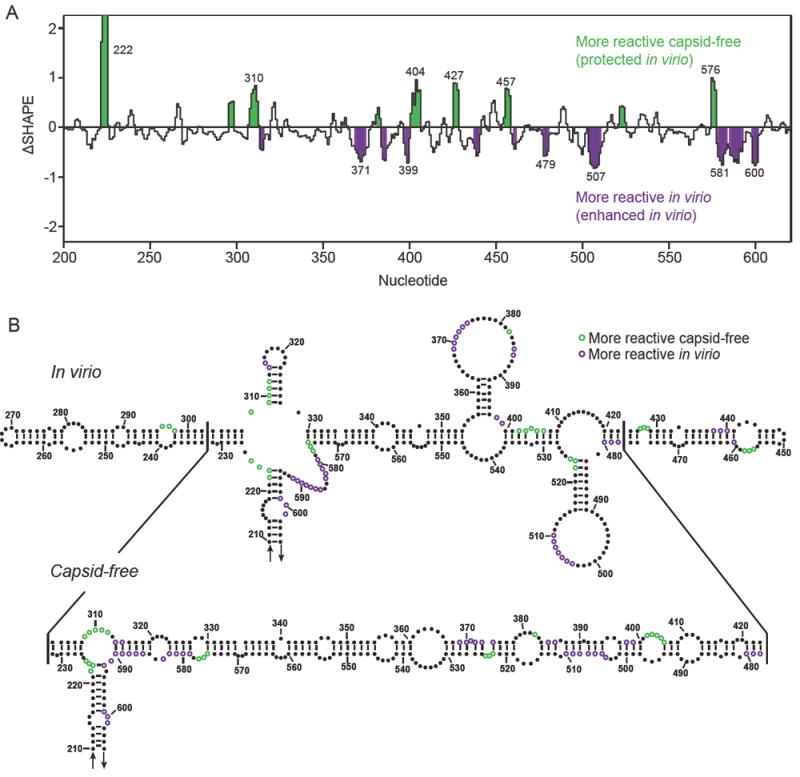
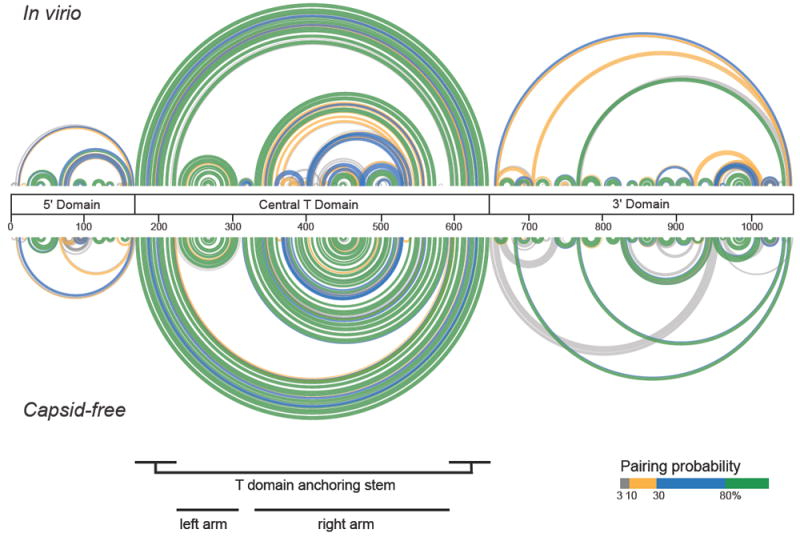
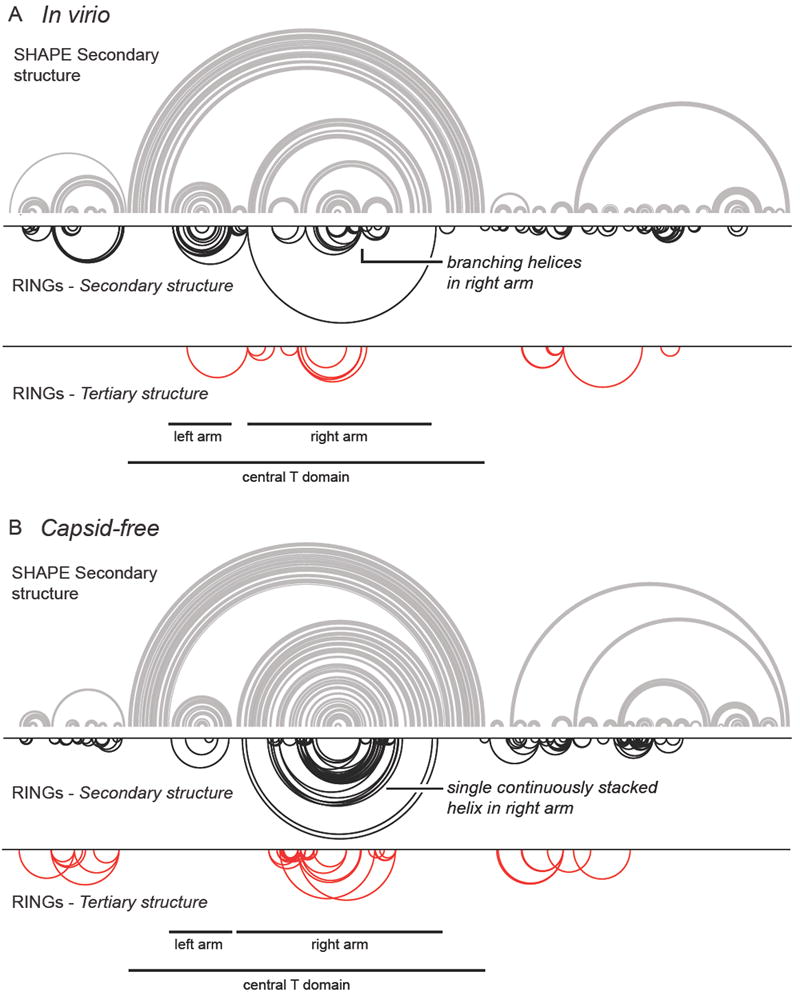
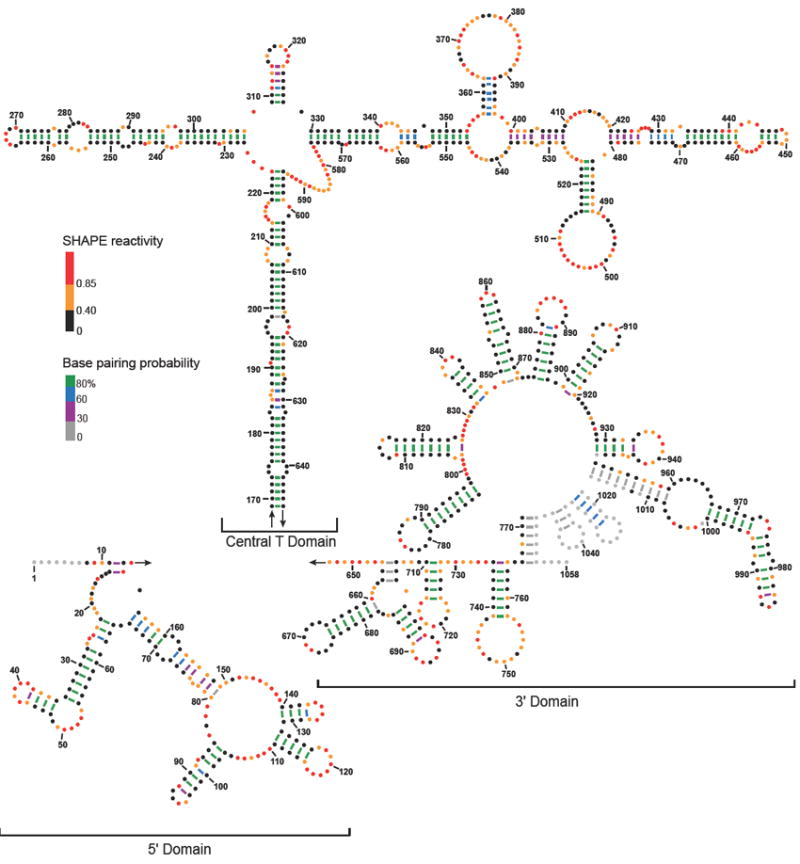
The RNA genomes of viruses likely undergo multiple functionally important conformational changes during their replication cycles, changes that are poorly understood at present. We used two complementary in-solution RNA structure probing strategies (SHAPE-MaP and RING-MaP) to examine the structure of the RNA genome of satellite tobacco mosaic virus inside authentic virions and in a capsid-free state. Both RNA states feature similar three-domain architectures in which each major replicative function-translation, capsid coding, and genome synthesis-fall into distinct domains. There are, however, large conformational differences between the in-virion and capsid-free states, primarily in one arm of the central T domain. These data support a model in which the packaged capsid-bound RNA is constrained in a local high-energy conformation by the native capsid shell. The removal of the viral capsid then allows the RNA genome to relax into a more thermodynamically stable conformation. The RNA architecture of the central T domain thus likely changes during capsid assembly and disassembly and may play a role in genome packaging.
病毒的RNA基因组在其复制周期中可能会经历多种功能上重要的构象变化,目前对这些变化了解甚少。我们使用了两种互补的溶液内RNA结构探测策略(SHAPE-MaP和RING-MaP),来研究烟草花叶病毒卫星病毒RNA基因组在完整病毒粒子内部以及无衣壳状态下的结构。两种RNA状态都具有相似的三结构域架构,其中每个主要的复制功能——翻译、衣壳编码和基因组合成——都落入不同的结构域。然而,病毒粒子内状态和无衣壳状态之间存在很大的构象差异,主要集中在中央T结构域的一个臂上。这些数据支持了一个模型,即包装好的与衣壳结合的RNA被天然衣壳壳层限制在局部高能构象中。去除病毒衣壳后,RNA基因组会松弛成更具热力学稳定性的构象。因此,中央T结构域的RNA架构可能在衣壳组装和拆卸过程中发生变化,并可能在基因组包装中发挥作用。