Department of Chemistry, University of North Carolina, Chapel Hill, North Carolina 27599-3290, USA.
RNA. 2014 Jun;20(6):846-54. doi: 10.1261/rna.043323.113. Epub 2014 Apr 17.
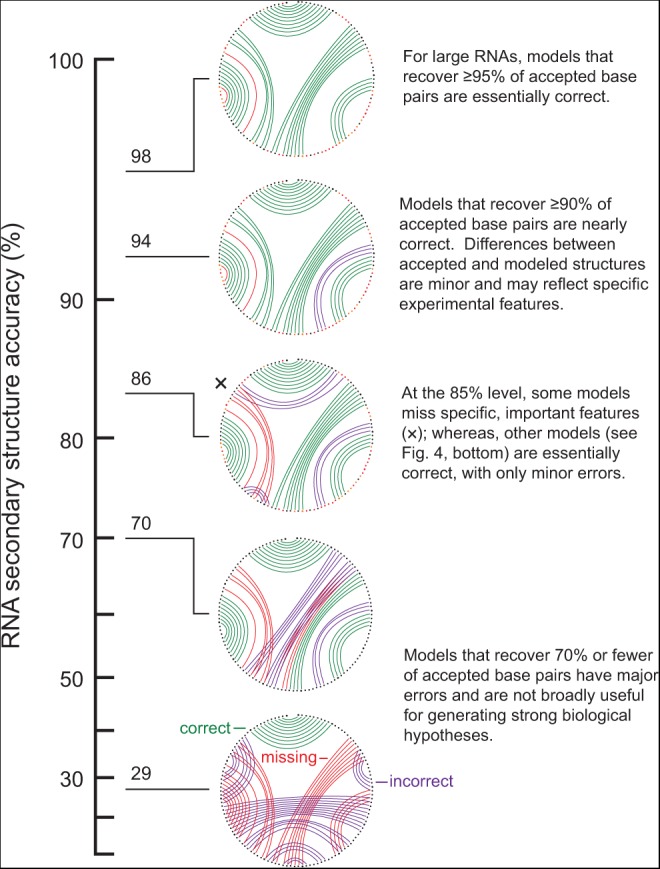
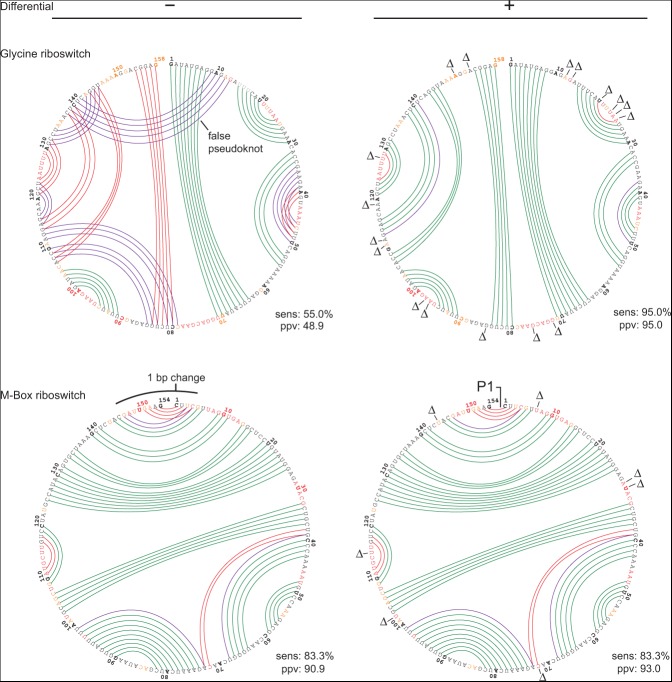
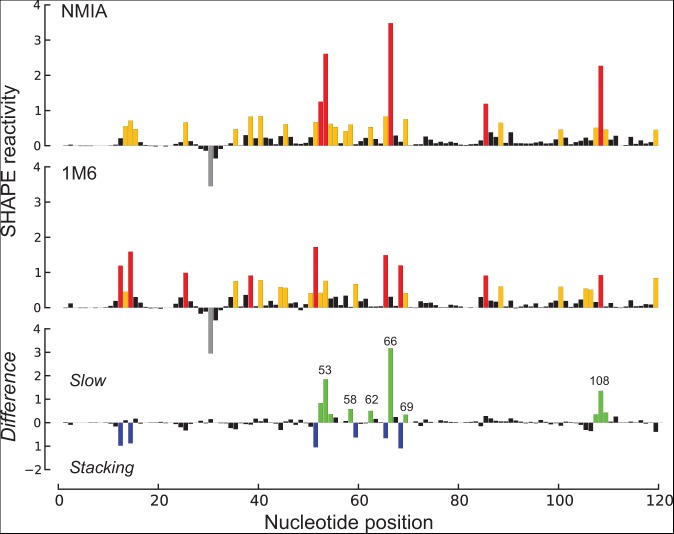
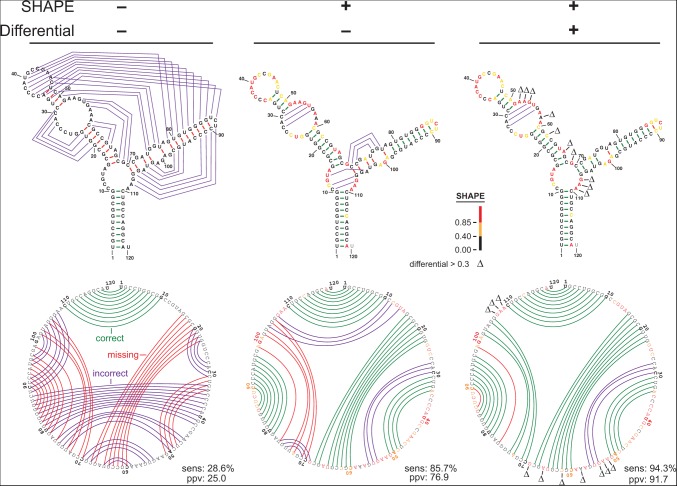
RNA secondary structure modeling is a challenging problem, and recent successes have raised the standards for accuracy, consistency, and tractability. Large increases in accuracy have been achieved by including data on reactivity toward chemical probes: Incorporation of 1M7 SHAPE reactivity data into an mfold-class algorithm results in median accuracies for base pair prediction that exceed 90%. However, a few RNA structures are modeled with significantly lower accuracy. Here, we show that incorporating differential reactivities from the NMIA and 1M6 reagents--which detect noncanonical and tertiary interactions--into prediction algorithms results in highly accurate secondary structure models for RNAs that were previously shown to be difficult to model. For these RNAs, 93% of accepted canonical base pairs were recovered in SHAPE-directed models. Discrepancies between accepted and modeled structures were small and appear to reflect genuine structural differences. Three-reagent SHAPE-directed modeling scales concisely to structurally complex RNAs to resolve the in-solution secondary structure analysis problem for many classes of RNA.
RNA 二级结构建模是一个具有挑战性的问题,最近的成功提高了准确性、一致性和可处理性的标准。通过纳入对化学探针反应性的数据,准确性得到了大幅提高:将 1M7 SHAPE 反应性数据纳入 mfold 类算法中,碱基对预测的中位数准确性超过 90%。然而,一些 RNA 结构的建模准确性较低。在这里,我们表明,将 NMIA 和 1M6 试剂的差异反应性(检测非规范和三级相互作用)纳入预测算法中,可得到先前难以建模的 RNA 的高度准确的二级结构模型。对于这些 RNA,在 SHAPE 指导的模型中,接受的规范碱基对的 93%被恢复。接受的和建模的结构之间的差异很小,似乎反映了真正的结构差异。三试剂 SHAPE 指导建模简洁地扩展到结构复杂的 RNA,以解决许多 RNA 类别的溶液中二级结构分析问题。