Qiu Anqi, Shen Mojun, Buss Claudia, Chong Yap-Seng, Kwek Kenneth, Saw Seang-Mei, Gluckman Peter D, Wadhwa Pathik D, Entringer Sonja, Styner Martin, Karnani Neerja, Heim Christine M, O'Donnell Kieran J, Holbrook Joanna D, Fortier Marielle V, Meaney Michael J
Department of Biomedical Engineering and Clinical Imaging Research Center, National University of Singapore, Singapore 117576, Singapore.
Singapore Institute for Clinical Sciences, Singapore 117609, Singapore.
Cereb Cortex. 2017 May 1;27(5):3080-3092. doi: 10.1093/cercor/bhx065.
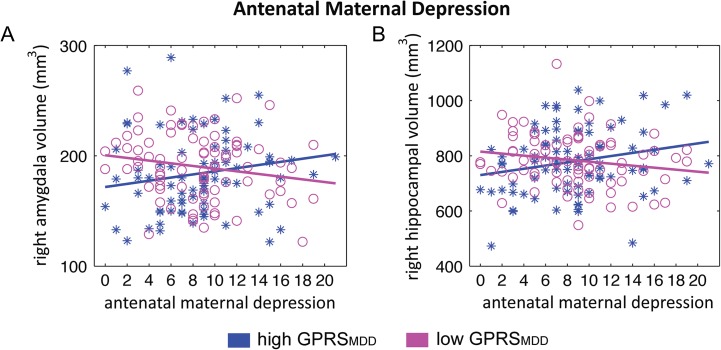
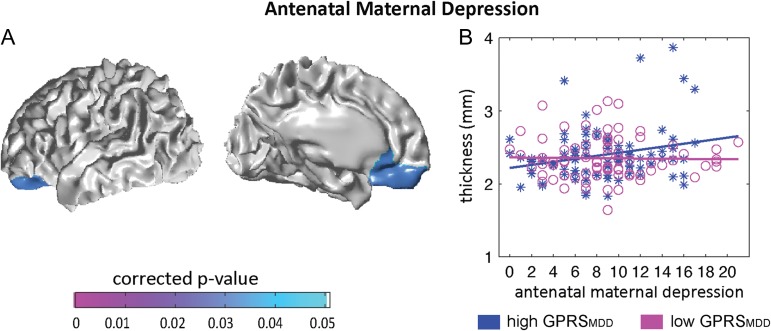
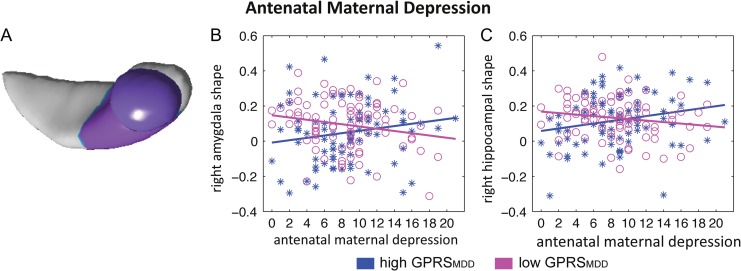
This study included 168 and 85 mother-infant dyads from Asian and United States of America cohorts to examine whether a genomic profile risk score for major depressive disorder (GPRSMDD) moderates the association between antenatal maternal depressive symptoms (or socio-economic status, SES) and fetal neurodevelopment, and to identify candidate biological processes underlying such association. Both cohorts showed a significant interaction between antenatal maternal depressive symptoms and infant GPRSMDD on the right amygdala volume. The Asian cohort also showed such interaction on the right hippocampal volume and shape, thickness of the orbitofrontal and ventromedial prefrontal cortex. Likewise, a significant interaction between SES and infant GPRSMDD was on the right amygdala and hippocampal volumes and shapes. After controlling for each other, the interaction effect of antenatal maternal depressive symptoms and GPRSMDD was mainly shown on the right amygdala, while the interaction effect of SES and GPRSMDD was mainly shown on the right hippocampus. Bioinformatic analyses suggested neurotransmitter/neurotrophic signaling, SNAp REceptor complex, and glutamate receptor activity as common biological processes underlying the influence of antenatal maternal depressive symptoms on fetal cortico-limbic development. These findings suggest gene-environment interdependence in the fetal development of brain regions implicated in cognitive-emotional function. Candidate biological mechanisms involve a range of brain region-specific signaling pathways that converge on common processes of synaptic development.
本研究纳入了来自亚洲和美国队列的168对及85对母婴,以检验重度抑郁症的基因组概况风险评分(GPRSMDD)是否会调节产前母亲抑郁症状(或社会经济地位,SES)与胎儿神经发育之间的关联,并确定这种关联背后的候选生物学过程。两个队列均显示,产前母亲抑郁症状与婴儿GPRSMDD在右侧杏仁核体积上存在显著交互作用。亚洲队列在右侧海马体积和形状、眶额叶和腹内侧前额叶皮质厚度上也显示出这种交互作用。同样,SES与婴儿GPRSMDD在右侧杏仁核和海马体积及形状上存在显著交互作用。在相互控制之后,产前母亲抑郁症状与GPRSMDD的交互作用主要表现在右侧杏仁核,而SES与GPRSMDD的交互作用主要表现在右侧海马。生物信息学分析表明,神经递质/神经营养信号传导、突触小体相关蛋白受体复合体和谷氨酸受体活性是产前母亲抑郁症状影响胎儿皮质-边缘系统发育的共同生物学过程。这些发现表明,在涉及认知-情感功能的脑区胎儿发育过程中存在基因-环境相互依存关系。候选生物学机制涉及一系列脑区特异性信号通路,这些通路汇聚于突触发育的共同过程。