Ming Qingsen, Zhang Yun, Yi Jinyao, Wang Xiang, Zhu Xiongzhao, Yao Shuqiao
Medical Psychological Institute, The Second Xiangya Hospital, Central South University, NO.139 Middle Renmin Road, Changsha, Hunan, 410011, China.
National Technology Institute of Psychiatry, Key Laboratory of Psychiatry and Mental Health of Hunan Province, Changsha, Hunan, 410011, China.
BMC Psychiatry. 2015 Oct 14;15:248. doi: 10.1186/s12888-015-0639-y.
Previous studies of the interaction between a functional polymorphism in the serotonin transporter gene-linked promoter region (5-HTTLPR) and stress in anxiety-related phenotypes have produced inconsistent results. The aim of the current study was to examine the effect of the 5-HTTLPR × stress interaction on anxiety symptoms in Chinese adolescents.
A total of 651 healthy adolescents [323 females and 328 males; age 14-17 (mean = 16.27, standard deviation = 0.77)] participated in this study. At the initial assessment, participants completed self-report measures assessing anxiety symptoms, depressive symptoms and stressful life events. Additionally, anxiety symptoms and stressful life events were assessed once every 3 months for the subsequent 9 months. A hierarchical linear model (HLM) was used to investigate the 5-HTTLPR × stress interaction.
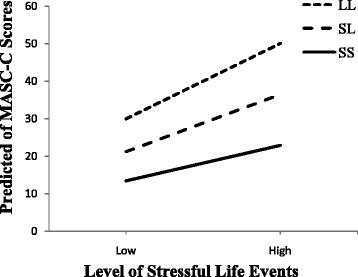
The HLM indicated no main effect of 5-HTTLPR on anxiety symptoms. Significant 5-HTTLPR × stress interaction effect in predicting anxiety symptoms was found. Specifically, individuals with the 5-HTTLPR L allele exhibited more anxiety symptoms related to stressful life events.
The association between stress and anxiety symptoms is moderated by 5-HTTLPR. The 5-HTTLPR L allele increases individuals' vulnerability to anxiety under stress situations.
先前关于血清素转运体基因连锁启动子区域(5-HTTLPR)功能性多态性与焦虑相关表型中的应激之间相互作用的研究结果并不一致。本研究的目的是检验5-HTTLPR×应激相互作用对中国青少年焦虑症状的影响。
共有651名健康青少年[323名女性和328名男性;年龄14 - 17岁(平均 = 16.27,标准差 = 0.77)]参与了本研究。在初始评估时,参与者完成了评估焦虑症状、抑郁症状和应激生活事件的自我报告测量。此外,在随后的9个月中,每3个月评估一次焦虑症状和应激生活事件。采用分层线性模型(HLM)来研究5-HTTLPR×应激相互作用。
HLM表明5-HTTLPR对焦虑症状没有主效应。发现5-HTTLPR×应激在预测焦虑症状方面有显著的相互作用效应。具体而言,携带5-HTTLPR L等位基因的个体表现出更多与应激生活事件相关的焦虑症状。
应激与焦虑症状之间的关联受5-HTTLPR调节。5-HTTLPR L等位基因增加了个体在应激情况下患焦虑症的易感性。