Zollo Massimo, Ahmed Mustafa, Ferrucci Veronica, Salpietro Vincenzo, Asadzadeh Fatemeh, Carotenuto Marianeve, Maroofian Reza, Al-Amri Ahmed, Singh Royana, Scognamiglio Iolanda, Mojarrad Majid, Musella Luca, Duilio Angela, Di Somma Angela, Karaca Ender, Rajab Anna, Al-Khayat Aisha, Mohan Mohapatra Tribhuvan, Eslahi Atieh, Ashrafzadeh Farah, Rawlins Lettie E, Prasad Rajniti, Gupta Rashmi, Kumari Preeti, Srivastava Mona, Cozzolino Flora, Kumar Rai Sunil, Monti Maria, Harlalka Gaurav V, Simpson Michael A, Rich Philip, Al-Salmi Fatema, Patton Michael A, Chioza Barry A, Efthymiou Stephanie, Granata Francesca, Di Rosa Gabriella, Wiethoff Sarah, Borgione Eugenia, Scuderi Carmela, Mankad Kshitij, Hanna Michael G, Pucci Piero, Houlden Henry, Lupski James R, Crosby Andrew H, Baple Emma L
Dipartimento di Medicina Molecolare e Biotecnologie Mediche DMMBM, Università di Napoli Federico II, Via Sergio Pansini 5, Naples, 80131, Italy.
CEINGE Biotecnologie Avanzate, Via Gaetano Salvatore 486, Naples, Italy.
Brain. 2017 Apr 1;140(4):940-952. doi: 10.1093/brain/awx014.
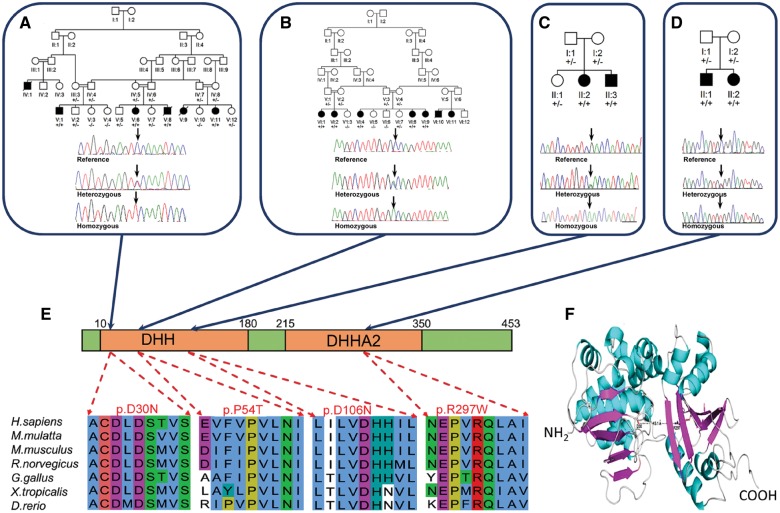
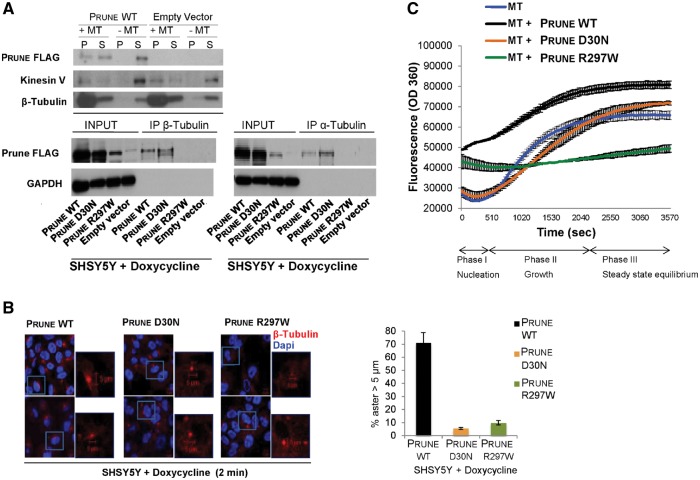
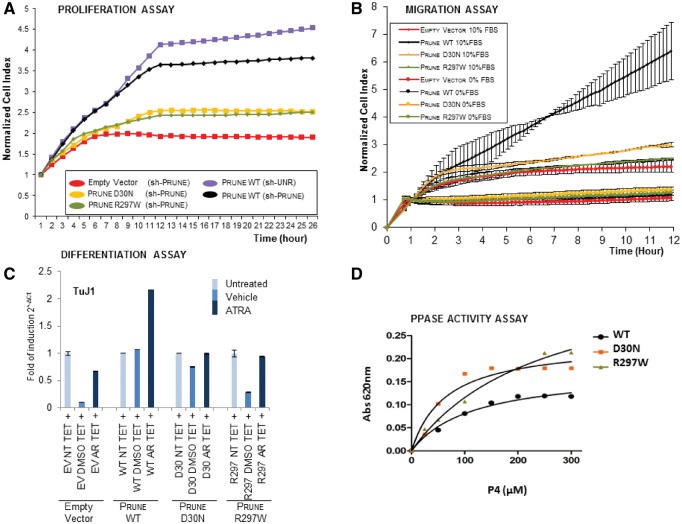
PRUNE is a member of the DHH (Asp-His-His) phosphoesterase protein superfamily of molecules important for cell motility, and implicated in cancer progression. Here we investigated multiple families from Oman, India, Iran and Italy with individuals affected by a new autosomal recessive neurodevelopmental and degenerative disorder in which the cardinal features include primary microcephaly and profound global developmental delay. Our genetic studies identified biallelic mutations of PRUNE1 as responsible. Our functional assays of disease-associated variant alleles revealed impaired microtubule polymerization, as well as cell migration and proliferation properties, of mutant PRUNE. Additionally, our studies also highlight a potential new role for PRUNE during microtubule polymerization, which is essential for the cytoskeletal rearrangements that occur during cellular division and proliferation. Together these studies define PRUNE as a molecule fundamental for normal human cortical development and define cellular and clinical consequences associated with PRUNE mutation.
PRUNE是DHH(天冬氨酸-组氨酸-组氨酸)磷酸酯酶蛋白超家族的成员,该超家族对细胞运动很重要,并与癌症进展有关。在这里,我们研究了来自阿曼、印度、伊朗和意大利的多个家族,这些家族中有个体患有一种新的常染色体隐性神经发育和退行性疾病,其主要特征包括原发性小头畸形和严重的全面发育迟缓。我们的基因研究确定PRUNE1的双等位基因突变是病因。我们对与疾病相关的变异等位基因进行的功能分析显示,突变型PRUNE的微管聚合以及细胞迁移和增殖特性受损。此外,我们的研究还突出了PRUNE在微管聚合过程中的潜在新作用,微管聚合对于细胞分裂和增殖过程中发生的细胞骨架重排至关重要。这些研究共同将PRUNE定义为正常人类皮质发育的基础分子,并确定了与PRUNE突变相关的细胞和临床后果。