
癫痫患者言语和语言的三维及四维映射
Three- and four-dimensional mapping of speech and language in patients with epilepsy.
作者信息
Nakai Yasuo, Jeong Jeong-Won, Brown Erik C, Rothermel Robert, Kojima Katsuaki, Kambara Toshimune, Shah Aashit, Mittal Sandeep, Sood Sandeep, Asano Eishi
机构信息
Department of Pediatrics, Wayne State University, Children's Hospital of Michigan, Detroit Medical Center, Detroit, MI, 48201, USA.
Department of Neurological Surgery, Wakayama Medical University, Wakayama-shi, Wakayama, 6418510, Japan.
出版信息
Brain. 2017 May 1;140(5):1351-1370. doi: 10.1093/brain/awx051.
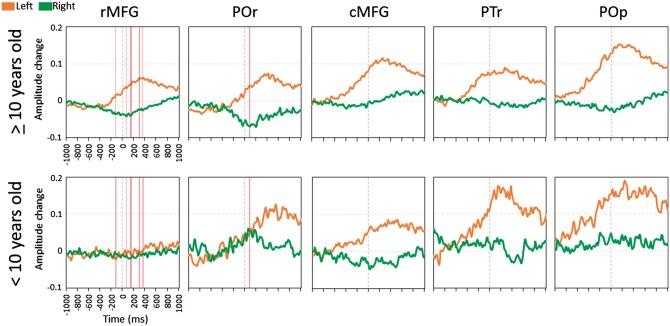
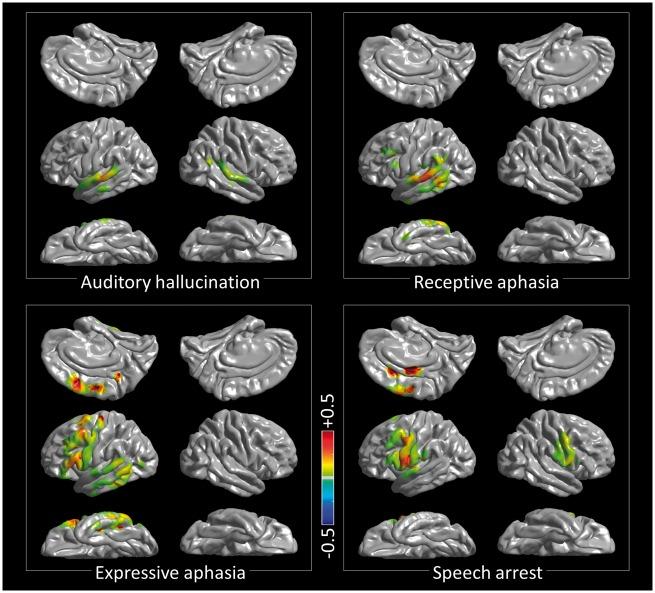
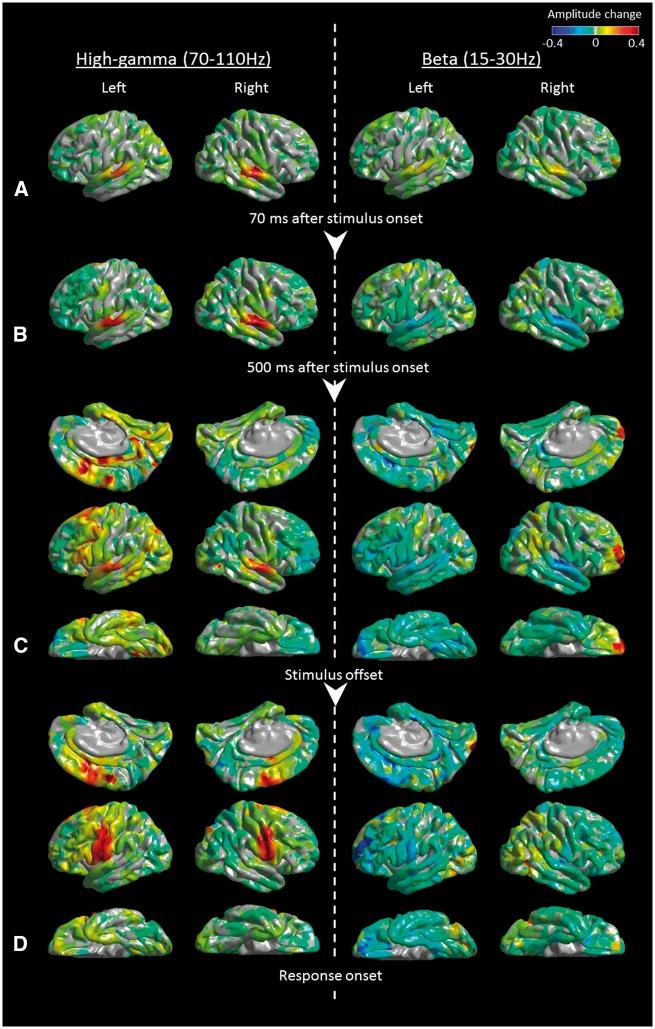
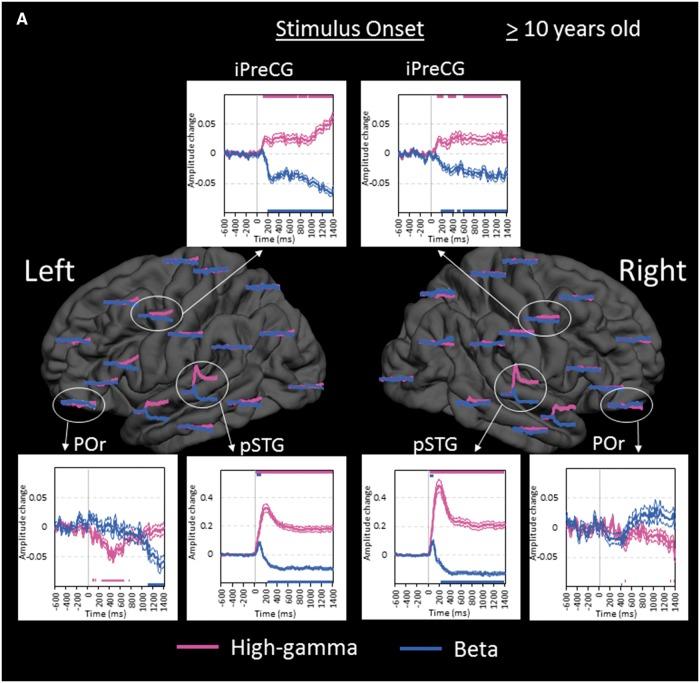
We have provided 3-D and 4D mapping of speech and language function based upon the results of direct cortical stimulation and event-related modulation of electrocorticography signals. Patients estimated to have right-hemispheric language dominance were excluded. Thus, 100 patients who underwent two-stage epilepsy surgery with chronic electrocorticography recording were studied. An older group consisted of 84 patients at least 10 years of age (7367 artefact-free non-epileptic electrodes), whereas a younger group included 16 children younger than age 10 (1438 electrodes). The probability of symptoms transiently induced by electrical stimulation was delineated on a 3D average surface image. The electrocorticography amplitude changes of high-gamma (70-110 Hz) and beta (15-30 Hz) activities during an auditory-naming task were animated on the average surface image in a 4D manner. Thereby, high-gamma augmentation and beta attenuation were treated as summary measures of cortical activation. Stimulation data indicated the causal relationship between (i) superior-temporal gyrus of either hemisphere and auditory hallucination; (ii) left superior-/middle-temporal gyri and receptive aphasia; (iii) widespread temporal/frontal lobe regions of the left hemisphere and expressive aphasia; and (iv) bilateral precentral/left posterior superior-frontal regions and speech arrest. On electrocorticography analysis, high-gamma augmentation involved the bilateral superior-temporal and precentral gyri immediately following question onset; at the same time, high-gamma activity was attenuated in the left orbitofrontal gyrus. High-gamma activity was augmented in the left temporal/frontal lobe regions, as well as left inferior-parietal and cingulate regions, maximally around question offset, with high-gamma augmentation in the left pars orbitalis inferior-frontal, middle-frontal, and inferior-parietal regions preceded by high-gamma attenuation in the contralateral homotopic regions. Immediately before verbal response, high-gamma augmentation involved the posterior superior-frontal and pre/postcentral regions, bilaterally. Beta-attenuation was spatially and temporally correlated with high-gamma augmentation in general but with exceptions. The younger and older groups shared similar spatial-temporal profiles of high-gamma and beta modulation; except, the younger group failed to show left-dominant activation in the rostral middle-frontal and pars orbitalis inferior-frontal regions around stimulus offset. The human brain may rapidly and alternately activate and deactivate cortical areas advantageous or obtrusive to function directed toward speech and language at a given moment. Increased left-dominant activation in the anterior frontal structures in the older age group may reflect developmental consolidation of the language system. The results of our functional mapping may be useful in predicting, across not only space but also time and patient age, sites specific to language function for presurgical evaluation of focal epilepsy.
基于直接皮层刺激结果和皮层脑电图信号的事件相关调制,我们提供了言语和语言功能的三维及四维图谱。排除估计具有右半球语言优势的患者。因此,对100例行两阶段癫痫手术并进行慢性皮层脑电图记录的患者进行了研究。年龄较大的一组包括84名至少10岁的患者(7367个无伪迹非癫痫电极),而年龄较小的一组包括16名10岁以下的儿童(1438个电极)。在三维平均表面图像上描绘了电刺激瞬时诱发症状的概率。在听觉命名任务期间,高伽马(70 - 110赫兹)和贝塔(15 - 30赫兹)活动的皮层脑电图振幅变化以四维方式在平均表面图像上进行动态显示。由此,高伽马增强和贝塔衰减被视为皮层激活的汇总指标。刺激数据表明了以下因果关系:(i)任一半球的颞上回与幻听;(ii)左侧颞上/中回与感觉性失语;(iii)左侧半球广泛的颞叶/额叶区域与表达性失语;以及(iv)双侧中央前回/左侧额上回后部区域与言语停顿。在皮层脑电图分析中,高伽马增强在问题开始后立即涉及双侧颞上回和中央前回;与此同时,左侧眶额回的高伽马活动减弱。在问题结束前后,左侧颞叶/额叶区域以及左侧顶下和扣带区域的高伽马活动增强,左侧眶额下回、额中回和顶下区域的高伽马增强之前,对侧同位区域的高伽马活动减弱。在言语反应前即刻,双侧额上回后部和中央前/后区域出现高伽马增强。一般而言,贝塔衰减在空间和时间上与高伽马增强相关,但也有例外。年龄较大和较小的两组在高伽马和贝塔调制的时空分布上相似;不同的是,年龄较小的组在刺激结束时,在额中回前部和眶额下回区域未显示出左侧优势激活。人脑可能会在给定时刻快速交替激活和停用对言语和语言功能有利或有干扰的皮层区域。年龄较大组在前额叶结构中左侧优势激活增加可能反映了语言系统的发育巩固。我们的功能图谱结果不仅在空间上,而且在时间和患者年龄方面,可能有助于预测局灶性癫痫术前评估中特定于语言功能的部位。


 Zotero 插件