Xia Zhaobo, Han Yijiang, Wang Ke, Guo Shikun, Wu Dazhou, Huang Xiaozhong, Li Zhongrong, Zhu Libin
Department of Pediatric Surgery, the Second Affiliated Hospital & Yuying Children's Hospital of Wenzhou Medical University, Xueyuan West Road, 109#, Wenzhou, Zhejiang, 325000, China.
Department of Pediatric Surgery, the First Affiliated Hospital of Wenzhou Medical University, Baixiang South, Wenzhou, Zhejiang, 325000, China.
Lipids Health Dis. 2017 Mar 23;16(1):62. doi: 10.1186/s12944-017-0452-3.
Propionic acid is a three-carbon short chain fatty acid (SCFA) that has various effects on colonic functions. Although several studies have shown the effects of propionic acid on intestinal mucosal barrier function, studies of the promotion effect during pre-weaning are rare in the literature as far as we know.
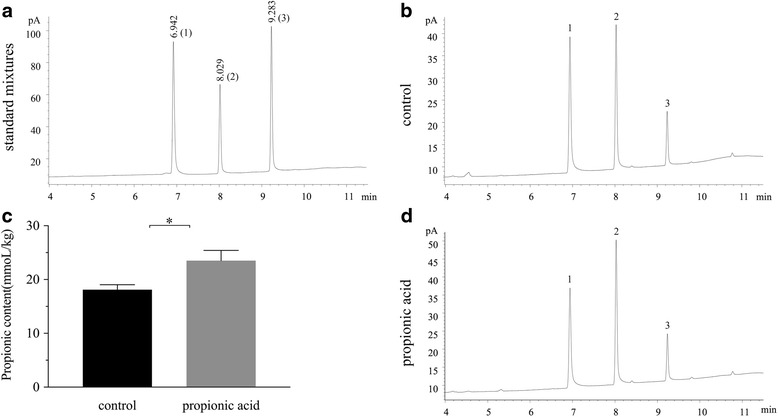
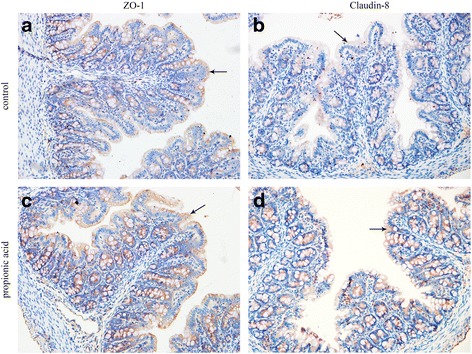
Pre-weaning male Sprague-Dawley rats 7 days after birth were given an oral 0.2 mL/10 g of 200 mM propionic acid solution in the propionic acid group or normal saline solution in the control group by gavage twice a day for ten days. The proximal colonic contents were used for extraction and determination of propionic acid by gas chromatographic analysis; the transepithelial electrical resistance (TER) of colonic tissue was detected by an Ussing chamber; the alterations of ZO-1, Claudin-1, Claudin-8 and Occludin proteins were analyzed by Western blot and immunohistochemistry; and The activity of ERK and p38 MAPK was determined by the phosphorylation status of ERK1/2 and p38 with Western blot.
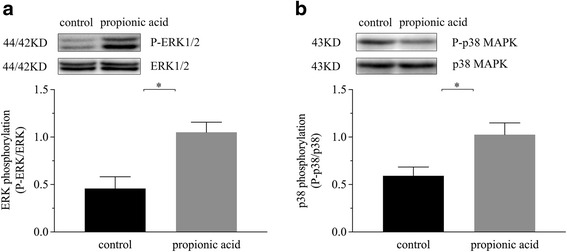
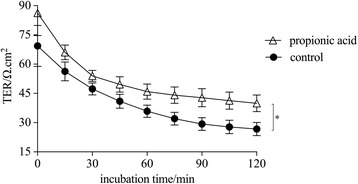
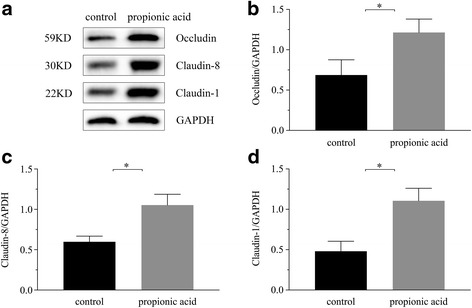
Our results suggested a higher concentration (23.5 ± 1.9 mmol/kg) of propionic acid compared to the physiological concentration (18.1 ± 0.9 mmol/kg) in colonic contents after oral administration increased the value of TER and the expression of ZO-1, Claudin-1, Claudin-8 and Occludin compared to the control group. Furthermore, the expression levels of phosphorylated ERK1/2 and p38 MAPK were increased in propionic acid group.
We concluded that continuous oral administration of propionic acid during lactation may increase its concentration in the proximal colon and promote epithelial barrier function of proximal colon by enhancing the expression of ZO-1, Claudin-8, Claudin-1 and Occludin via increases in the expression of ERK1/2 and p38 MAPK.
丙酸是一种三碳短链脂肪酸(SCFA),对结肠功能有多种影响。尽管多项研究已表明丙酸对肠道黏膜屏障功能的作用,但据我们所知,断奶前丙酸促进作用的研究在文献中较为少见。
出生7天的断奶前雄性Sprague-Dawley大鼠,丙酸组每天经口灌胃给予0.2 mL/10 g的200 mM丙酸溶液,对照组给予生理盐水溶液,每天两次,持续十天。取近端结肠内容物用于通过气相色谱分析提取和测定丙酸;用尤斯灌流小室检测结肠组织的跨上皮电阻(TER);通过蛋白质免疫印迹法和免疫组织化学分析ZO-1、Claudin-1、Claudin-8和闭合蛋白(Occludin)蛋白的变化;通过蛋白质免疫印迹法检测ERK1/2和p38的磷酸化状态来测定ERK和p38丝裂原活化蛋白激酶(MAPK)的活性。
我们的结果表明,与对照组相比,口服给药后结肠内容物中丙酸浓度(23.5±1.9 mmol/kg)高于生理浓度(18.1±0.9 mmol/kg),TER值以及ZO-1、Claudin-1、Claudin-8和Occludin的表达增加。此外,丙酸组中磷酸化ERK1/2和p38 MAPK的表达水平升高。
我们得出结论,哺乳期持续口服丙酸可能会增加其在近端结肠中的浓度,并通过增加ERK1/2和p38 MAPK的表达来增强ZO-1、Claudin-8、Claudin-1和Occludin的表达,从而促进近端结肠的上皮屏障功能。