Li Yanhua, Wang Jiuping, Wang Juan, Xiao Yunfeng, Xu Bin, Li Hongwei, Yang Liu, Hao Xiaoke, Ma Yueyun
Department of Clinical Laboratory Medicine, Xijing Hospital, The Fourth Military Medical University, 169 Changle West Road, Xi'an, Shaanxi, 710032, People's Republic of China.
Department of Infectious Disease, Xijing Hospital, Fourth Military Medical University, Xi'an, Shaanxi, 710032, People's Republic of China.
Virol J. 2017 Mar 23;14(1):62. doi: 10.1186/s12985-017-0708-6.
Chronic HCV Patients taking PEG-IFN-α/R from different ethnic groups have different probabilities of reaching a sustained viral response (SVR). There are many influence factors, such as HCV genotype, IL-28B single-nucleotide polymorphisms (SNP), Fibrosis 4 index (FIB-4), and aspartate aminotransferase-to-platelet ratio index (APRI) score. But the baseline factors in relation to treatment outcome was still not much clear.
We evaluated data from 231 chronic HCV patients with or without liver fibrosis and their antiviral efficacy after treatment with pegylated interferon plus ribavirin (PEG-IFN-α/R) for 24-48 weeks. IL-28B SNP and HCV genotypes were analyzed with genome sequencing using pyrosequencing.
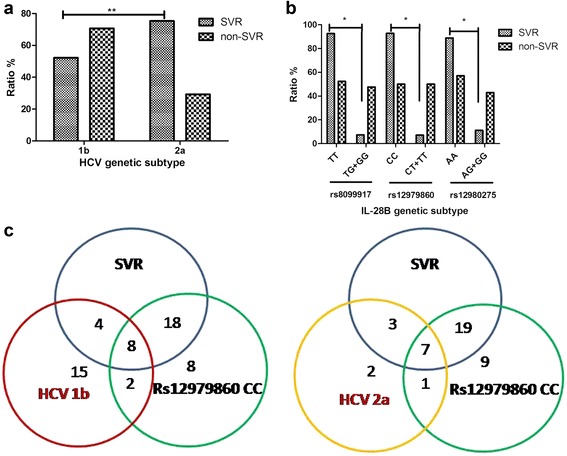
Sustained viral response (SVR) rates of patients with HCV 1b and 2a genotypes were 52.25% (58/111) and 75.28% (67/89) (P < 0.01). SVR rates of patients with IL-28B rs8099917 TT, rs12979860 CC and rs12980275 AA were 92.41% (25/27), 92.86% (26/28) and 88.89% (24/27) separately. We found that SVR rates in HCV 1b and 2a patients were only 31.0 and 39.4% if their FIB-4 > 3.25. In addition, when their APRI > 2, only 30.3% of HCV 1b patients and 50.2% of HCV 2a patients could obtain SVR.
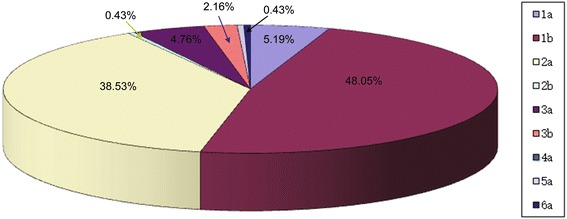
There were high proportion of HCV genotype 1b and 2a in Northwest China. In both HCV 1b and 2a genotypes, patients with protective-genotype of IL-28B were more likely to obtain SVR. However, those with significant fibrosis or cirrhosis were less likely, no matter their genotype. Combined factors of HCV genotype, IL-28B genotype, FIB-4 and ARPI may indicate high prediction and clinical value regarding treatment with PEG-IFN-α/R and prognostic evaluation of chronic hepatitis C patients.
不同种族的慢性丙型肝炎病毒(HCV)患者接受聚乙二醇干扰素-α/利巴韦林(PEG-IFN-α/R)治疗后达到持续病毒学应答(SVR)的概率不同。影响因素众多,如HCV基因型、白细胞介素-28B单核苷酸多态性(SNP)、纤维化4指数(FIB-4)以及天冬氨酸转氨酶与血小板比值指数(APRI)评分。但与治疗结局相关的基线因素仍不太明确。
我们评估了231例有或无肝纤维化的慢性HCV患者的数据,以及他们接受聚乙二醇干扰素联合利巴韦林(PEG-IFN-α/R)治疗24至48周后的抗病毒疗效。采用焦磷酸测序法通过基因组测序分析白细胞介素-28B SNP和HCV基因型。
HCV 1b和2a基因型患者的持续病毒学应答(SVR)率分别为52.25%(58/111)和75.28%(67/89)(P<0.01)。白细胞介素-28B rs8099917 TT、rs12979860 CC和rs12980275 AA基因型患者的SVR率分别为92.41%(25/27)、92.86%(26/28)和88.89%(24/27)。我们发现,若FIB-4>3.25,HCV 1b和2a患者的SVR率分别仅为31.0%和39.4%。此外,当APRI>2时,只有30.3%的HCV 1b患者和50.2%的HCV 2a患者能够获得SVR。
中国西北地区HCV 1b和2a基因型比例较高。在HCV 1b和2a基因型患者中,白细胞介素-28B具有保护性基因型的患者更有可能获得SVR。然而,无论其基因型如何,有显著纤维化或肝硬化的患者获得SVR的可能性较小。HCV基因型、白细胞介素-28B基因型、FIB-4和ARPI的综合因素可能对PEG-IFN-α/R治疗慢性丙型肝炎患者的疗效预测及预后评估具有较高的价值。