Hussain Lal, Aziz Wajid, Alowibdi Jalal S, Habib Nazneen, Rafique Muhammad, Saeed Sharjil, Kazmi Syed Zaki Hassan
University of Azad Jammu and Kashmir, Directorate of Quality Enhancement Cell, City Campus, Muzaffarabad, 13100, Azad Kashmir, Pakistan.
Department of Computer Science, Faculty of Computing and IT, University of Jeddah, Jeddah, Kingdom of Saudi Arabia.
J Physiol Anthropol. 2017 Mar 23;36(1):21. doi: 10.1186/s40101-017-0136-8.
Epilepsy is a neuronal disorder for which the electrical discharge in the brain is synchronized, abnormal and excessive. To detect the epileptic seizures and to analyse brain activities during different mental states, various methods in non-linear dynamics have been proposed. This study is an attempt to quantify the complexity of control and epileptic subject with and without seizure as well as to distinguish eye-open (EO) and eye-closed (EC) conditions using threshold-based symbolic entropy.
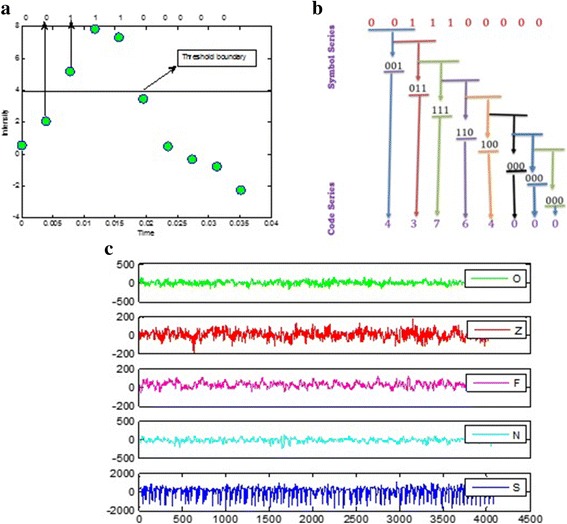
The threshold-dependent symbolic entropy was applied to distinguish the healthy and epileptic subjects with seizure and seizure-free intervals (i.e. interictal and ictal) as well as to distinguish EO and EC conditions. The original time series data was converted into symbol sequences using quantization level, and word series of symbol sequences was generated using a word length of three or more. Then, normalized corrected Shannon entropy (NCSE) was computed to quantify the complexity. The NCSE values were not following the normal distribution, and the non-parametric Mann-Whitney-Wilcoxon (MWW) test was used to find significant differences among various groups at 0.05 significance level. The values of NCSE were presented in a form of topographic maps to show significant brain regions during EC and EO conditions. The results of the study were compared to those of the multiscale entropy (MSE).
The results indicated that the dynamics of healthy subjects are more complex compared to epileptic subjects (during seizure and seizure-free intervals) in both EO and EC conditions. The comparison of the dynamics of epileptic subjects revealed that seizure-free intervals are more complex than seizure intervals. The dynamics of healthy subjects during EO conditions are more complex compared to those during EC conditions. Further, the results clearly demonstrated that threshold-dependent symbolic entropy outperform MSE in distinguishing different physiological and pathological conditions.
The threshold symbolic entropy has provided improved accuracy in quantifying the dynamics of healthy and epileptic subjects during EC an EO conditions for each electrode compared to the MSE.
癫痫是一种神经元紊乱疾病,其大脑中的放电是同步、异常且过度的。为了检测癫痫发作并分析不同精神状态下的大脑活动,人们提出了各种非线性动力学方法。本研究旨在使用基于阈值的符号熵来量化有癫痫发作和无癫痫发作的癫痫患者以及对照者的复杂性,并区分睁眼(EO)和闭眼(EC)状态。
应用依赖阈值的符号熵来区分健康受试者与有癫痫发作和无癫痫发作间隔(即发作间期和发作期)的癫痫患者,以及区分EO和EC状态。使用量化级别将原始时间序列数据转换为符号序列,并使用三个或更多的字长生成符号序列的字序列。然后,计算归一化校正香农熵(NCSE)以量化复杂性。NCSE值不遵循正态分布,使用非参数曼 - 惠特尼 - 威尔科克森(MWW)检验在0.05显著性水平下发现不同组之间的显著差异。NCSE值以地形图的形式呈现,以显示EC和EO状态下的显著脑区。将研究结果与多尺度熵(MSE)的结果进行比较。
结果表明,在EO和EC条件下,健康受试者的动力学比癫痫患者(在发作期和发作间期)更复杂。癫痫患者动力学的比较表明,无癫痫发作间隔比癫痫发作间隔更复杂。健康受试者在EO条件下的动力学比在EC条件下更复杂。此外,结果清楚地表明,依赖阈值的符号熵在区分不同生理和病理状态方面优于MSE。
与MSE相比,阈值符号熵在量化每个电极在EC和EO条件下健康和癫痫患者的动力学方面提供了更高的准确性。