Renner Kathrin, Singer Katrin, Koehl Gudrun E, Geissler Edward K, Peter Katrin, Siska Peter J, Kreutz Marina
Internal Medicine III, University Hospital Regensburg, Regensburg, Germany; Regensburg Center for Interventional Immunology, Regensburg, Germany.
Internal Medicine III, University Hospital Regensburg , Regensburg , Germany.
Front Immunol. 2017 Mar 8;8:248. doi: 10.3389/fimmu.2017.00248. eCollection 2017.
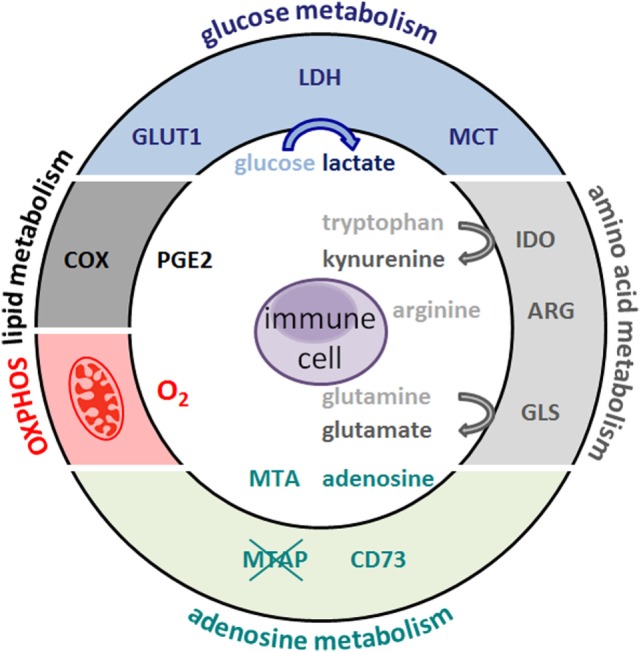
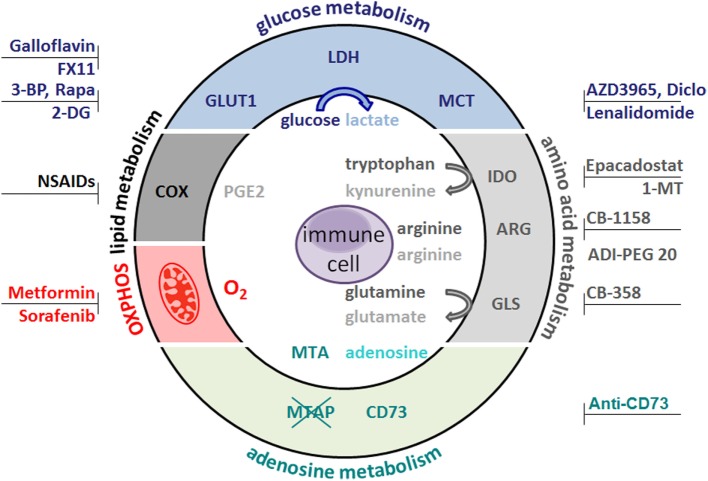
Cytotoxic T lymphocytes and NK cells play an important role in eliminating malignant tumor cells and the number and activity of tumor-infiltrating T cells represent a good marker for tumor prognosis. Based on these findings, immunotherapy, e.g., checkpoint blockade, has received considerable attention during the last couple of years. However, for the majority of patients, immune control of their tumors is gray theory as malignant cells use effective mechanisms to outsmart the immune system. Increasing evidence suggests that changes in tumor metabolism not only ensure an effective energy supply and generation of building blocks for tumor growth but also contribute to inhibition of the antitumor response. Immunosuppression in the tumor microenvironment is often based on the mutual metabolic requirements of immune cells and tumor cells. Cytotoxic T and NK cell activation leads to an increased demand for glucose and amino acids, a well-known feature shown by tumor cells. These close metabolic interdependencies result in metabolic competition, limiting the proliferation, and effector functions of tumor-specific immune cells. Moreover, not only nutrient restriction but also tumor-driven shifts in metabolite abundance and accumulation of metabolic waste products (e.g., lactate) lead to local immunosuppression, thereby facilitating tumor progression and metastasis. In this review, we describe the metabolic interplay between immune cells and tumor cells and discuss tumor cell metabolism as a target structure for cancer therapy. Metabolic (re)education of tumor cells is not only an approach to kill tumor cells directly but could overcome metabolic immunosuppression in the tumor microenvironment and thereby facilitate immunotherapy.
细胞毒性T淋巴细胞和自然杀伤细胞在清除恶性肿瘤细胞中发挥着重要作用,肿瘤浸润性T细胞的数量和活性是肿瘤预后的良好标志物。基于这些发现,免疫疗法,如检查点阻断,在过去几年中受到了广泛关注。然而,对于大多数患者来说,肿瘤的免疫控制仍是纸上谈兵,因为恶性细胞会利用有效的机制来智取免疫系统。越来越多的证据表明,肿瘤代谢的变化不仅确保了肿瘤生长所需的有效能量供应和构建模块的生成,还有助于抑制抗肿瘤反应。肿瘤微环境中的免疫抑制通常基于免疫细胞和肿瘤细胞的相互代谢需求。细胞毒性T细胞和自然杀伤细胞的激活导致对葡萄糖和氨基酸的需求增加,这是肿瘤细胞的一个众所周知的特征。这些紧密的代谢相互依赖导致代谢竞争,限制了肿瘤特异性免疫细胞的增殖和效应功能。此外,不仅营养物质限制,而且肿瘤驱动的代谢物丰度变化和代谢废物(如乳酸)的积累都会导致局部免疫抑制,从而促进肿瘤进展和转移。在这篇综述中,我们描述了免疫细胞和肿瘤细胞之间的代谢相互作用,并讨论了肿瘤细胞代谢作为癌症治疗的靶点结构。对肿瘤细胞进行代谢(再)调控不仅是一种直接杀死肿瘤细胞的方法,还可以克服肿瘤微环境中的代谢性免疫抑制,从而促进免疫治疗。