
多学科团队会议对胃肠道恶性肿瘤患者的价值:系统评价。
The Value of Multidisciplinary Team Meetings for Patients with Gastrointestinal Malignancies: A Systematic Review.
机构信息
Department of Gastroenterology and Hepatology, Academic Medical Center, University of Amsterdam, Amsterdam, The Netherlands.
Faculty of Social and Behavioral Sciences, University of Amsterdam, Amsterdam, The Netherlands.
出版信息
Ann Surg Oncol. 2017 Sep;24(9):2669-2678. doi: 10.1245/s10434-017-5833-3. Epub 2017 Mar 23.
INTRODUCTION
The incidence of gastrointestinal (GI) cancer is rising and most patients with GI malignancies are discussed by a multidisciplinary team (MDT). We performed a systematic review to assess whether MDTs for patients with GI malignancies can correctly change diagnosis, tumor stage and subsequent treatment plan, and whether the treatment plan was implemented.
METHODS
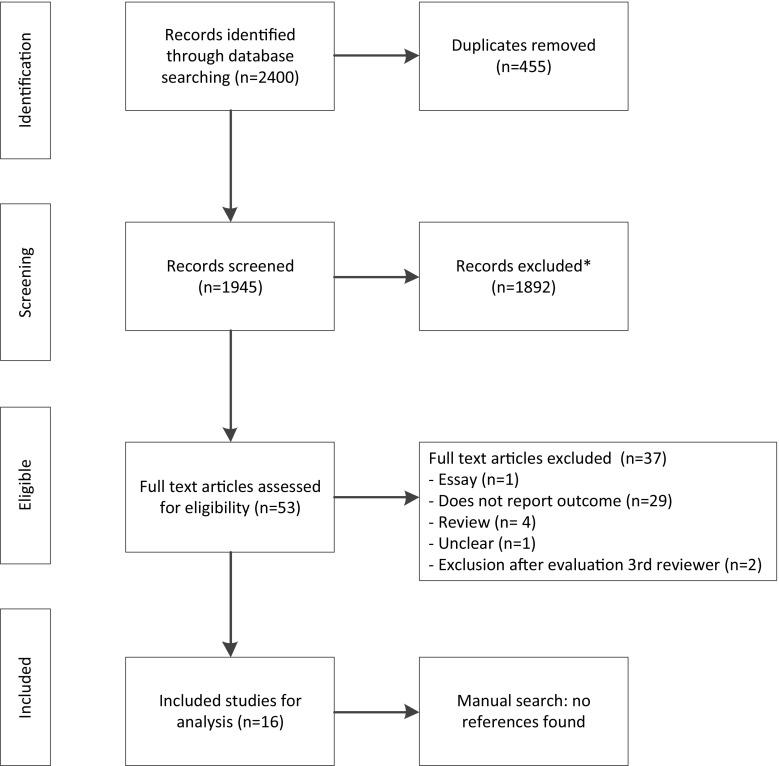
We performed a systematic review according to the Preferred Reporting Items for Systematic Reviews and Meta-Analyses guidelines. We conducted a search of the PubMed, MEDLINE and EMBASE electronic databases, and included studies relating to adults with a GI malignancy discussed by an MDT prior to the start of treatment which described a change of initial diagnosis, stage or treatment plan. Two researchers independently evaluated all retrieved titles and abstracts from the abovementioned databases.
RESULTS
Overall, 16 studies were included; the study quality was rated as fair. Four studies reported that MDTs changed the diagnoses formulated by individual physicians in 18.4-26.9% of evaluated cases; two studies reported that MDTs formulated an accurate diagnosis in 89 and 93.5% of evaluated cases, respectively; nine studies described that the treatment plan was altered in 23.0-41.7% of evaluated cases; and four studies found that MDT decisions were implemented in 90-100% of evaluated cases. The reasons for altering a treatment plan included the patient's wishes, and comorbidities.
CONCLUSIONS
MDT meetings for patients with a GI malignancy are responsible for changes in diagnoses and management in a significant number of patients. Treatment plans formulated by MDTs are implemented in 90-100% of discussed patients. All patients with a GI malignancy should be discussed by an MDT.
简介
胃肠道(GI)癌症的发病率正在上升,大多数胃肠道恶性肿瘤患者都由多学科团队(MDT)讨论。我们进行了系统评价,以评估胃肠道恶性肿瘤患者的 MDT 是否可以正确改变诊断、肿瘤分期和后续治疗计划,以及治疗计划是否得到实施。
方法
我们根据系统评价和荟萃分析的首选报告项目指南进行了系统评价。我们对 PubMed、MEDLINE 和 EMBASE 电子数据库进行了检索,纳入了在开始治疗前由 MDT 讨论的成年胃肠道恶性肿瘤患者的研究,这些研究描述了初始诊断、分期或治疗计划的变化。两名研究人员独立评估了上述数据库中检索到的所有标题和摘要。
结果
共纳入 16 项研究;研究质量评为一般。四项研究报告 MDT 改变了个体医生制定的诊断,在评估的病例中占 18.4-26.9%;两项研究报告 MDT 分别在评估的病例中制定了 89 和 93.5%的准确诊断;九项研究描述了在评估的病例中 23.0-41.7%的治疗计划发生了改变;四项研究发现 MDT 决策在评估的病例中 90-100%得到了实施。改变治疗计划的原因包括患者的意愿和合并症。
结论
胃肠道恶性肿瘤患者的 MDT 会议负责改变大量患者的诊断和治疗。MDT 制定的治疗计划在讨论的患者中 90-100%得到实施。所有胃肠道恶性肿瘤患者都应接受 MDT 讨论。
 Zotero 插件