Gardner Lauren, Chen Nan, Sarkar Sahotra
School of Civil and Environmental Engineering, University of New South Wales (UNSW) Sydney, Sydney, NSW, Australia.
Department of Integrative Biology and Department of Philosophy, University of Texas at Austin, Austin, Texas, United States of America.
PLoS Negl Trop Dis. 2017 Mar 24;11(3):e0005487. doi: 10.1371/journal.pntd.0005487. eCollection 2017 Mar.
The 2015-16 Zika virus pandemic originating in Latin America led to predictions of a catastrophic global spread of the disease. Since the current outbreak began in Brazil in May 2015 local transmission of Zika has been reported in over 60 countries and territories, with over 750 thousand confirmed and suspected cases. As a result of its range expansion attention has focused on possible modes of transmission, of which the arthropod vector-based disease spread cycle involving Aedes species is believed to be the most important. Additional causes of concern are the emerging new links between Zika disease and Guillain-Barre Syndrome (GBS), and a once rare congenital disease, microcephaly.
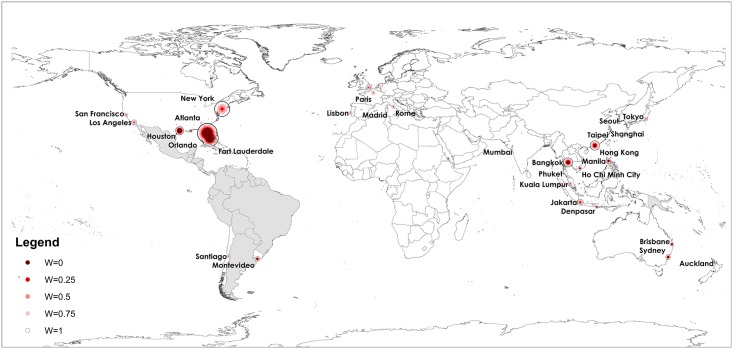
METHODOLOGY/PRINCIPAL FINDINGS: Like dengue and chikungunya, the geographic establishment of Zika is thought to be limited by the occurrence of its principal vector mosquito species, Ae. aegypti and, possibly, Ae. albopictus. While Ae. albopictus populations are more widely established than those of Ae. aegypti, the relative competence of these species as a Zika vector is unknown. The analysis reported here presents a global risk model that considers the role of each vector species independently, and quantifies the potential spreading risk of Zika into new regions. Six scenarios are evaluated which vary in the weight assigned to Ae. albopictus as a possible spreading vector. The scenarios are bounded by the extreme assumptions that spread is driven by air travel and Ae. aegypti presence alone and spread driven equally by both species. For each scenario destination cities at highest risk of Zika outbreaks are prioritized, as are source cities in affected regions. Finally, intercontinental air travel routes that pose the highest risk for Zika spread are also ranked. The results are compared between scenarios.
CONCLUSIONS/SIGNIFICANCE: Results from the analysis reveal that if Ae. aegypti is the only competent Zika vector, then risk is geographically limited; in North America mainly to Florida and Texas. However, if Ae. albopictus proves to be a competent vector of Zika, which does not yet appear to be the case, then there is risk of local establishment in all American regions including Canada and Chile, much of Western Europe, Australia, New Zealand, as well as South and East Asia, with a substantial increase in risk to Asia due to the more recent local establishment of Zika in Singapore.
2015 - 2016年起源于拉丁美洲的寨卡病毒大流行引发了该疾病将在全球灾难性传播的预测。自2015年5月在巴西开始当前疫情爆发以来,已有60多个国家和地区报告了寨卡病毒的本地传播,确诊和疑似病例超过75万例。由于其传播范围的扩大,人们的注意力集中在可能的传播方式上,其中涉及伊蚊属的基于节肢动物媒介的疾病传播周期被认为是最重要的。另外令人担忧的是寨卡疾病与吉兰 - 巴雷综合征(GBS)以及一种曾经罕见的先天性疾病小头畸形之间新出现的联系。
方法/主要发现:与登革热和基孔肯雅热一样,寨卡病毒在地理上的传播被认为受到其主要媒介蚊种埃及伊蚊以及可能的白纹伊蚊分布情况的限制。虽然白纹伊蚊的种群分布比埃及伊蚊更广泛,但这些蚊种作为寨卡病毒媒介的相对传播能力尚不清楚。此处报告的分析提出了一个全球风险模型,该模型独立考虑每个媒介蚊种的作用,并量化寨卡病毒传播到新地区的潜在风险。评估了六种情景,这些情景在赋予白纹伊蚊作为可能传播媒介的权重方面有所不同。这些情景的边界是由极端假设界定的,即传播是由航空旅行和仅埃及伊蚊的存在驱动的,以及传播是由两种蚊种同等驱动的。对于每种情景,确定了寨卡病毒爆发风险最高的目的地城市以及受影响地区的源城市的优先级。最后,还对寨卡病毒传播风险最高的洲际航空旅行路线进行了排名。并对各情景的结果进行了比较。
结论/意义:分析结果表明,如果埃及伊蚊是唯一能够传播寨卡病毒的媒介,那么风险在地理上是有限的;在北美主要局限于佛罗里达州和得克萨斯州。然而,如果事实证明白纹伊蚊是寨卡病毒的有效传播媒介(目前似乎并非如此),那么在包括加拿大和智利在内的所有美洲地区、西欧大部分地区、澳大利亚、新西兰以及南亚和东亚都存在本地传播的风险,由于寨卡病毒最近在新加坡本地传播,亚洲的风险将大幅增加。