Grimm Marcus O W, Mett Janine, Grimm Heike S, Hartmann Tobias
Experimental Neurology, Saarland UniversityHomburg/Saar, Germany; Neurodegeneration and Neurobiology, Saarland UniversityHomburg/Saar, Germany; Deutsches Institut für DemenzPrävention (DIDP), Saarland UniversityHomburg/Saar, Germany.
Experimental Neurology, Saarland University Homburg/Saar, Germany.
Front Mol Neurosci. 2017 Mar 10;10:63. doi: 10.3389/fnmol.2017.00063. eCollection 2017.
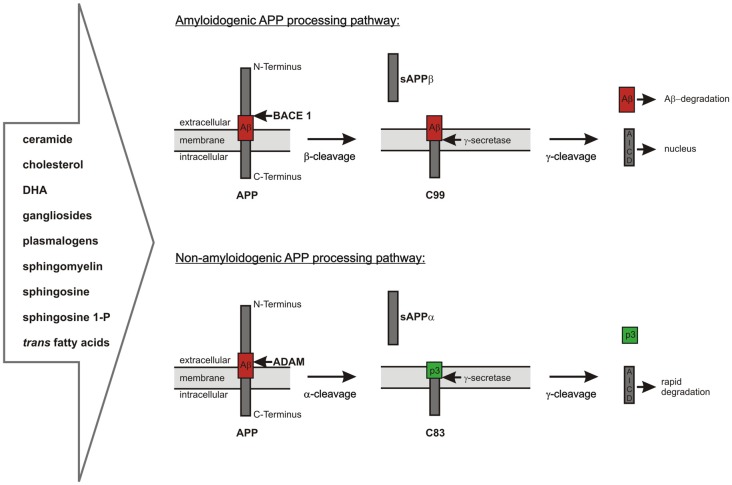
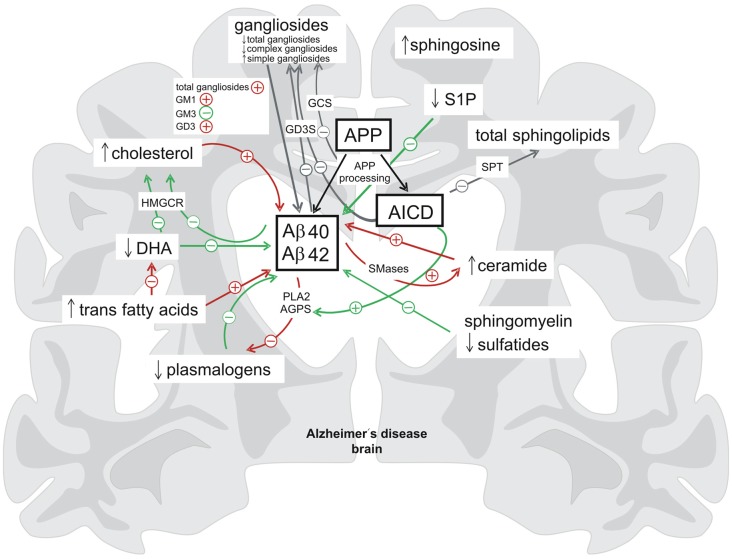
Extracellular neuritic plaques, composed of aggregated amyloid-β (Aβ) peptides, are one of the major histopathological hallmarks of Alzheimer's disease (AD), a progressive, irreversible neurodegenerative disorder and the most common cause of dementia in the elderly. One of the most prominent risk factor for sporadic AD, carrying one or two aberrant copies of the apolipoprotein E (ApoE) ε4 alleles, closely links AD to lipids. Further, several lipid classes and fatty acids have been reported to be changed in the brain of AD-affected individuals. Interestingly, the observed lipid changes in the brain seem not only to be a consequence of the disease but also modulate Aβ generation. In line with these observations, protective lipids being able to decrease Aβ generation and also potential negative lipids in respect to AD were identified. Mechanistically, Aβ peptides are generated by sequential proteolytic processing of the amyloid precursor protein (APP) by β- and γ-secretase. The α-secretase appears to compete with β-secretase for the initial cleavage of APP, preventing Aβ production. All APP-cleaving secretases as well as APP are transmembrane proteins, further illustrating the impact of lipids on Aβ generation. Beside the pathological impact of Aβ, accumulating evidence suggests that Aβ and the APP intracellular domain (AICD) play an important role in regulating lipid homeostasis, either by direct effects or by affecting gene expression or protein stability of enzymes involved in the synthesis of different lipid classes. This review summarizes the current literature addressing the complex bidirectional link between lipids and AD and APP processing including lipid alterations found in AD brains, lipids that alter APP processing and the physiological functions of Aβ and AICD in the regulation of several lipid metabolism pathways.
细胞外神经炎性斑块由聚集的淀粉样β(Aβ)肽组成,是阿尔茨海默病(AD)的主要组织病理学特征之一。AD是一种进行性、不可逆的神经退行性疾病,也是老年人痴呆最常见的病因。散发性AD最显著的危险因素之一是携带载脂蛋白E(ApoE)ε4等位基因的一个或两个异常拷贝,这将AD与脂质紧密联系起来。此外,据报道,在受AD影响的个体大脑中,几种脂质类别和脂肪酸发生了变化。有趣的是,大脑中观察到的脂质变化似乎不仅是疾病的结果,还能调节Aβ的产生。与这些观察结果一致,已鉴定出能够减少Aβ产生的保护性脂质以及与AD相关的潜在负面脂质。从机制上讲,Aβ肽是由淀粉样前体蛋白(APP)经β和γ分泌酶的顺序蛋白水解加工产生的。α分泌酶似乎与β分泌酶竞争APP的初始切割,从而阻止Aβ的产生。所有切割APP的分泌酶以及APP都是跨膜蛋白,这进一步说明了脂质对Aβ产生的影响。除了Aβ的病理影响外,越来越多的证据表明,Aβ和APP细胞内结构域(AICD)在调节脂质稳态中发挥着重要作用,无论是通过直接作用,还是通过影响参与不同脂质类别合成的酶的基因表达或蛋白质稳定性。本综述总结了当前关于脂质与AD以及APP加工之间复杂双向联系的文献,包括AD大脑中发现的脂质改变、改变APP加工的脂质以及Aβ和AICD在调节几种脂质代谢途径中的生理功能。