Cauz-Santos Luiz A, Munhoz Carla F, Rodde Nathalie, Cauet Stephane, Santos Anselmo A, Penha Helen A, Dornelas Marcelo C, Varani Alessandro M, Oliveira Giancarlo C X, Bergès Hélène, Vieira Maria Lucia C
Departamento de Genética, Escola Superior de Agricultura "Luiz de Queiroz", Universidade de São Paulo, Piracicaba Brazil.
Institut National de la Recherche Agronomique, French Plant Genomic Resource Center, Castanet-Tolosan France.
Front Plant Sci. 2017 Mar 10;8:334. doi: 10.3389/fpls.2017.00334. eCollection 2017.
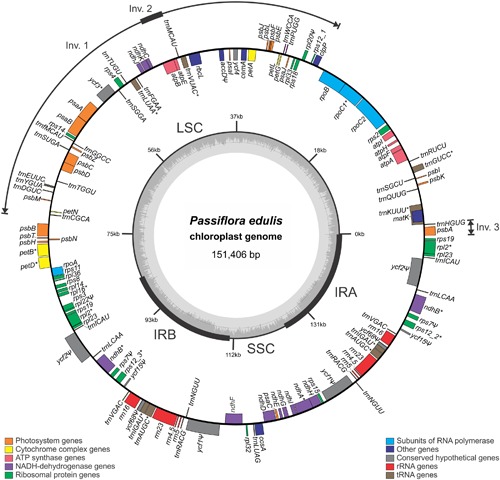
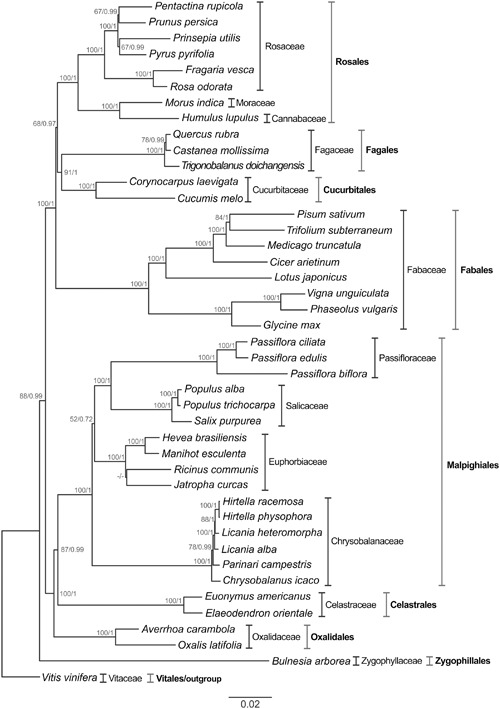
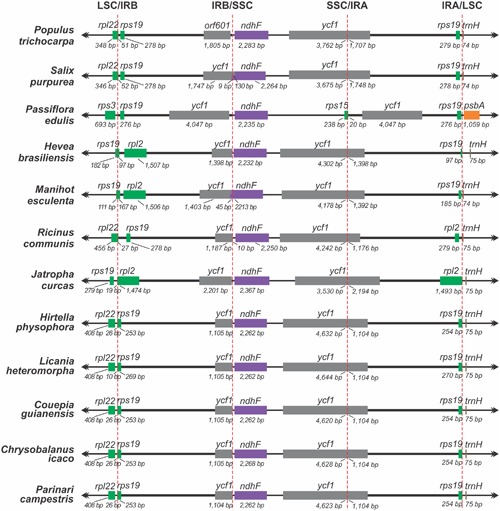
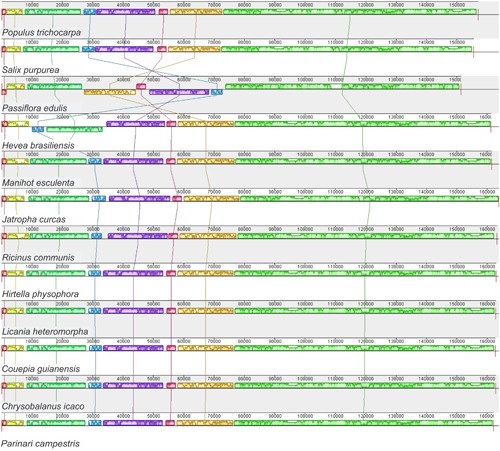
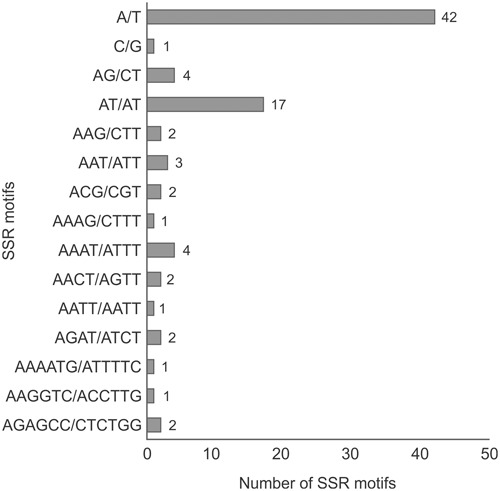
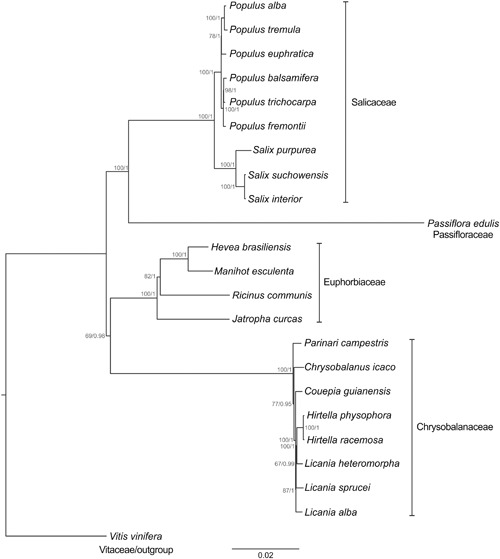
The family Passifloraceae consists of some 700 species classified in around 16 genera. Almost all its members belong to the genus . In Brazil, the yellow passion fruit () is of considerable economic importance, both for juice production and consumption as fresh fruit. The availability of chloroplast genomes (cp genomes) and their sequence comparisons has led to a better understanding of the evolutionary relationships within plant taxa. In this study, we obtained the complete nucleotide sequence of the chloroplast genome, the first entirely sequenced in the Passifloraceae family. We determined its structure and organization, and also performed phylogenomic studies on the order Malpighiales and the Fabids clade. The chloroplast genome is characterized by the presence of two copies of an inverted repeat sequence (IRA and IRB) of 26,154 bp, each separating a small single copy region of 13,378 bp and a large single copy (LSC) region of 85,720 bp. The annotation resulted in the identification of 105 unique genes, including 30 tRNAs, 4 rRNAs, and 71 protein coding genes. Also, 36 repetitive elements and 85 SSRs (microsatellites) were identified. The structure of the complete cp genome of differs from that of other species because of rearrangement events detected by means of a comparison based on 22 members of the Malpighiales. The rearrangements were three inversions of 46,151, 3,765 and 1,631 bp, located in the LSC region. Phylogenomic analysis resulted in strongly supported trees, but this could also be a consequence of the limited taxonomic sampling used. Our results have provided a better understanding of the evolutionary relationships in the Malpighiales and the Fabids, confirming the potential of complete chloroplast genome sequences in inferring evolutionary relationships and the utility of long sequence reads for generating very accurate biological information.
西番莲科约有700个物种,分为约16个属。几乎所有成员都属于西番莲属。在巴西,黄果西番莲()在果汁生产和鲜果消费方面都具有相当重要的经济意义。叶绿体基因组(cp基因组)的可得性及其序列比较有助于更好地理解植物类群内部的进化关系。在本研究中,我们获得了黄果西番莲叶绿体基因组的完整核苷酸序列,这是西番莲科中首个完全测序的叶绿体基因组。我们确定了其结构和组织,并对金虎尾目和豆类分支进行了系统发育基因组学研究。黄果西番莲叶绿体基因组的特征是存在两个26,154 bp的反向重复序列(IRA和IRB)拷贝,每个拷贝分隔一个13,378 bp的小单拷贝区域和一个85,720 bp的大单拷贝(LSC)区域。注释结果鉴定出105个独特基因,包括30个tRNA、4个rRNA和71个蛋白质编码基因。此外,还鉴定出36个重复元件和85个SSR(微卫星)。由于基于金虎尾目22个成员的比较检测到重排事件,黄果西番莲完整cp基因组的结构与其他物种不同。重排包括位于LSC区域的46,151、3,765和1,631 bp的三次倒位。系统发育基因组学分析得出了支持度很高的树,但这也可能是所用分类抽样有限的结果。我们的结果有助于更好地理解金虎尾目和豆类的进化关系,证实了完整叶绿体基因组序列在推断进化关系方面的潜力以及长序列读数在生成非常准确的生物学信息方面的实用性。