Schuster Andrea C, Zimmermann Uwe, Hauer Carina, Foerster Katharina
Department of Comparative Zoology, Institute for Evolution and Ecology, University of Tübingen, Auf der Morgenstelle 28, D-72076 Tübingen, Germany.
Front Zool. 2017 Mar 24;14:19. doi: 10.1186/s12983-017-0204-2. eCollection 2017.
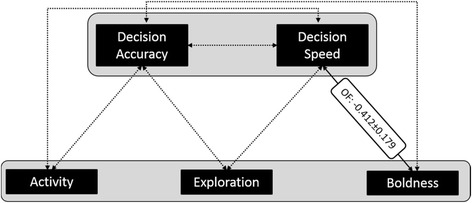
Animals show consistent individual behavioural differences in many species. Further, behavioural traits (personality traits) form behavioural syndromes, characterised by correlations between different behaviours. Mechanisms maintaining these correlations could be constrained due to underlying relationships with cognitive traits. There is growing evidence for the non-independence of animal personality and general cognitive abilities in animals, but so far, studies on the direction of the relationship between them revealed contradictory results. Still, it is hypothesised that individuals may exhibit consistent learning and decision styles. Fast behavioural types (consistently bolder and more active individuals) are expected to show faster learning styles. Slow behavioural types in contrast are assumed to learn slower but more accurately. This can be caused by a speed-accuracy trade-off that individuals face during decision making. We measured the repeatability of three personality and four spatial cognitive traits in adult Eurasian harvest mice (). We analysed correlations among personality traits (behavioural syndrome). We further investigated the relationships between personality and spatial cognitive traits as a first step exploring the potential connection between personality and cognition in this species.
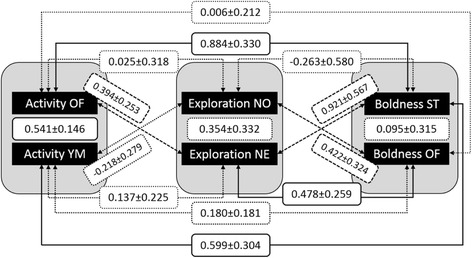
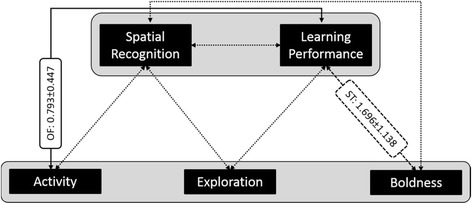
Our results showed that exploration, activity and boldness were repeatable in adult mice. Spatial recognition measured in a Y Maze was also significantly repeatable, as well as spatial learning performance and decision speed. We found no repeatability of decision accuracy. Harvest mice showed a behavioural syndrome as we observed strong positive correlations between personality traits. The speed-accuracy trade-off was not apparent within, nor between individuals. Nevertheless, we found weak evidence for a relationship between personality and spatial cognitive traits as fast behavioural types learned a spatial orientation task faster than slow types, and shyer harvest mice made decisions quicker than bolder mice.
Given these correlations, our data provided some first insights into the relationship between personality and spatial cognitive traits in harvest mice and will hopefully stimulate more studies in this field.
在许多物种中,动物表现出一致的个体行为差异。此外,行为特征(个性特征)形成行为综合征,其特征是不同行为之间存在相关性。由于与认知特征的潜在关系,维持这些相关性的机制可能受到限制。越来越多的证据表明动物个性和一般认知能力在动物中并非相互独立,但到目前为止,关于它们之间关系方向的研究结果相互矛盾。不过,据推测个体可能表现出一致的学习和决策风格。快速行为类型(一贯更大胆、更活跃的个体)预计表现出更快的学习风格。相比之下,缓慢行为类型被认为学习较慢但更准确。这可能是由于个体在决策过程中面临的速度-准确性权衡所致。我们测量了成年欧亚收获鼠三种个性和四种空间认知特征的重复性。我们分析了个性特征之间的相关性(行为综合征)。作为探索该物种个性与认知之间潜在联系的第一步,我们进一步研究了个性与空间认知特征之间的关系。
我们的结果表明,成年小鼠的探索、活动和大胆程度具有重复性。在Y迷宫中测量的空间识别以及空间学习表现和决策速度也具有显著重复性。我们发现决策准确性没有重复性。收获鼠表现出行为综合征,因为我们观察到个性特征之间存在强烈的正相关。速度-准确性权衡在个体内部和个体之间均不明显。然而,我们发现个性与空间认知特征之间存在关系的微弱证据,因为快速行为类型比缓慢行为类型更快地学会空间定向任务,且更害羞的收获鼠比大胆的小鼠更快做出决策。
鉴于这些相关性,我们的数据为收获鼠个性与空间认知特征之间的关系提供了一些初步见解,并有望激发该领域更多的研究。