Peng Bin, Shi Ruifeng, Jiang Weiwei, Ding Yue-He, Dong Meng-Qiu, Zhu Wei-Guo, Xu Xingzhi
Beijing Key Laboratory of DNA Damage Response and College of Life Sciences, Capital Normal University, Beijing, 100048 China.
Guangdong Key Laboratory of Genome Stability & Disease Prevention, Shenzhen University School of Medicine, Shenzhen, 518060 Guangdong China.
Cell Biosci. 2017 Mar 23;7:15. doi: 10.1186/s13578-017-0142-x. eCollection 2017.
Lysine-specific histone demethylase 1 (LSD1) modulates chromatin status through demethylation of H3K4 and H3K9. It has been demonstrated that LSD1 is hyperphosphorylated and dissociates from chromatin during mitosis. However, the molecular mechanism of LSD1 detachment is unknown.
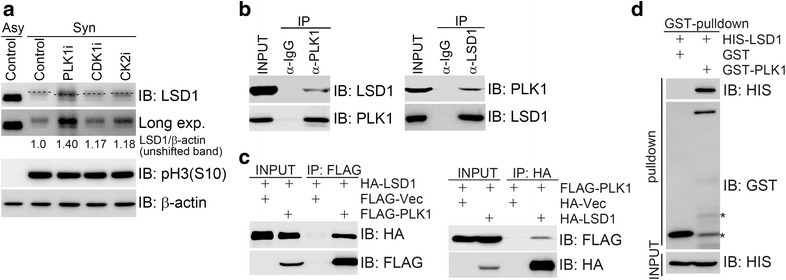
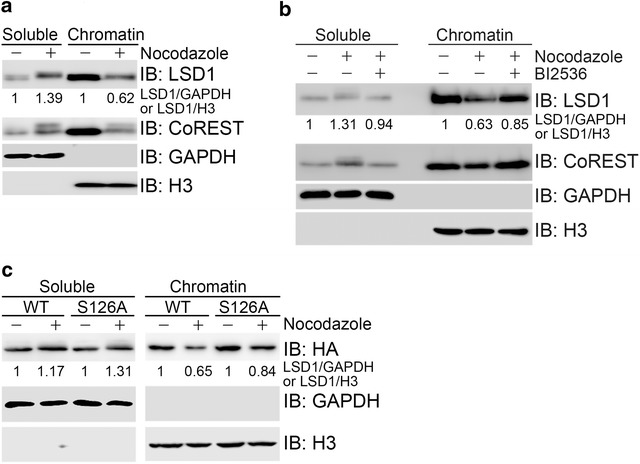
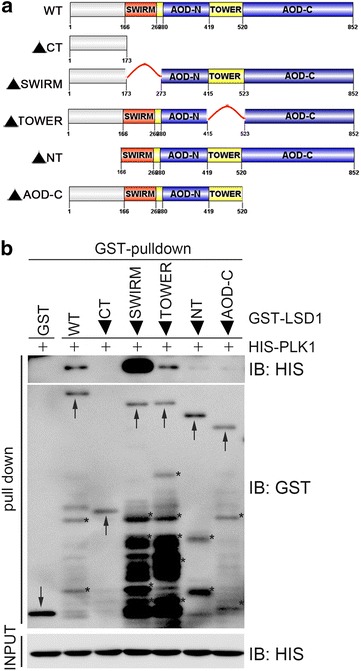
In this report, we found that polo-like kinase 1 (PLK1) directly interacted with LSD1 and phosphorylated LSD1 at Ser-126 . Nocodazole-induced metaphase arrest promoted release of LSD1 from chromatin, and the phosphorylation-defective mutant LSD1 (S126A) failed to dissociate from chromatin upon nocodazole treatment.
Taken together, our findings demonstrate that phosphorylation of LSD1 at Ser-126 by PLK1 promotes its release from chromatin during mitosis.
赖氨酸特异性组蛋白去甲基化酶1(LSD1)通过对H3K4和H3K9进行去甲基化来调节染色质状态。已有研究表明,LSD1在有丝分裂期间发生过度磷酸化并从染色质上解离。然而,LSD1解离的分子机制尚不清楚。
在本报告中,我们发现polo样激酶1(PLK1)直接与LSD1相互作用,并在Ser-126位点磷酸化LSD1。诺考达唑诱导的中期阻滞促进了LSD1从染色质上的释放,而磷酸化缺陷型突变体LSD1(S126A)在诺考达唑处理后未能从染色质上解离。
综上所述,我们的研究结果表明,PLK1在Ser-126位点对LSD1的磷酸化促进了其在有丝分裂期间从染色质上的释放。