Pitout Johann D D, DeVinney Rebekah
Departments of Microbiology, Immunology, and Infectious Diseases, Cummings School of Medicine, University of Calgary, Calgary, Alberta, Canada; Departments of Pathology and Laboratory Medicine, Cummings School of Medicine, University of Calgary, Calgary, Canada; Division of Microbiology, Calgary Laboratory Services, Calgary, Alberta, Canada; Department of Medical Microbiology, University of Pretoria, Pretoria, South Africa.
Departments of Microbiology, Immunology, and Infectious Diseases, Cummings School of Medicine, University of Calgary, Calgary, Alberta, Canada.
F1000Res. 2017 Feb 28;6. doi: 10.12688/f1000research.10609.1. eCollection 2017.
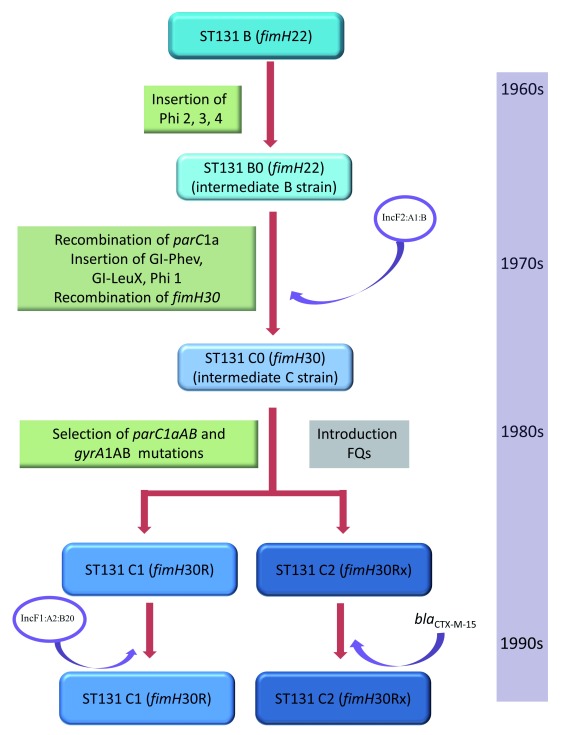
A single extra-intestinal pathogenic (ExPEC) clone, named sequence type (ST) 131, is responsible for millions of global antimicrobial-resistant (AMR) infections annually. Population genetics indicate that ST131 consists of different clades (i.e. A, B, and C); however, clade C is the most dominant globally. A ST131 subclade, named C1-M27, is emerging in Japan and has been responsible for the recent increase in AMR ExPEC in that country. The sequential acquisition of several virulence and AMR genes associated with mobile genetic elements during the 1960s to 1980s primed clade C (and its subclades C1 and C2) for success in the 1990s to 2000s. IncF plasmids with F1:A2:B20 and F2:A1:B replicons have shaped the evolution of the C1 and C2 subclades. It is possible that ST131 is a host generalist with different accessory gene profiles. Compensatory mutations within the core genome of this clone have counterbalanced the fitness cost associated with IncF plasmids. ST131 clade C had dramatically changed the population structure of ExPEC, but it still remains unclear which features of this clade resulted in one of the most unprecedented AMR successes of the 2000s.
一种名为序列型(ST)131的肠道外致病性(ExPEC)单一克隆每年在全球导致数百万例耐抗菌药物(AMR)感染。群体遗传学研究表明,ST131由不同的进化枝组成(即A、B和C);然而,进化枝C在全球最为占主导地位。一个名为C1-M27的ST131亚进化枝正在日本出现,并导致了该国近期耐AMR ExPEC感染病例的增加。在20世纪60年代至80年代期间,与可移动遗传元件相关的几种毒力和AMR基因的相继获得,使进化枝C(及其亚进化枝C1和C2)在20世纪90年代至21世纪初取得成功。带有F1:A2:B20和F2:A1:B复制子的IncF质粒塑造了C1和C2亚进化枝的进化。ST131可能是一种具有不同辅助基因谱的宿主泛化菌。该克隆核心基因组内的补偿性突变抵消了与IncF质粒相关的适应性代价。ST131进化枝C极大地改变了ExPEC的群体结构,但仍不清楚该进化枝的哪些特征导致了21世纪最前所未有的AMR成功案例之一。