Pitout Johann D D, Chen Liang
Cummings School of Medicine, University of Calgary, #9, 3535 Research Road NW, Calgary, AB, T2L 2K8, Canada.
Dynacare Laboratories, Alberta, Canada.
Infect Dis Ther. 2023 Apr;12(4):1029-1041. doi: 10.1007/s40121-023-00791-4. Epub 2023 Mar 22.
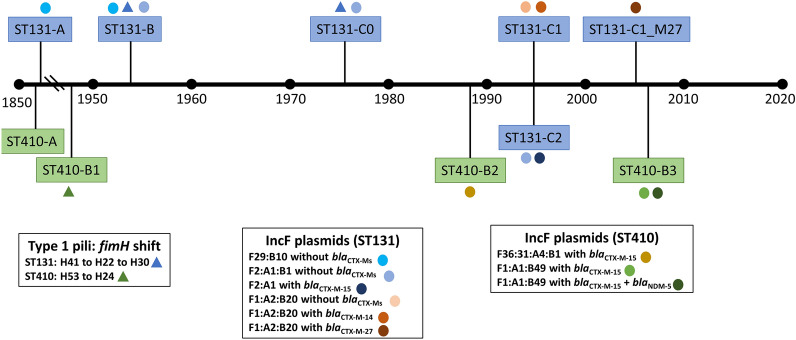
Epidemic IncF plasmids have been pivotal in the selective advantage of multidrug-resistant (MDR) extraintestinal pathogenic Escherichia coli (ExPEC). These plasmids have offered several advantages to their hosts that allowed them to coevolve with the bacterial host genomes and played an integral role in the success of ExPEC. IncF plasmids are large, mosaic, and often contain various types of antimicrobial resistance (AMR) and virulence associated factor (VAF) genes. The presence of AMR, VAF genes, several addition/restriction systems combined with truncated transfer regions, led to the fixation of IncF plasmids in certain ExPEC MDR clones, such as ST131 and ST410. IncF plasmids entered the ST131 ancestral lineage in the mid 1900s and different ST131 clade/CTX-M plasmid combinations coevolved over time. The IncF_CTX-M-15/ST131-C2 subclade combination emerged during the early 2000s, spread rapidly across the globe, and is one of the greatest clone/plasmid successes of the millennium. The ST410-B3 subclade containing bla incorporated the NDM-5 carbapenemase gene into existing IncF platforms, providing an additional positive selective advantage that included the carbapenems. A "plasmid-replacement" clade scenario occurred in the histories of ST131 and ST410 as different subclades gained different AMR genes on different IncF platforms. The use of antimicrobial agents will generate selection pressures that enhance the risks for the continuous emergence of MDR ExPEC clone/IncF plasmid combinations. The reasons for clade/IncF replacements and associations between certain clades and specific IncF plasmid types are unknown. Such information will aid in designing management and prevention strategies to combat AMR.
流行的IncF质粒在多重耐药(MDR)肠外致病性大肠杆菌(ExPEC)的选择优势中起关键作用。这些质粒为其宿主提供了多种优势,使其能够与细菌宿主基因组共同进化,并在ExPEC的成功中发挥了不可或缺的作用。IncF质粒很大,是镶嵌型的,通常包含各种类型的抗菌抗性(AMR)和毒力相关因子(VAF)基因。AMR、VAF基因的存在,几种额外的/限制系统与截短的转移区域相结合,导致IncF质粒在某些ExPEC MDR克隆(如ST131和ST410)中固定下来。IncF质粒在20世纪中叶进入ST131祖先谱系,不同的ST131分支/CTX-M质粒组合随时间共同进化。IncF_CTX-M-15/ST131-C2亚分支组合在21世纪初出现,迅速在全球传播,是千年来最成功的克隆/质粒组合之一。含有bla的ST410-B3亚分支将NDM-5碳青霉烯酶基因整合到现有的IncF平台中,提供了包括碳青霉烯类在内的额外正选择优势。在ST131和ST410的历史中发生了“质粒替换”分支情况,因为不同的亚分支在不同的IncF平台上获得了不同的AMR基因。抗菌药物的使用将产生选择压力,增加MDR ExPEC克隆/IncF质粒组合持续出现的风险。分支/IncF替换的原因以及某些分支与特定IncF质粒类型之间的关联尚不清楚。此类信息将有助于设计对抗AMR的管理和预防策略。