Elfering Achim, Gerhardt Christin, Grebner Simone, Müller Urs
Department of Work and Organisational Psychology, University of Bern, Bern, Switzerland; National Centre of Competence in Research, Affective Sciences, University of Geneva, CISA, Geneva, Switzerland.
Department of Work and Organisational Psychology, University of Bern, Bern, Switzerland.
Saf Health Work. 2017 Mar;8(1):19-28. doi: 10.1016/j.shaw.2016.06.003. Epub 2016 Jul 1.
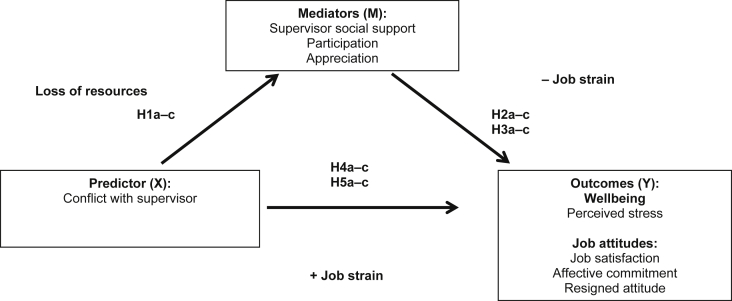
Conservation of resources theory assumes loss of resources as a cause of job strain. In hospital work, conflicts with supervisors are tested to predict lower resources, that is, supervisory social support, participation possibilities, and appreciation. All three resources are expected to predict, in turn, experienced stress (job strain) and lower job satisfaction, lower affective commitment, and a higher resigned attitude towards the job (job attitudes).
The sample included 1,073 employees from 14 Swiss hospitals ( = 604 nurses, = 81 physicians, = 135 medical therapists, and = 253 technical and administrative staff). Of the total sample, 83.1% were female and 38.9% worked full-time. The median tenure was between 7 years and 10 years. Constructs were assessed by online questionnaires. Structural equation modeling was used to test mediation.
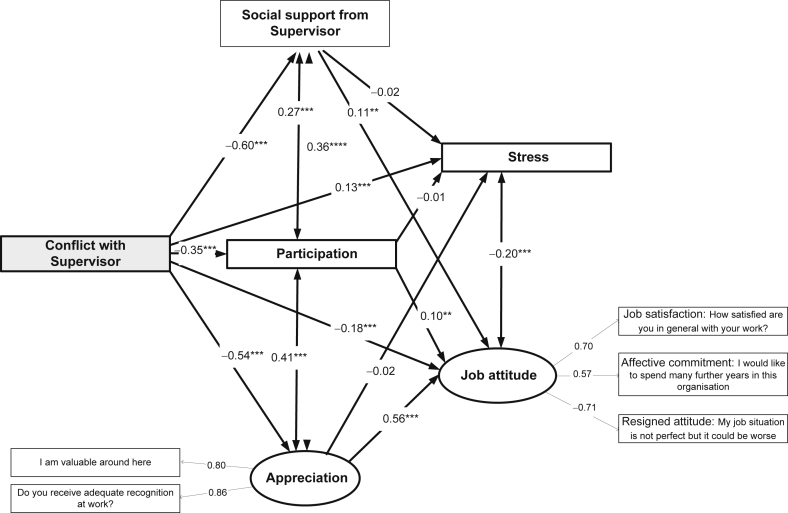
Structural equation modeling confirmed the negative association of conflict with supervisors and job resources. Tests of indirect paths to resources as a link between conflicts with supervisors and job attitudes were significant. For nurses, social support, participation and appreciation showed a significant indirect path, while among medical technicians the indirect paths included social support and appreciation, and among physicians only appreciation showed a significant indirect path. In medical therapists no indirect path was significant. Job resources did not mediate the link between conflict with supervisors and stress in any occupational group.
Conflicts with supervisors are likely to reduce job resources and in turn to lower job attitudes. Work design in hospitals should, therefore, address interpersonal working conditions and conflict management in leadership development.
资源守恒理论认为资源丧失是工作压力的一个原因。在医院工作中,与上级的冲突被视为预测资源减少的因素,即上级的社会支持、参与机会和认可。反过来,预计这三种资源会预测所经历的压力(工作压力)、较低的工作满意度、较低的情感承诺以及对工作更高的离职倾向(工作态度)。
样本包括来自14家瑞士医院的1073名员工(护士604名、医生81名、医学治疗师135名、技术和行政人员253名)。在总样本中,83.1%为女性,38.9%为全职工作。工作年限中位数在7年至10年之间。通过在线问卷评估各构念。采用结构方程模型来检验中介作用。
结构方程模型证实了与上级的冲突与工作资源之间的负相关。作为与上级的冲突和工作态度之间联系的资源间接路径检验具有显著性。对于护士,社会支持、参与和认可显示出显著的间接路径,而在医学技术人员中,间接路径包括社会支持和认可,在医生中只有认可显示出显著的间接路径。在医学治疗师中,没有间接路径具有显著性。工作资源在任何职业群体中都没有介导与上级的冲突和压力之间的联系。
与上级的冲突可能会减少工作资源,进而降低工作态度。因此,医院的工作设计应在领导力发展中关注人际工作条件和冲突管理。