Arrica Mariantonietta, Carta Giovanna, Cocco Fabio, Cagetti Maria Grazia, Campus Guglielmo, Ierardo Gaetano, Ottolenghi Livia, Sale Silvana, Strohmenger Laura
1 Depertment of Surgical, Microsurgical and Medical Sciences, University of Sassari, Sassari, Italy.
2 World Health Organization, Collaborating Centre for Epidemiology and Preventive Dentistry, Milan, Italy.
J Int Med Res. 2017 Apr;45(2):451-461. doi: 10.1177/0300060516675682. Epub 2017 Mar 27.
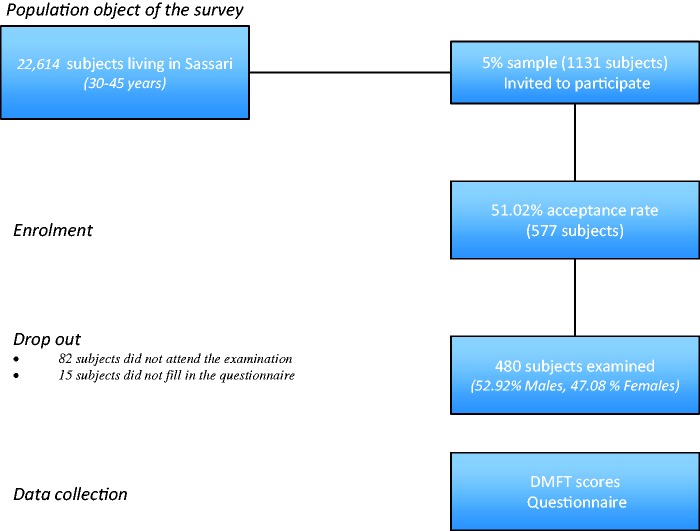
Objective To explore the potential presence of a social/behavioural gradient in dental health among Italian adults using a cross-sectional study. Methods Caries indices were recorded among 480 subjects (52.9% men, 47.1% women) who also completed a structured self-administered social and behavioural questionnaire. A social/behavioural gradient was generated as the sum of the worst circumstances recorded on the questionnaire (cariogenic diet, smoking, lowest occupational profile, brushing teeth < twice daily, lowest educational level, uneven dental examination attendance). Results Caries figures (DMFT) and the number of filled sound teeth (FS-T) were statistically significantly linked to the social/behavioural gradient (DMFT: χ = 20.17 p = 0.02, Z = 0.02 p = 0.99; FS-T: χ = 25.68 p < 0.01, Z = -4.31 p < 0.01). DMFT was statistically significantly associated with gender and with social and behavioural variables. FS-T was higher in women (p = 0.03) and was linked to smoking ( p < 0.01). Conclusions The proposed social/behavioural gradient demonstrated how subjects reporting the worst circumstances on the questionnaire exhibited the worst dental health. The use of the gradient demonstrates that health promotion and prevention cannot be compartmentalized.
目的 通过横断面研究探讨意大利成年人牙齿健康方面社会/行为梯度的潜在存在情况。方法 对480名受试者(52.9%为男性,47.1%为女性)记录龋病指数,这些受试者还完成了一份结构化的自我管理社会和行为问卷。社会/行为梯度是通过问卷中记录的最糟糕情况(致龋饮食、吸烟、最低职业状况、每天刷牙少于两次、最低教育水平、不定期进行牙齿检查)的总和得出的。结果 龋病数据(DMFT)和充填完好牙齿数量(FS-T)与社会/行为梯度在统计学上有显著关联(DMFT:χ = 20.17,p = 0.02;Z = 0.02,p = 0.99;FS-T:χ = 25.68,p < 0.01;Z = -4.31,p < 0.01)。DMFT在统计学上与性别以及社会和行为变量显著相关。FS-T在女性中更高(p = 0.03),并且与吸烟有关(p < 0.01)。结论 所提出的社会/行为梯度表明,在问卷中报告最糟糕情况的受试者牙齿健康状况最差。该梯度的使用表明健康促进和预防不能被分割开来。