1 National Center for Biotechnology Information, National Library of Medicine, National Institutes of Health, Bethesda, MD, USA.
SLAS Discov. 2017 Jul;22(6):655-666. doi: 10.1177/2472555216685069. Epub 2017 Jan 13.
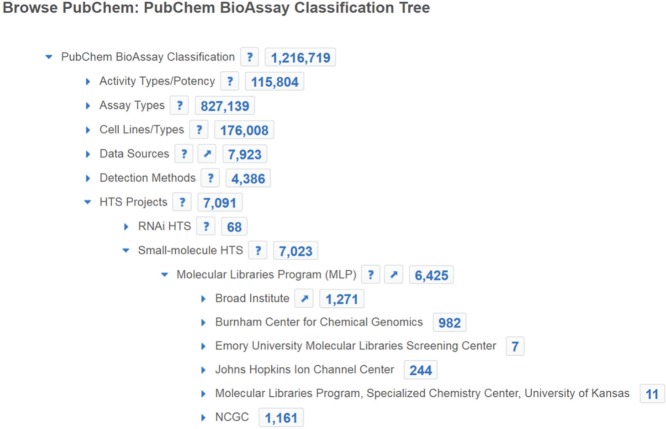
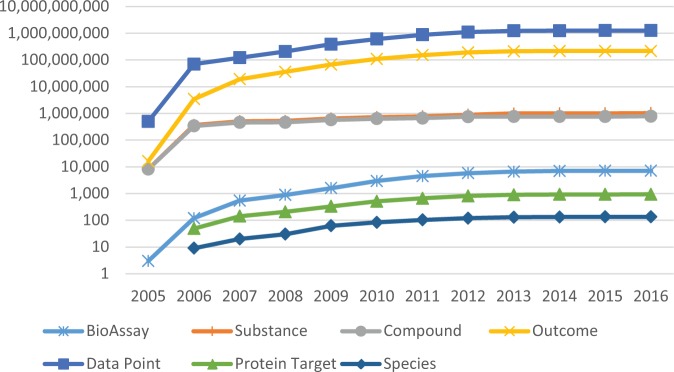
High-throughput screening (HTS) is now routinely conducted for drug discovery by both pharmaceutical companies and screening centers at academic institutions and universities. Rapid advance in assay development, robot automation, and computer technology has led to the generation of terabytes of data in screening laboratories. Despite the technology development toward HTS productivity, fewer efforts were devoted to HTS data integration and sharing. As a result, the huge amount of HTS data was rarely made available to the public. To fill this gap, the PubChem BioAssay database ( https://www.ncbi.nlm.nih.gov/pcassay/ ) was set up in 2004 to provide open access to the screening results tested on chemicals and RNAi reagents. With more than 10 years' development and contributions from the community, PubChem has now become the largest public repository for chemical structures and biological data, which provides an information platform to worldwide researchers supporting drug development, medicinal chemistry study, and chemical biology research. This work presents a review of the HTS data content in the PubChem BioAssay database and the progress of data deposition to stimulate knowledge discovery and data sharing. It also provides a description of the database's data standard and basic utilities facilitating information access and use for new users.
高通量筛选(HTS)现在已成为制药公司和学术机构及大学筛选中心进行药物发现的常规手段。检测方法开发、机器人自动化和计算机技术的快速进步导致筛选实验室产生了数太字节的数据。尽管在 HTS 生产力方面有技术进步,但在 HTS 数据集成和共享方面的投入较少。结果,大量的 HTS 数据很少向公众提供。为了填补这一空白,2004 年建立了 PubChem BioAssay 数据库(https://www.ncbi.nlm.nih.gov/pcassay/),以提供对化学品和 RNAi 试剂进行筛选结果的公开访问。经过 10 多年的发展和社区的贡献,PubChem 现已成为最大的公共化学结构和生物数据存储库,为支持药物开发、药物化学研究和化学生物学研究的全球研究人员提供了一个信息平台。本文综述了 PubChem BioAssay 数据库中的 HTS 数据内容和数据提交进展,以激发知识发现和数据共享。它还描述了数据库的数据标准和基本实用程序,为新用户提供了信息访问和使用的便利。