Redchuk Taras A, Omelina Evgeniya S, Chernov Konstantin G, Verkhusha Vladislav V
Department of Biochemistry and Developmental Biology, Faculty of Medicine, University of Helsinki, Helsinki, Finland.
Department of Anatomy and Structural Biology and Gruss Lipper Biophotonics Center, Albert Einstein College of Medicine, Bronx, New York, USA.
Nat Chem Biol. 2017 Jun;13(6):633-639. doi: 10.1038/nchembio.2343. Epub 2017 Mar 27.
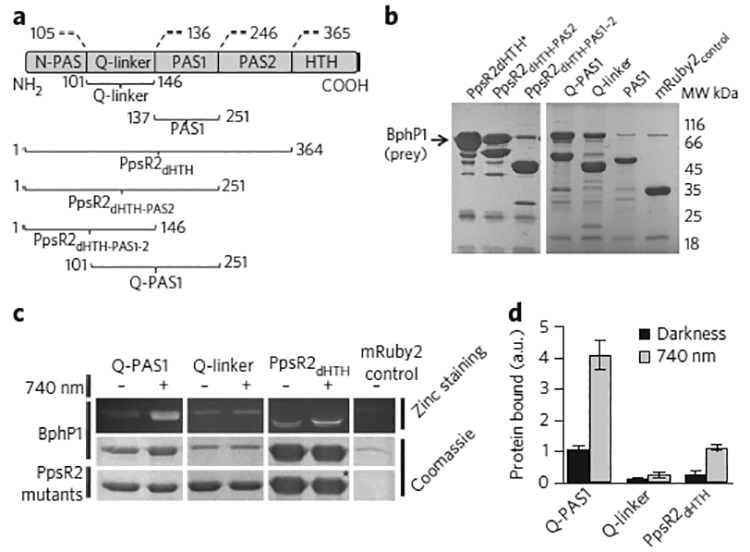
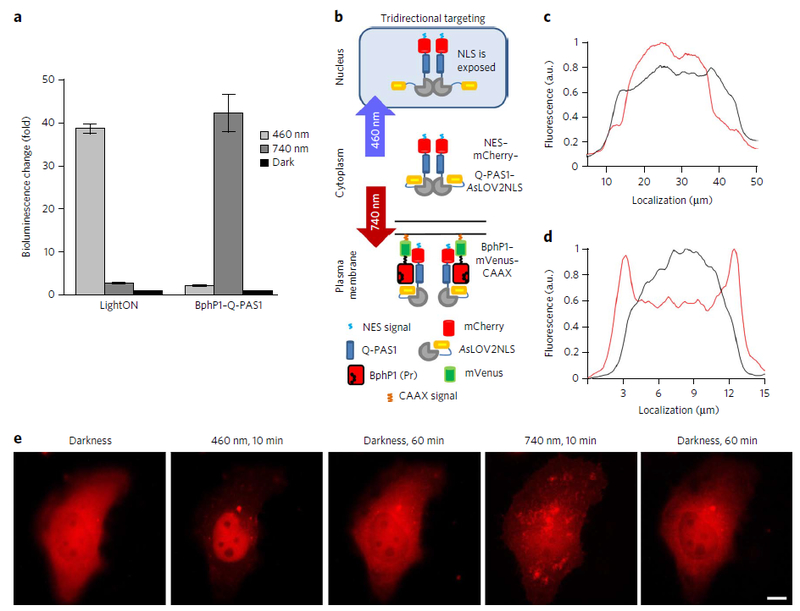
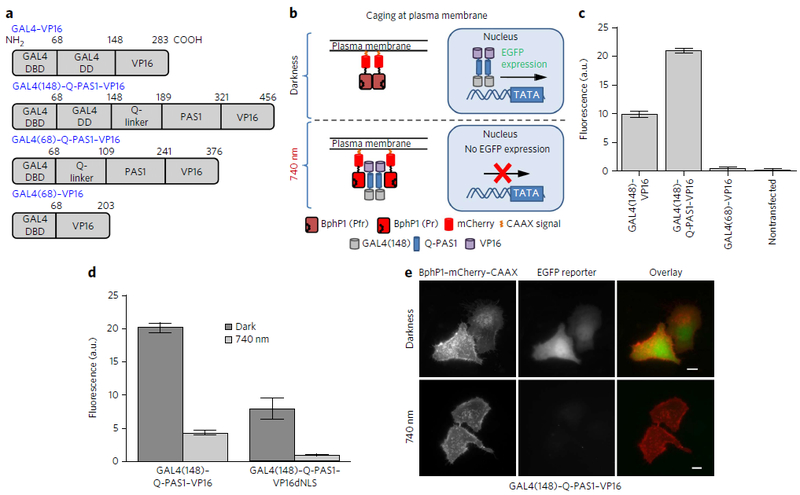
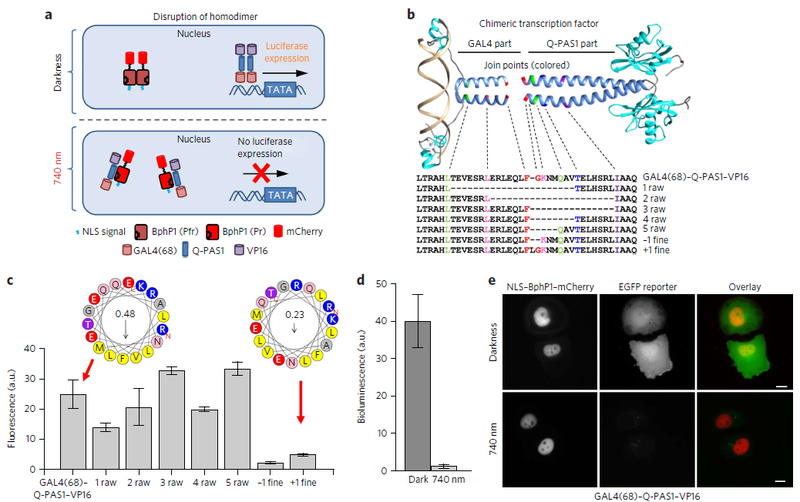
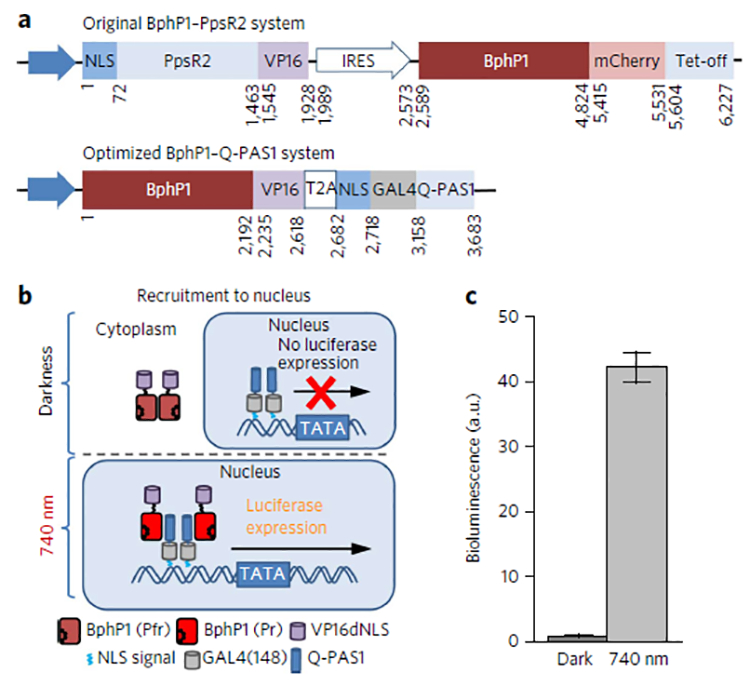
Multifunctional optogenetic systems are in high demand for use in basic and biomedical research. Near-infrared-light-inducible binding of bacterial phytochrome BphP1 to its natural PpsR2 partner is beneficial for simultaneous use with blue-light-activatable tools. However, applications of the BphP1-PpsR2 pair are limited by the large size, multidomain structure and oligomeric behavior of PpsR2. Here, we engineered a single-domain BphP1 binding partner, Q-PAS1, which is three-fold smaller and lacks oligomerization. We exploited a helix-PAS fold of Q-PAS1 to develop several near-infrared-light-controllable transcription regulation systems, enabling either 40-fold activation or inhibition. The light-induced BphP1-Q-PAS1 interaction allowed modification of the chromatin epigenetic state. Multiplexing the BphP1-Q-PAS1 pair with a blue-light-activatable LOV-domain-based system demonstrated their negligible spectral crosstalk. By integrating the Q-PAS1 and LOV domains in a single optogenetic tool, we achieved tridirectional protein targeting, independently controlled by near-infrared and blue light, thus demonstrating the superiority of Q-PAS1 for spectral multiplexing and engineering of multicomponent systems.
多功能光遗传学系统在基础研究和生物医学研究中有着很高的需求。细菌光敏色素BphP1与其天然伴侣PpsR2的近红外光诱导结合,有利于与蓝光激活工具同时使用。然而,BphP1-PpsR2对的应用受到PpsR2的大尺寸、多结构域结构和寡聚行为的限制。在此,我们设计了一个单结构域的BphP1结合伴侣Q-PAS1,其体积小三倍且缺乏寡聚化。我们利用Q-PAS1的螺旋- PAS折叠开发了几种近红外光可控转录调控系统,实现了40倍的激活或抑制。光诱导的BphP1-Q-PAS1相互作用能够改变染色质的表观遗传状态。将BphP1-Q-PAS1对与基于蓝光激活的LOV结构域系统复用,证明它们的光谱串扰可忽略不计。通过将Q-PAS1和LOV结构域整合到单个光遗传学工具中,我们实现了由近红外光和蓝光独立控制的三向蛋白质靶向,从而证明了Q-PAS1在光谱复用和多组分系统工程方面的优越性。