Campbell Suzy J, Nery Susana V, Wardell Rebecca, D'Este Catherine A, Gray Darren J, McCarthy James S, Traub Rebecca J, Andrews Ross M, Llewellyn Stacey, Vallely Andrew J, Williams Gail M, Clements Archie C A
Research School of Population Health, College of Medicine, Biology and Environment, The Australian National University, Acton, Australian Capital Territory, Australia.
Molecular Parasitology Laboratory, QIMR Berghofer Medical Research Institute, Brisbane, Queensland, Australia.
PLoS Negl Trop Dis. 2017 Mar 27;11(3):e0005393. doi: 10.1371/journal.pntd.0005393. eCollection 2017 Mar.
No investigations have been undertaken of risk factors for intensity of soil-transmitted helminth (STH) infection in Timor-Leste. This study provides the first analysis of risk factors for intensity of STH infection, as determined by quantitative PCR (qPCR), examining a broad range of water, sanitation and hygiene (WASH) and environmental factors, among communities in Manufahi District, Timor-Leste.
A baseline cross-sectional survey of 18 communities was undertaken as part of a cluster randomised controlled trial, with additional identically-collected data from six other communities. qPCR was used to assess STH infection from stool samples, and questionnaires administered to collect WASH, demographic, and socioeconomic data. Environmental information was obtained from open-access sources and linked to infection outcomes. Mixed-effects multinomial logistic regression was undertaken to assess risk factors for intensity of Necator americanus and Ascaris infection.
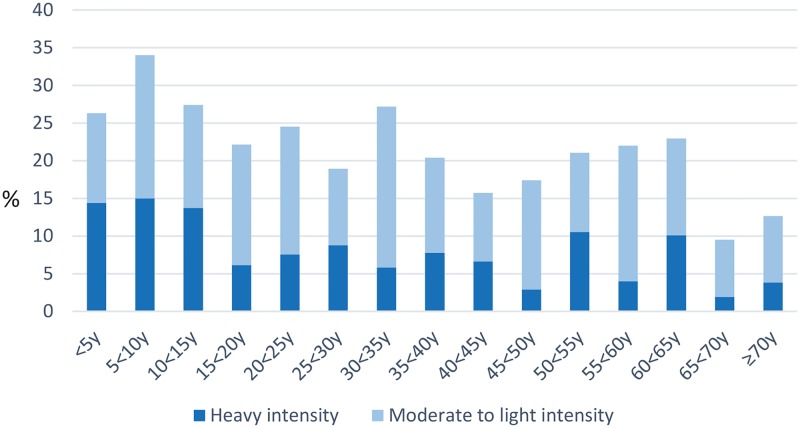
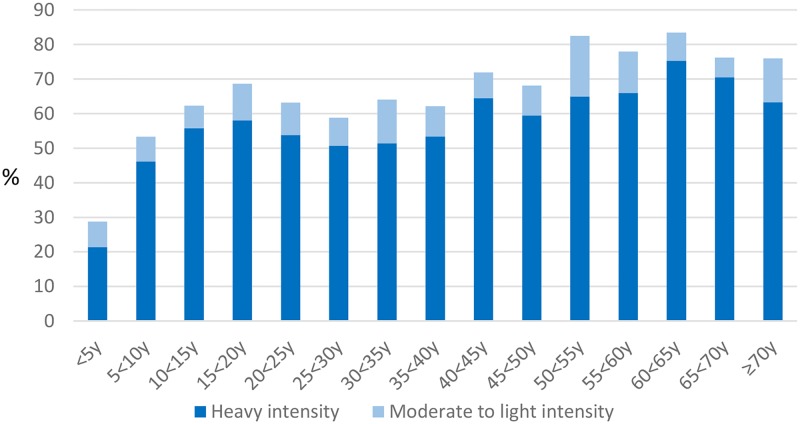
2152 participants provided stool and questionnaire information for this analysis. In adjusted models incorporating WASH, demographic and environmental variables, environmental variables were generally associated with infection intensity for both N. americanus and Ascaris spp. Precipitation (in centimetres) was associated with increased risk of moderate-intensity (adjusted relative risk [ARR] 6.1; 95% confidence interval [CI] 1.9-19.3) and heavy-intensity (ARR 6.6; 95% CI 3.1-14.1) N. americanus infection, as was sandy-loam soil around households (moderate-intensity ARR 2.1; 95% CI 1.0-4.3; heavy-intensity ARR 2.7; 95% CI 1.6-4.5; compared to no infection). For Ascaris, alkaline soil around the household was associated with reduced risk of moderate-intensity infection (ARR 0.21; 95% CI 0.09-0.51), and heavy-intensity infection (ARR 0.04; 95% CI 0.01-0.25). Few WASH risk factors were significant.
In this high-prevalence setting, strong risk associations with environmental factors indicate that anthelmintic treatment alone will be insufficient to interrupt STH transmission, as conditions are favourable for ongoing environmental transmission. Integrated STH control strategies should be explored as a priority.
东帝汶尚未对土壤传播性蠕虫(STH)感染强度的风险因素进行调查。本研究首次分析了通过定量聚合酶链反应(qPCR)测定的STH感染强度的风险因素,研究了东帝汶马努法伊区各社区广泛的水、环境卫生和个人卫生(WASH)以及环境因素。
作为一项整群随机对照试验的一部分,对18个社区进行了基线横断面调查,并从其他6个社区收集了相同的数据。使用qPCR评估粪便样本中的STH感染情况,并通过问卷调查收集WASH、人口统计学和社会经济数据。环境信息从公开渠道获取,并与感染结果相关联。采用混合效应多项逻辑回归分析评估美洲板口线虫和蛔虫感染强度的风险因素。
2152名参与者提供了粪便和问卷信息用于本分析。在纳入WASH、人口统计学和环境变量的校正模型中,环境变量通常与美洲板口线虫和蛔虫的感染强度相关。降水量(厘米)与中度感染风险增加相关(校正相对风险[ARR]6.1;95%置信区间[CI]1.9-19.3)以及重度美洲板口线虫感染风险增加相关(ARR 6.6;95%CI 3.1-14.1),家庭周围的砂壤土也是如此(中度感染ARR 2.1;95%CI 1.0-4.3;重度感染ARR 2.7;95%CI 1.6-4.5;与未感染相比)。对于蛔虫,家庭周围的碱性土壤与中度感染风险降低相关(ARR 0.21;95%CI 0.09-0.51)以及重度感染风险降低相关(ARR 0.04;95%CI 0.01-0.25)。很少有WASH风险因素具有显著性。
在这种高流行率的情况下,与环境因素的强烈风险关联表明,仅进行驱虫治疗不足以阻断STH传播,因为环境条件有利于持续传播。应优先探索综合STH控制策略。