Enriquez Thomas, Colinet Hervé
Université de Rennes I, UMR CNRS 6553 ECOBIO , Rennes , France.
PeerJ. 2017 Mar 23;5:e3112. doi: 10.7717/peerj.3112. eCollection 2017.
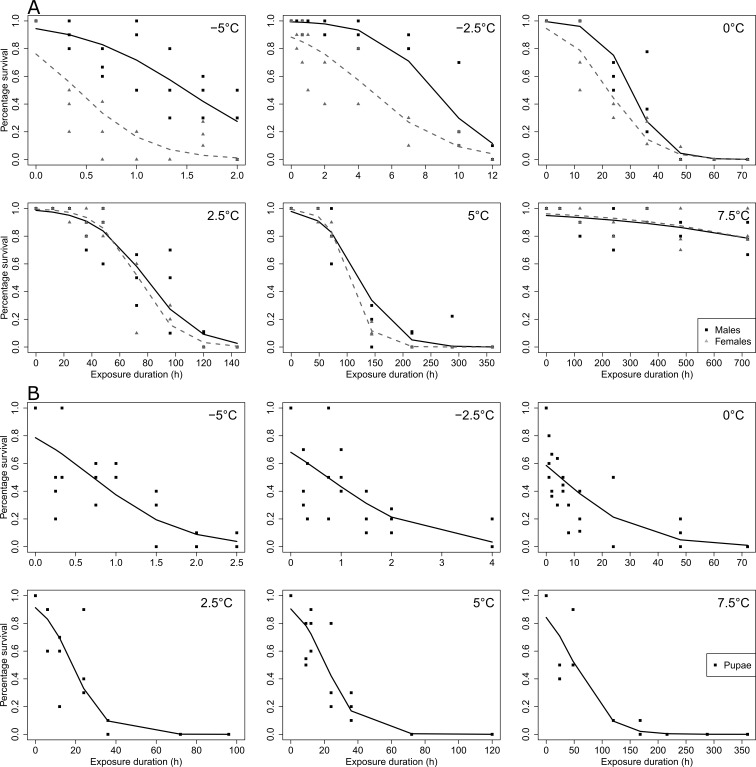
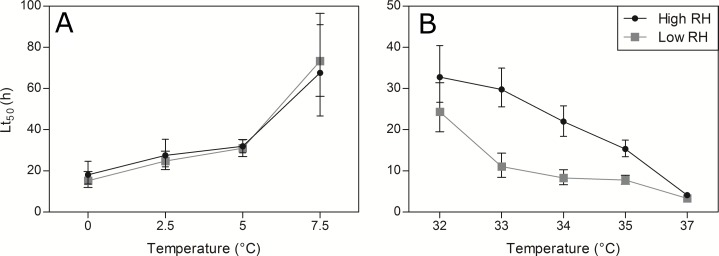
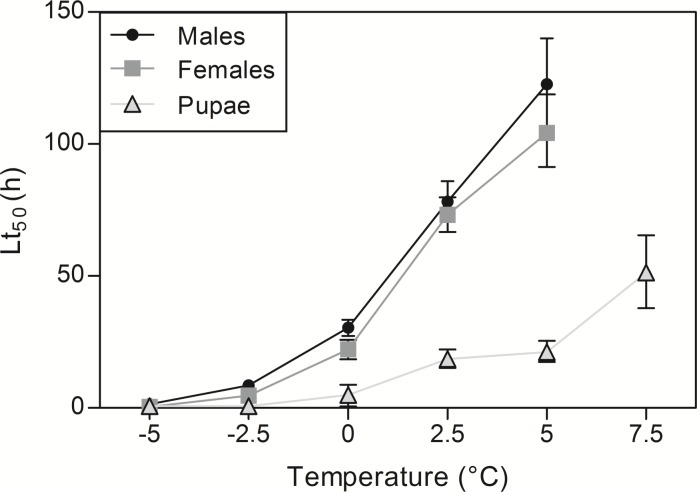
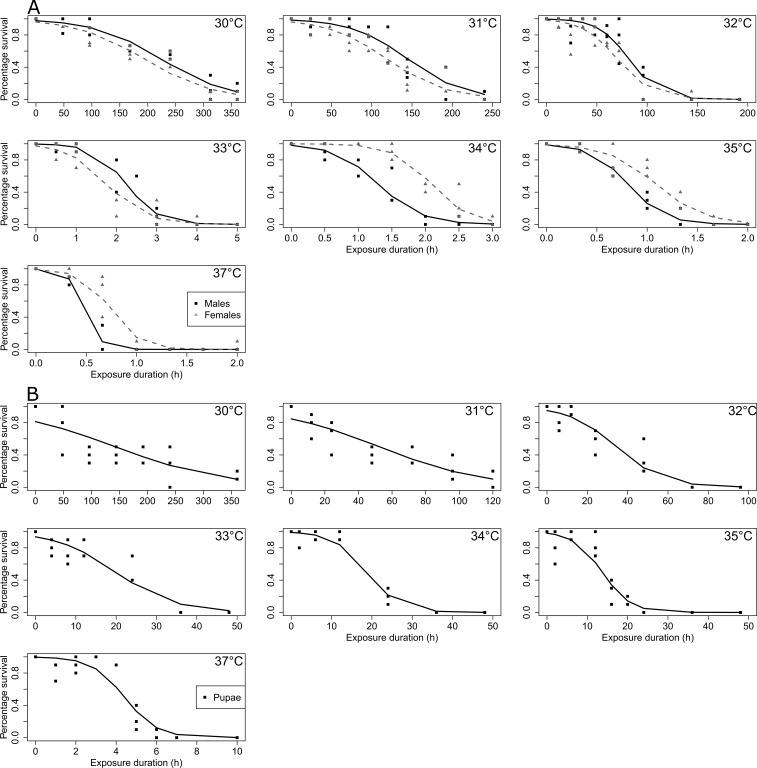
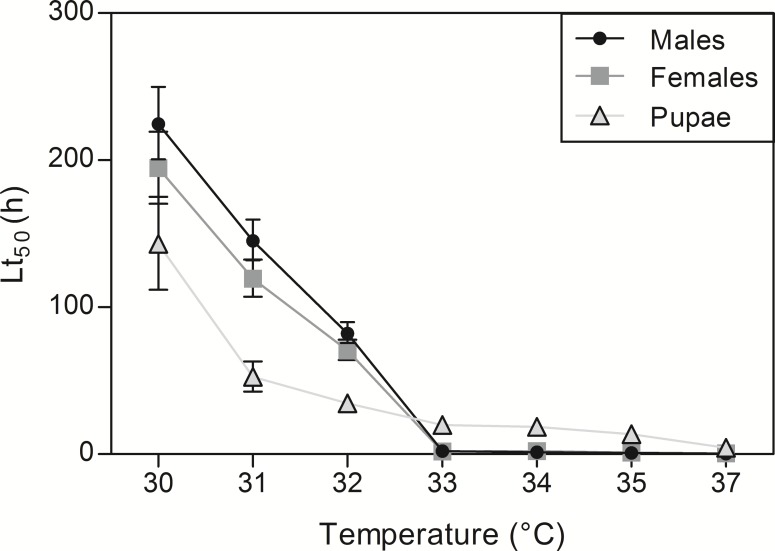
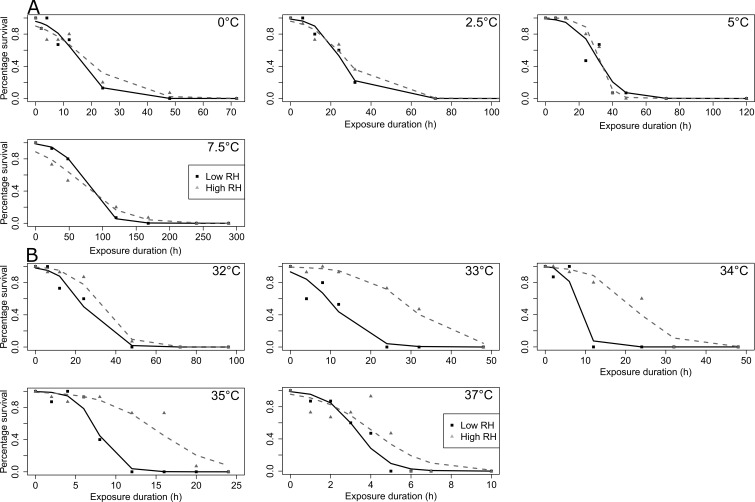
The spotted wing Drosophila, , is a new pest in Europe and America which causes severe damages, mostly to stone fruit crops. Temperature and humidity are among the most important abiotic factors governing insect development and fitness. In many situations, temperature can become stressful thus compromising survival. The ability to cope with thermal stress depends on basal level of thermal tolerance. Basic knowledge on temperature-dependent mortality of is essential to facilitate management of this pest. The objective of the present study was to investigate basal cold and heat tolerance. Adults and pupae were subjected to six low temperatures (-5-7.5 °C) and seven high temperatures (30-37 °C) for various durations, and survival-time-temperature relationships were investigated. Data showed that males were globally more cold tolerant than females. At temperature above 5 °C, adult cold mortality became minor even after prolonged exposures (e.g., only 20% mortality after one month at 7.5 °C). Heat tolerance of males was lower than that of females at the highest tested temperatures (34, 35 and 37 °C). Pupae appeared much less cold tolerant than adults at all temperatures (e.g., Lt at 5° C: 4-5 d for adults 21 h for pupae). Pupae were more heat tolerant than adults at the most extreme high temperatures (e.g., Lt at 37 °C: 30 min for adults 4 h for pupae). The pupal thermal tolerance was further investigated under low high humidity. Low relative humidity did not affect pupal cold survival, but it reduced survival under heat stress. Overall, this study shows that survival of under heat and cold conditions can vary with stress intensity, duration, humidity, sex and stage, and the methodological approach used here, which was based on thermal tolerance landscapes, provides a comprehensive description of thermal tolerance and limits.
斑翅果蝇是欧美地区一种新出现的害虫,造成严重危害,主要针对核果类作物。温度和湿度是影响昆虫发育和适应性的最重要非生物因素。在许多情况下,温度会变得具有胁迫性,从而危及生存。应对热胁迫的能力取决于基础热耐受性水平。了解斑翅果蝇温度依赖性死亡率的基本知识对于该害虫的管理至关重要。本研究的目的是调查其基础耐寒性和耐热性。将成虫和蛹置于六个低温(-5至7.5°C)和七个高温(30至37°C)下不同时长,研究存活时间与温度的关系。数据表明,总体而言雄性比雌性更耐寒。在5°C以上的温度下,即使长时间暴露,成虫的冷死亡率也较低(例如,在7.5°C下暴露一个月后死亡率仅为20%)。在最高测试温度(34、35和37°C)下,雄性的耐热性低于雌性。在所有温度下,蛹的耐寒性似乎远低于成虫(例如,在5°C时的致死时间:成虫为4至5天,蛹为21小时)。在最极端的高温下,蛹比成虫更耐热(例如,在37°C时的致死时间:成虫为30分钟,蛹为4小时)。在低湿度和高湿度条件下进一步研究了蛹的热耐受性。低相对湿度不影响蛹的冷存活,但会降低热胁迫下的存活率。总体而言,本研究表明,斑翅果蝇在热和冷条件下的存活会因胁迫强度、持续时间、湿度、性别和发育阶段而有所不同,此处基于热耐受性景观的方法全面描述了热耐受性及其限度。