Sharma Sumedha, Adetoro Olalekan O, Vidler Marianne, Drebit Sharla, Payne Beth A, Akeju David O, Adepoju Akinmade, Jaiyesimi Ebunoluwa, Sotunsa John, Bhutta Zulfiqar A, Magee Laura A, von Dadelszen Peter, Dada Olukayode
Department of Obstetrics and Gynaecology and Child & Family Research Institute, University of British Columbia, Vancouver, Canada.
Centre for Research in Reproductive Health, Olabisi Onabanjo University Teaching Hospital, Sagamu, Nigeria.
BMC Health Serv Res. 2017 Mar 28;17(1):238. doi: 10.1186/s12913-017-2124-4.
Despite increased investment in community-level maternal health interventions, process evaluations of such interventions are uncommon, and can be instrumental in understanding mediating factors leading to outcomes. In Nigeria, where an unacceptably number of maternal deaths occur (maternal mortality ratio of 814/100,000 livebirths), the Community Level Interventions for Pre-eclampsia (CLIP) study (NCT01911494) aimed to reduce maternal and neonatal mortality and morbidity with a complex intervention of five interrelated components. Building from previous frameworks, we illustrate a methodology to evaluate implementation processes of the complex CLIP intervention, assess mechanisms of impact and identify emerging unintended causal pathways.
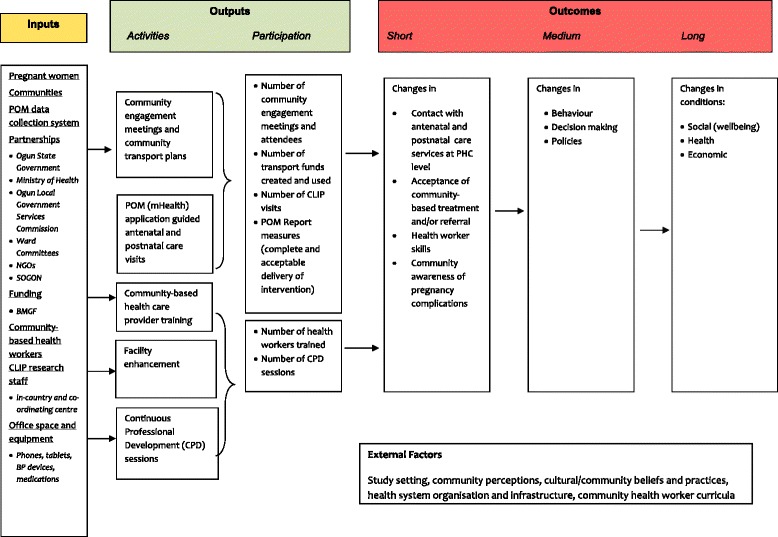
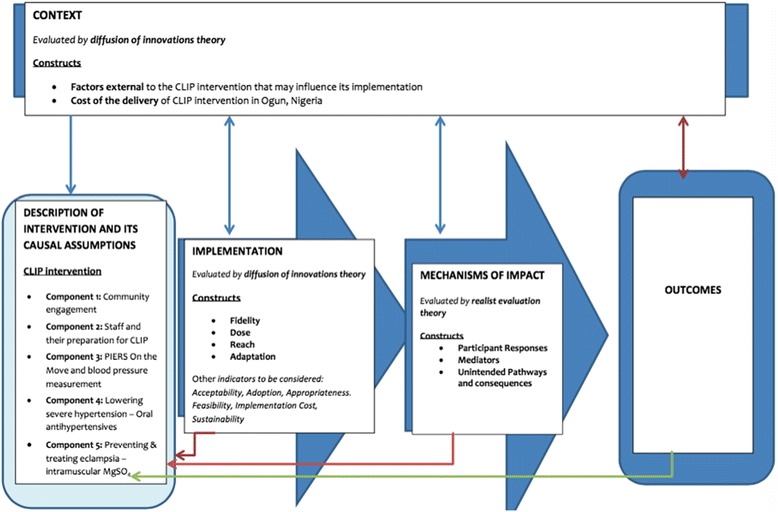
The study was conducted from 2013-2016 in five Local Government Areas in Ogun State, Nigeria. A six-step approach was developed to evaluate key constructs of context (external factors related to intervention), implementation (fidelity, dose, reach, and adaption) and mechanisms of impact (unintended outcomes and mediating pathways). The steps are: 1) describing the intervention by a logic model, 2) defining acceptable delivery, 3) formulating questions, 4) determining methodology, 5) planning resources in context, lastly, step 6) finalising the plan in consideration with relevant stakeholders.
Quantitative data were collected from 32,785 antenatal and postnatal visits at the primary health care level, from 66 community engagement sessions, training assessments of community health workers, and standard health facility questionnaires. Forty-three focus group discussions, 38 in-depth interviews, and 23 structured observations were conducted to capture qualitative data. A total of 103 community engagement reports and 182 suspected pre-eclampsia case reports were purposively collected. Timing of data collection was staggered to understand feedback mechanisms that may have resulted from the delivery of the intervention. Data will be analysed using R and NVivo. Diffusions of innovations and realist evaluation theories will underpin analysis of the interaction between context, mechanisms and outcomes.
This comprehensive approach can serve as a guide for researchers and policy makers to plan the evaluation of similar complex health interventions in resource-constrained settings, and to aid in measuring 'effectiveness' of interventions and not just 'efficacy'.
This research is a part of the Community Level Interventions for Pre-eclampsia Study, NCT01911494. The trial is registered in Clinicaltrials.gov, the URL is https://clinicaltrials.gov/ct2/show/NCT01911494 The trial was registered on June 28, 2013 and the first participant was enrolled for intervention on March 1, 2014.
尽管对社区层面的孕产妇健康干预措施的投资有所增加,但对此类干预措施的过程评估并不常见,而这有助于理解导致结果的中介因素。在尼日利亚,孕产妇死亡人数令人无法接受(孕产妇死亡率为每10万例活产814例),子痫前期社区层面干预措施(CLIP)研究(NCT01911494)旨在通过一项由五个相互关联的组成部分构成的复杂干预措施来降低孕产妇和新生儿的死亡率及发病率。基于先前的框架,我们阐述了一种方法,用于评估复杂的CLIP干预措施的实施过程、评估影响机制并识别新出现的意外因果途径。
该研究于2013年至2016年在尼日利亚奥贡州的五个地方政府辖区开展。开发了一种六步法来评估背景(与干预措施相关的外部因素)、实施(保真度、剂量、覆盖范围和适应性)以及影响机制(意外结果和中介途径)的关键构成要素。这些步骤包括:1)通过逻辑模型描述干预措施,2)定义可接受的实施方式,3)制定问题,4)确定方法,5)根据实际情况规划资源,最后,步骤6)与相关利益攸关方协商确定最终计划。
在初级卫生保健层面收集了32,785次产前和产后访视的定量数据、66次社区参与活动的数据、社区卫生工作者的培训评估数据以及标准卫生设施调查问卷数据。进行了43次焦点小组讨论、38次深入访谈和23次结构化观察,以获取定性数据。有目的地收集了103份社区参与报告和182份疑似子痫前期病例报告。数据收集时间错开,以了解干预措施实施可能产生的反馈机制。将使用R和NVivo软件对数据进行分析。创新扩散理论和现实主义评估理论将为分析背景、机制和结果之间的相互作用提供支撑。
这种综合方法可为研究人员和政策制定者在资源有限的环境中规划类似复杂卫生干预措施的评估提供指导,并有助于衡量干预措施的“有效性”而非仅仅是“功效”。
本研究是子痫前期社区层面干预措施研究(NCT01911494)的一部分。该试验已在Clinicaltrials.gov注册,网址为https://clinicaltrials.gov/ct2/show/NCT01911494。该试验于2013年6月28日注册,第一名参与者于2014年3月1日开始接受干预。