Zhang Hui, Mao Feng, Shen Tuyang, Luo Qingquan, Ding Zhengping, Qian Liqiang, Huang Jia
Department of Thoracic Surgery, Shanghai Chest Hospital, Shanghai Lung Tumor Clinical Medical Center, Shanghai Jiaotong University, Shanghai 200030, P.R. China.
Oncol Lett. 2017 Feb;13(2):669-676. doi: 10.3892/ol.2016.5462. Epub 2016 Dec 6.
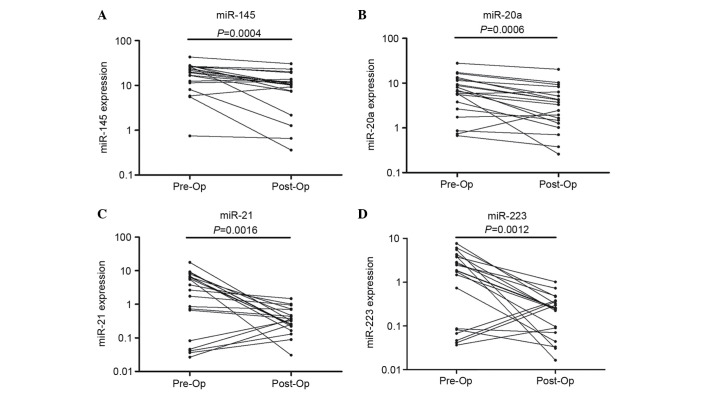
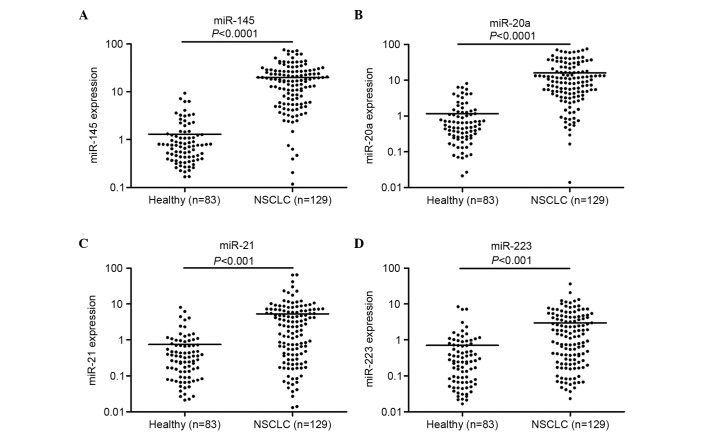
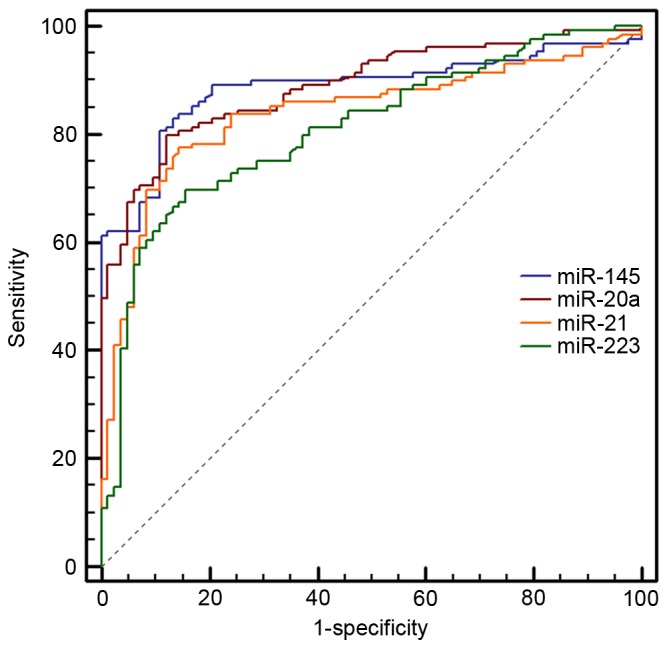
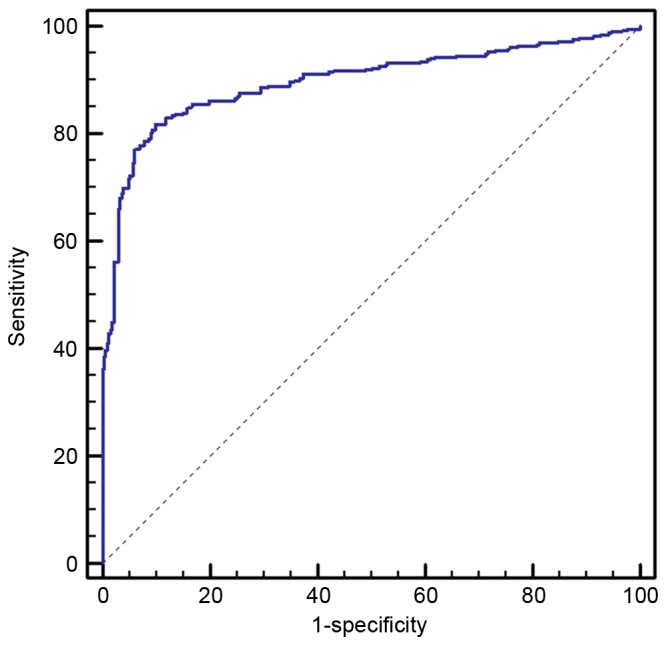
Non-small cell lung cancer (NSCLC) is the leading cause of cancer-related mortality in the world. Late diagnosis is one of the most significant reasons for the high mortality rate of lung cancer. The identification of microRNAs (miRNAs) has opened a new field for molecular diagnosis of cancer. The purpose of the present study was to investigate whether plasma miRNAs may be used as biomarkers for early-stage NSCLC. A total of 232 participants, including 149 NSCLC patients and 83 healthy controls, were recruited between July 2012 and May 2014. We measured the levels of 10 miRNAs (miR-30d, miR-383, miR-20a, miR-145, miR-221, miR-25, miR-223, miR-21, miR-126 and miR-210) in plasma samples of 40 individuals (20 patients and 20 matched healthy controls) at the point of identification of disease, and 129 NSCLC patients and 83 healthy controls at the validation stage using reverse transcription-quantitative polymerase chain reaction. Receiver operating characteristics (ROC) curves were generated for each possible combination of the miRNAs. We observed that the expression of plasma miR-145, miR-20a, miR-21 and miR-223 was significantly increased in the early-stage NSCLC samples compared with controls. miRNAs have significant diagnostic value for early-stage NSCLC. Combined ROC analyses using these four miRNAs revealed an elevated area under the ROC curve (AUC) of 0.897, with a sensitivity and specificity of 81.8 and 90.1%, respectively. This AUC helped in distinguishing early-stage NSCLC. Furthermore, the levels of the four plasma miRNAs were significantly decreased following surgery (P<0.05). Altered expression of miR-145, miR-20a, miR-21 and miR-223 in plasma are of tumor origin, and the four miRNAs may represent potential novel non-invasive biomarkers for early-stage NSCLC.
非小细胞肺癌(NSCLC)是全球癌症相关死亡的主要原因。晚期诊断是肺癌死亡率高的最重要原因之一。微小RNA(miRNA)的鉴定为癌症的分子诊断开辟了一个新领域。本研究的目的是调查血浆miRNA是否可作为早期NSCLC的生物标志物。在2012年7月至2014年5月期间,共招募了232名参与者,包括149名NSCLC患者和83名健康对照。我们使用逆转录定量聚合酶链反应测量了40名个体(20名患者和20名匹配的健康对照)在疾病确诊时血浆样本中10种miRNA(miR-30d、miR-383、miR-20a、miR-145、miR-221、miR-25、miR-223、miR-21、miR-126和miR-210)的水平,以及在验证阶段129名NSCLC患者和83名健康对照血浆样本中这些miRNA的水平。为每种可能的miRNA组合生成了受试者工作特征(ROC)曲线。我们观察到,与对照组相比,早期NSCLC样本中血浆miR-145、miR-20a、miR-21和miR-223的表达显著增加。miRNA对早期NSCLC具有显著的诊断价值。使用这四种miRNA进行的联合ROC分析显示,ROC曲线下面积(AUC)升高至0.897,敏感性和特异性分别为81.8%和90.1%。该AUC有助于区分早期NSCLC。此外,手术后这四种血浆miRNA的水平显著降低(P<0.05)。血浆中miR-145、miR-20a、miR-21和miR-223的表达改变源于肿瘤,这四种miRNA可能代表早期NSCLC潜在的新型非侵入性生物标志物。